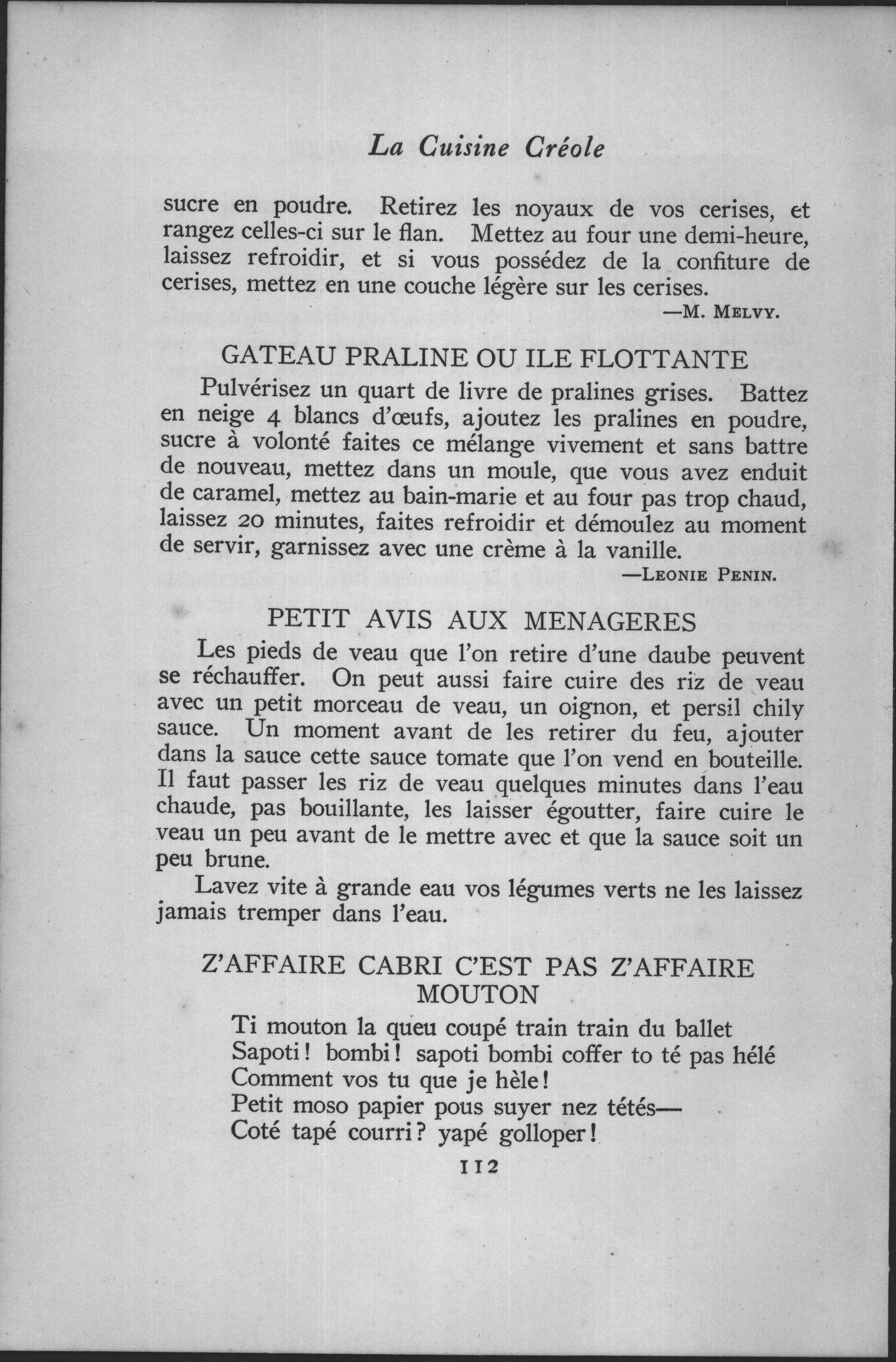
Z'Affaire Cabri C'est Pas Z'Affaire Mouton
A Creole rhyme
Ti mouton la queu coupé train train du ballet
Sapoti! bombi! sapoti bombi coffer to té pas hélé
Comment vos tu que je hèle!
Petit moso papier pous suyer nez tétés—
Coté tapé courri? yapé golloper!
This entry isn’t a recipe at all but a snatch of Louisiana Creole verse the book’s compilers tucked among the pages — a proverb-song in the old patois.
- Nothing to cookThere’s no dish here; the editors slipped in a bit of Creole folklore, as period cookbooks often did between recipes.
- The title proverbZ’affaire cabri c’est pas z’affaire mouton translates roughly as “the goat’s business is not the sheep’s business” — a saying about minding your own affairs and letting each to their own.
- It’s Creole, not FrenchThe lines are in the French-based creole once widely spoken in Louisiana — related to but distinct from standard French, with its own grammar and West African-influenced vocabulary.
- Read it as a songThe verse reads like a play- or work-song, full of rhythm and wordplay that resists a tidy literal translation; its charm is in the sound.
Cookbooks of this era, especially regional ones, often doubled as keepsakes of local color, gathering proverbs, songs, and sayings alongside their recipes. This fragment preserves Louisiana Creole — a language born on the plantations and in the streets of the colony, blending French vocabulary with African and Caribbean grammar and speech. Such verses lived mostly by mouth, passed down rather than written, so seeing one in print is a small act of preservation. Reading z’affaire cabri today is less about the kitchen than about hearing a voice of nineteenth-century Creole Louisiana.
From page 112 of the 1904 edition.
Original page from the book