Jerusalem Artichokes (Broad Hollow Farm)
Broad Hollow Farm, Westberry, L. I.
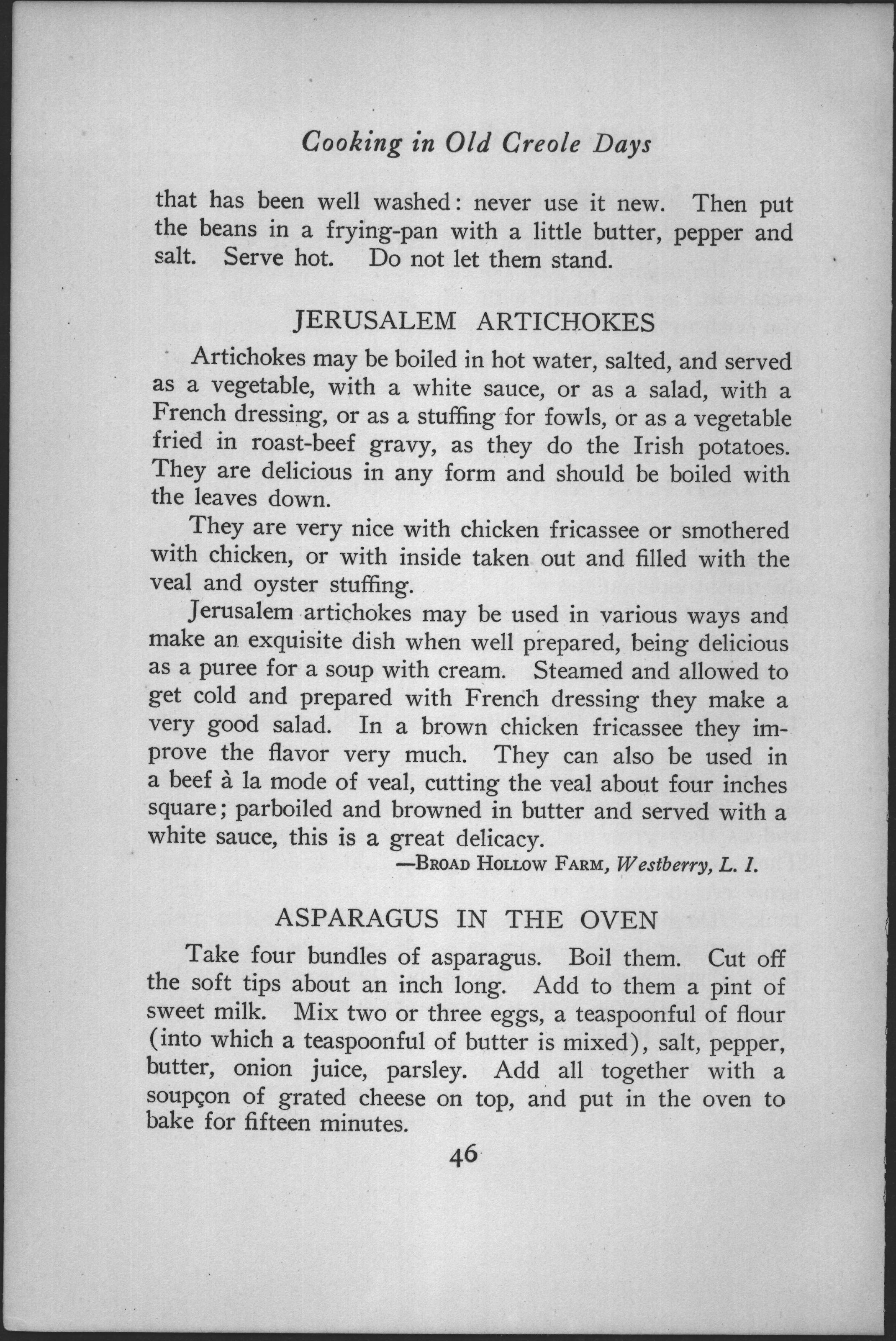
Artichokes may be boiled in hot water, salted, and served as a vegetable, with a white sauce, or as a salad, with a French dressing, or as a stuffing for fowls, or as a vegetable fried in roast-beef gravy, as they do the Irish potatoes. They are delicious in any form and should be boiled with the leaves down.
They are very nice with chicken fricassee or smothered with chicken, or with inside taken out and filled with the veal and oyster stuffing.
Jerusalem artichokes may be used in various ways and make an exquisite dish when well prepared, being delicious as a puree for a soup with cream. Steamed and allowed to get cold and prepared with French dressing they make a very good salad. In a brown chicken fricassee they improve the flavor very much. They can also be used in a beef à la mode of veal, cutting the veal about four inches square; parboiled and browned in butter and served with a white sauce, this is a great delicacy.
A catalogue of ways with the Jerusalem artichoke — boiled with white sauce, dressed cold as salad, puréed into cream soup, or fried in gravy like a potato — though the entry borrows some language from the unrelated globe artichoke.
- Not an artichoke at allThe Jerusalem artichoke is the knobby tuber of a North American sunflower — the ‘sunchoke.’ It is no relation to the globe artichoke, so the instruction to boil it “with the leaves down” (carried over from that entry) does not apply; simply scrub and boil the roots like potatoes.
- “Irish potatoes” = ordinary potatoesThe comparison to frying “Irish potatoes” just means everyday white potatoes, as opposed to sweet potatoes.
- A knife-and-lemon noteCut sunchokes discolor quickly; drop them into acidulated water (a squeeze of lemon) to keep them pale.
- “French dressing” = vinaigretteFor the salad, steam the tubers, cool, and toss in an oil-and-vinegar dressing — they hold their nutty flavor well when cold.
- Go gently at firstSunchokes are rich in inulin, a fiber that can cause noticeable gas until you are used to them — a small helping is wise for the uninitiated.
The Jerusalem artichoke is doubly misnamed. It has nothing to do with Jerusalem — that word is generally explained as an English mangling of the Italian girasole, “sunflower,” which is exactly what the plant is — and it is not an artichoke, though early eaters thought the cooked tuber tasted like one. Native to North America and grown by Indigenous peoples long before contact, it was carried to Europe in the early 1600s, where it briefly became a fashionable novelty before the potato eclipsed it. On this Long Island farm it was clearly still a cherished crop.
From page 46 of the 1904 edition.
Original page from the book