Jumballaya à la Créole
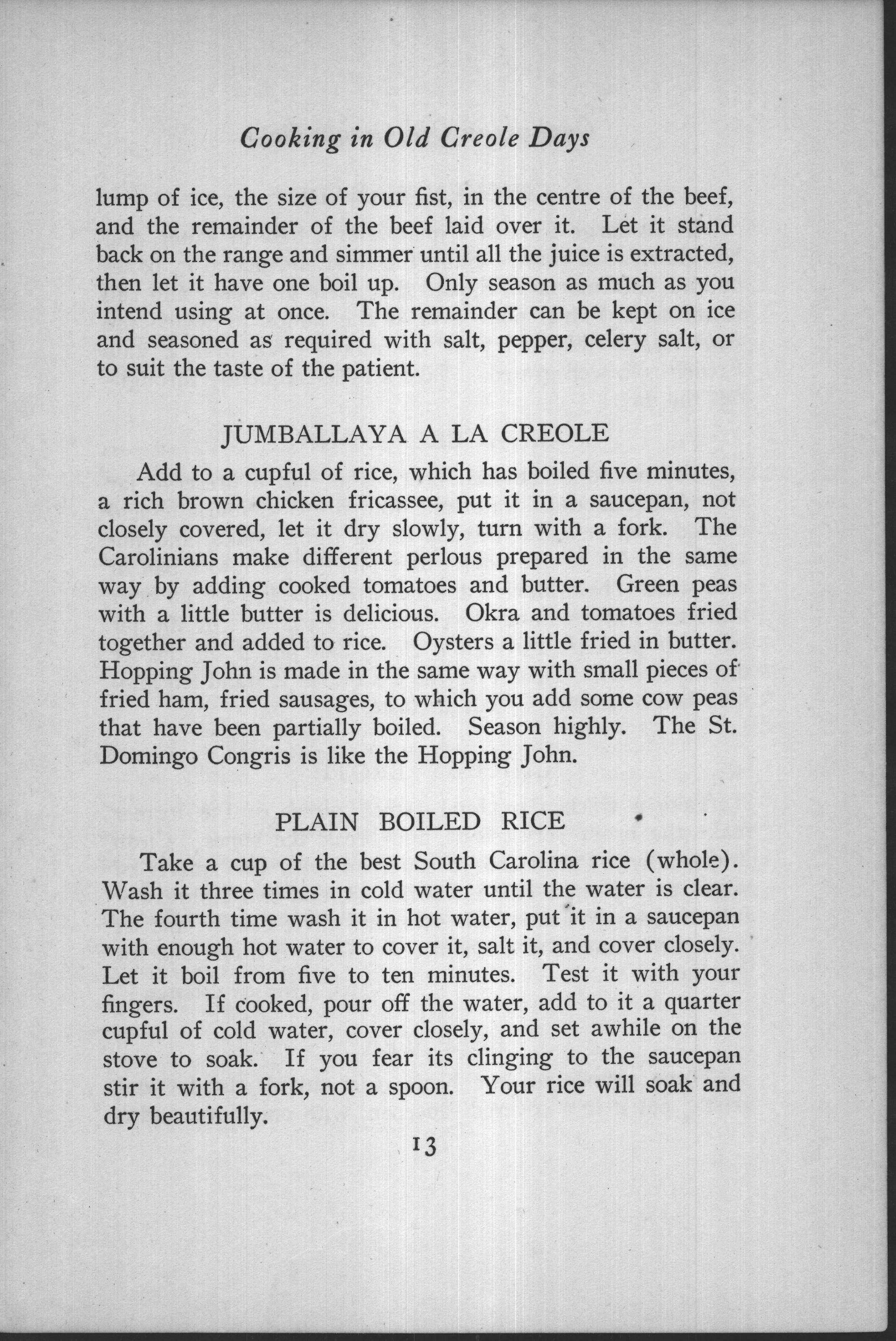
Add to a cupful of rice, which has boiled five minutes, a rich brown chicken fricassee, put it in a saucepan, not closely covered, let it dry slowly, turn with a fork. The Carolinians make different perlous prepared in the same way by adding cooked tomatoes and butter. Green peas with a little butter is delicious. Okra and tomatoes fried together and added to rice. Oysters a little fried in butter. Hopping John is made in the same way with small pieces of fried ham, fried sausages, to which you add some cow peas that have been partially boiled. Season highly. The St. Domingo Congris is like the Hopping John.
Less a single recipe than a Creole cook’s master key — one method (rice parboiled, then dried over a rich, savory base) and a whole list of things you can fold into it.
- “Brown chicken fricassee”A fricassee is simply cut-up meat gently stewed; “brown” means the chicken is browned first — rather than kept pale, as in a white fricassee — for a deep, dark gravy that then flavors the rice.
- “Perlous” = pilauThis is the Carolina pilau (also spelled perloo or purloo) — rice cooked in seasoned stock, a cousin of Persian and Turkish pilav.
- Cow peasField peas or black-eyed peas; use dried (soaked) or canned. “Partially boiled” means just tender, so they finish cooking with the rice.
- “St. Domingo Congris”The Caribbean congrí — rice cooked with beans; “St. Domingo” points to Saint-Domingue (Haiti), whose refugees deeply shaped New Orleans cooking. The name is often traced to a French-Creole joining of congo (the beans) and riz (rice). Season boldly, as directed: salt, pepper, cayenne.
- The technique that ties it togetherBoil the rice just 5 minutes, drain, then let it dry slowly over the meat, uncovered, turning with a fork, not a spoon so the grains stay separate.
Every dish named in this little paragraph — jambalaya, Carolina pilau, Hopping John, and Saint-Domingue congrí — is a variation on the same Atlantic-world idea: a pot of rice enriched with meat, beans, or vegetables. That family of one-pot rice dishes was carried and shaped by West Africans, Spanish and French colonists, and Caribbean cooks who all met in the Lowcountry and New Orleans. The word jambalaya’s exact origin is still debated, but the Creole version is typically the “red” one, tinted and sweetened with tomato, as several of these receipts show.
From page 13 of the 1904 edition.
Original page from the book