Jumballaya
Lydia Eustis
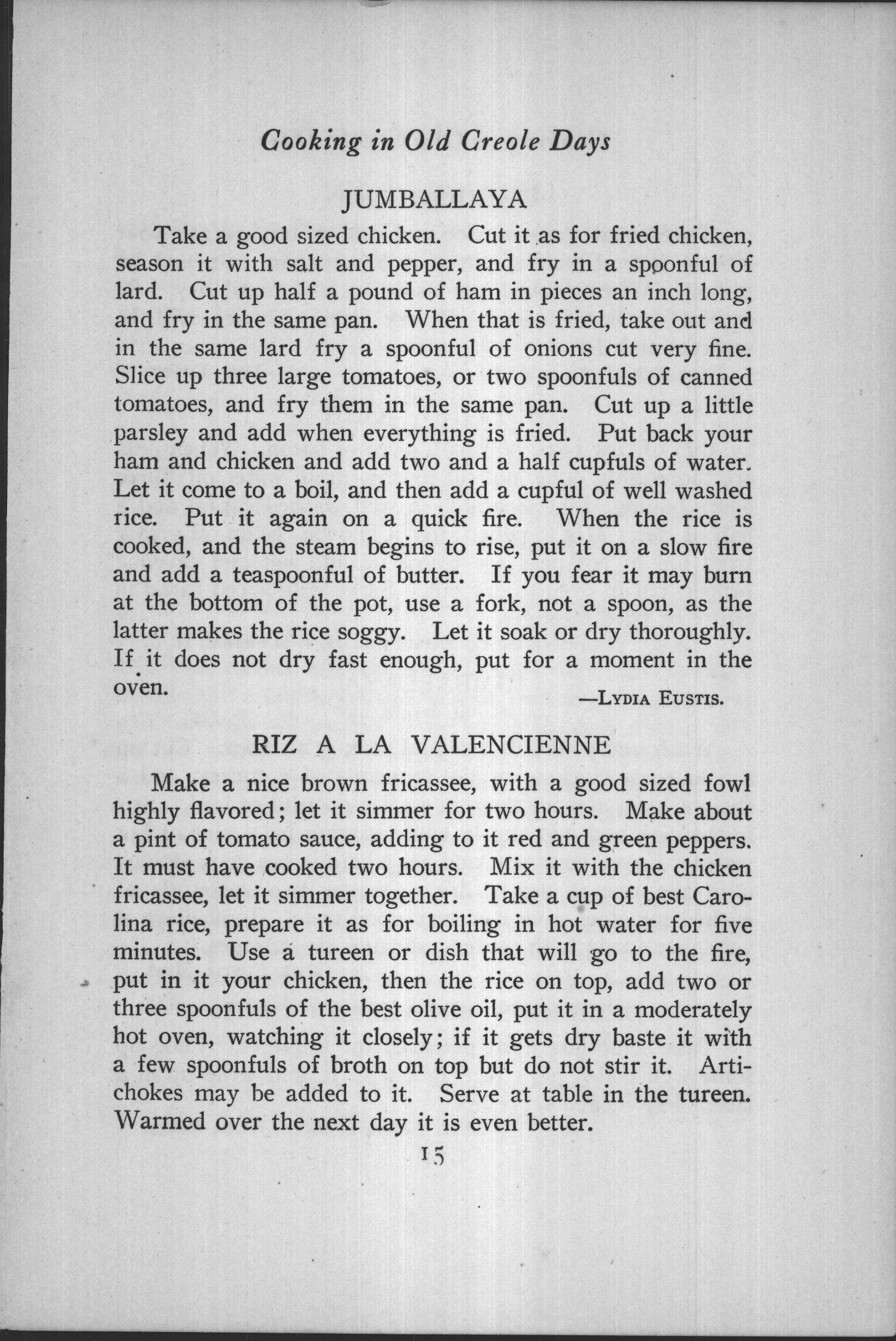
Take a good sized chicken. Cut it as for fried chicken, season it with salt and pepper, and fry in a spoonful of lard. Cut up half a pound of ham in pieces an inch long, and fry in the same pan. When that is fried, take out and in the same lard fry a spoonful of onions cut very fine. Slice up three large tomatoes, or two spoonfuls of canned tomatoes, and fry them in the same pan. Cut up a little parsley and add when everything is fried. Put back your ham and chicken and add two and a half cupfuls of water. Let it come to a boil, and then add a cupful of well washed rice. Put it again on a quick fire. When the rice is cooked, and the steam begins to rise, put it on a slow fire and add a teaspoonful of butter. If you fear it may burn at the bottom of the pot, use a fork, not a spoon, as the latter makes the rice soggy. Let it soak or dry thoroughly. If it does not dry fast enough, put for a moment in the oven.
The fullest jambalaya in this group — chicken, ham, onion, and tomato all browned in one pan before the rice goes in to soak up every bit of flavor.
- “Spoonful of lard”A tablespoon; use oil, butter, or bacon fat. Brown the chicken, ham, and onion in it in turn, building layers of flavor.
- The tomatoThree fresh tomatoes or 2 tablespoons canned — this is what makes it a “red,” Creole-style jambalaya.
- A clear ratio2½ cups water to 1 cup rice — generous, because the rice boils hard and then dries slowly.
- “Quick fire” then “slow fire”High heat to boil and cook the rice, then low heat to steam and dry it; finish with a teaspoon of butter.
- Fork, not spoonStir only with a fork so the grains stay whole; if it won’t dry, a few minutes in a moderate oven (350°F / 175°C) finishes it.
Jambalaya splits into two broad camps, and this receipt sits firmly in one. The New Orleans, or Creole, style is the “red” jambalaya — colored with tomato, as here — while the country Cajun style to the west is typically “brown,” taking its color from browned meat and stock alone, with no tomato at all. Tomatoes reached the city’s markets readily by way of Caribbean and Mediterranean trade, and their presence is a reliable fingerprint of a downriver, city kitchen. Several cooks in this collection offer their own versions, a reminder that jambalaya was never one fixed formula but a household improvisation.
From page 15 of the 1904 edition.
Original page from the book