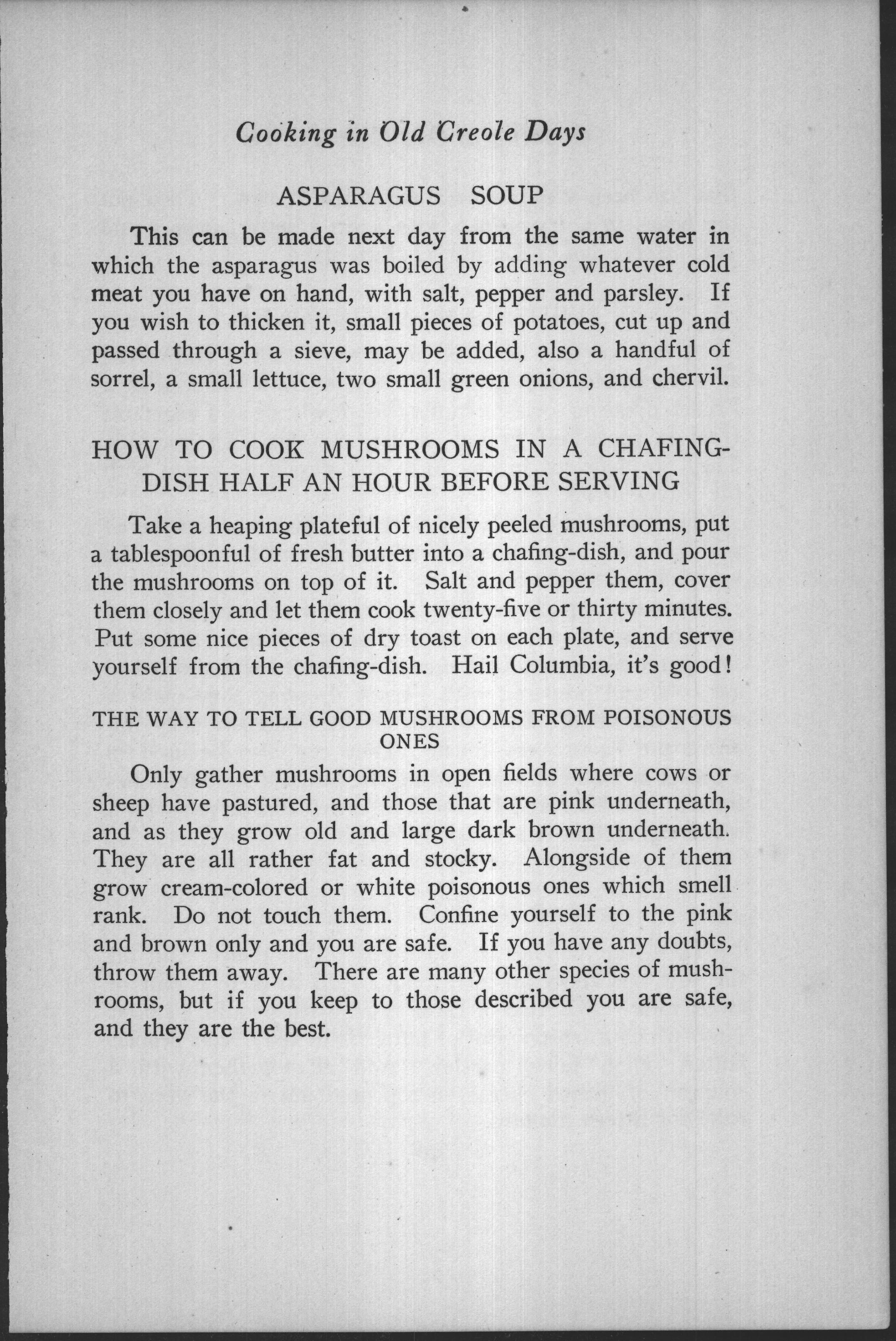
How to Cook Mushrooms in a Chafing-Dish Half an Hour Before Serving
Take a heaping plateful of nicely peeled mushrooms, put a tablespoonful of fresh butter into a chafing-dish, and pour the mushrooms on top of it. Salt and pepper them, cover them closely and let them cook twenty-five or thirty minutes. Put some nice pieces of dry toast on each plate, and serve yourself from the chafing-dish. Hail Columbia, it's good!
The way to tell good mushrooms from poisonous ones: Only gather mushrooms in open fields where cows or sheep have pastured, and those that are pink underneath, and as they grow old and large dark brown underneath. They are all rather fat and stocky. Alongside of them grow cream-colored or white poisonous ones which smell rank. Do not touch them. Confine yourself to the pink and brown only and you are safe. If you have any doubts, throw them away. There are many other species of mushrooms, but if you keep to those described you are safe, and they are the best.
Mushrooms stewed in butter at the table in a chafing-dish and served on dry toast — a fashionable little supper from the age when cooking in the dining room was entertainment.
- What a chafing-dish isA chafing-dish is a tabletop pan set over a small spirit flame — the Edwardian version of cooking at the table. A covered skillet on the stovetop does exactly the same job.
- Skip the peelingOld cooks peeled mushroom caps; today just wipe them with a damp cloth — never soak them, as they drink up water.
- They stew, then brownCovered for 25–30 minutes, the mushrooms release their liquid and stew; uncover at the end to boil that liquor away and let them brown and concentrate.
- Be generous with butterOne tablespoon is lean for a heaping plateful; mushrooms soak up fat, so add more if they look dry.
- The toast mattersThe “dry toast” is there to catch the dark, savory mushroom liquor — do not skip it.
When this was written, chafing-dish cookery was a genuine craze in America. Around the turn of the twentieth century, cooking at the table over a spirit lamp became the height of fashion for late suppers — among college students, bachelors, and hostesses alike — and whole cookbooks were devoted to it, with mushrooms, oysters, and Welsh rarebit the favorite dishes. The author’s delighted cry of “Hail Columbia, it’s good!” borrows an early American patriotic song that once served as an unofficial national anthem — a period way of saying this is a triumph.
From page 47 of the 1904 edition.
Original page from the book