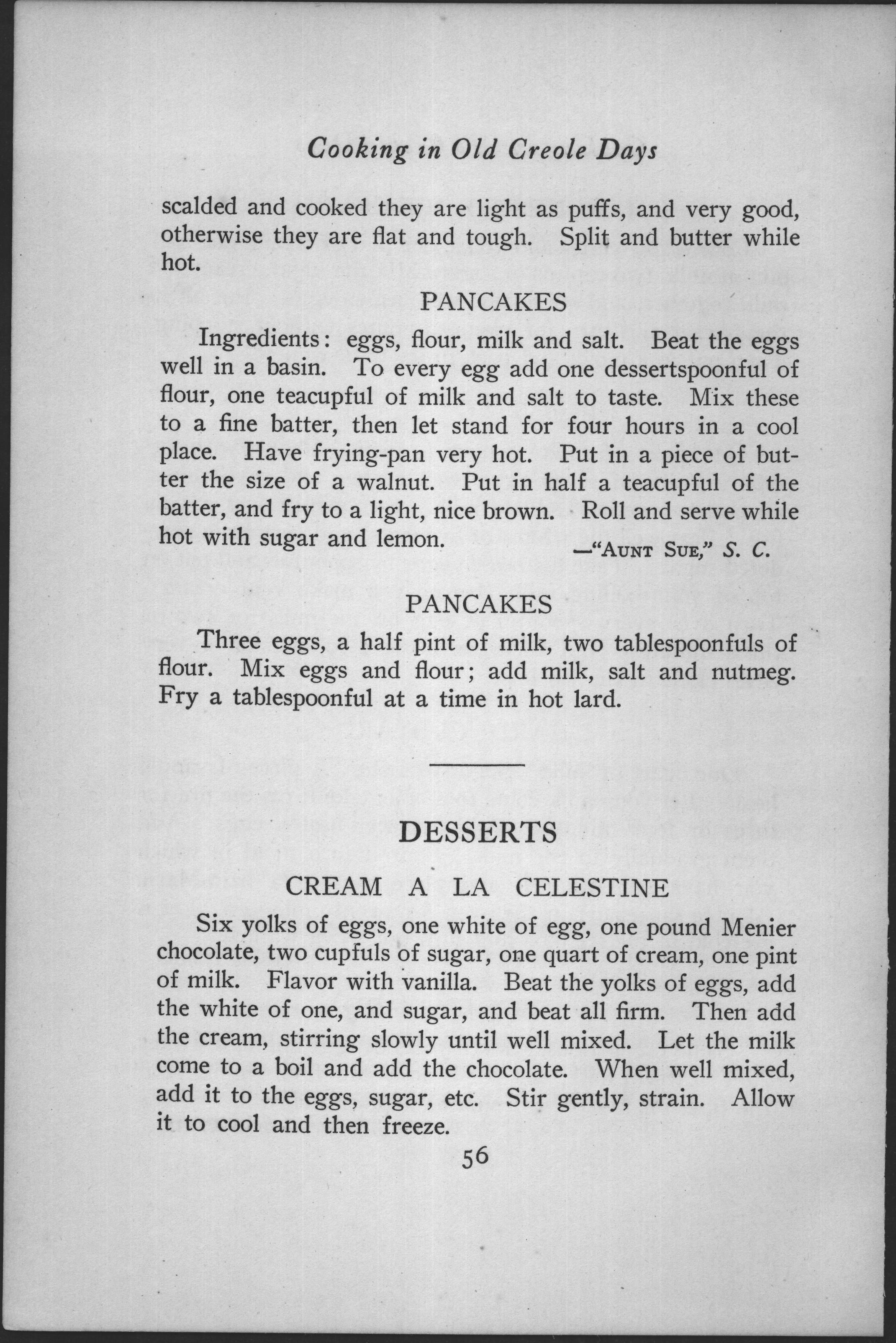
Pancakes
"Aunt Sue," S. C.
Ingredients: eggs, flour, milk and salt. Beat the eggs well in a basin. To every egg add one dessertspoonful of flour, one teacupful of milk and salt to taste. Mix these to a fine batter, then let stand for four hours in a cool place. Have frying-pan very hot. Put in a piece of butter the size of a walnut. Put in half a teacupful of the batter, and fry to a light, nice brown. Roll and serve while hot with sugar and lemon.
These aren’t fluffy stacks but thin, tender crepes — rolled up with sugar and lemon, the classic English way.
- A per-egg formulaScale to taste: per egg, use 1 dessertspoon (about 2 tsp) flour and 1 teacupful (about ¾ cup) milk. Three eggs makes a good batch.
- A very thin batterSo much milk to so little flour is deliberate — it makes a crepe-thin batter that spreads across the pan.
- Rest the batterThe 4-hour rest lets the flour fully hydrate and the gluten relax, for more tender pancakes; even 30 minutes helps if you’re short on time.
- Butter “size of a walnut”About 1 Tbsp of butter in a good and hot pan for each pancake.
- “Half a teacupful” per pancakeHalf of a ¾-cup teacup is about 6 Tbsp (a generous ⅓ cup) of batter, swirled thin; fry light brown, then roll with sugar and a squeeze of lemon.
Rolled thin, dusted with sugar, and finished with a squeeze of lemon, these are English pancakes to the core — the same treatment Britons have given the dish for centuries, especially on Shrove Tuesday, or “Pancake Day.” That feast fell on the eve of Lent, when devout households used up the rich eggs, milk, and butter forbidden during the fast, and a thin pancake was the perfect way to do it. Carried to the American South, as by this South Carolina cook, the recipe kept its Old World character: closer to a French crêpe than to the tall, baking-powder flapjacks Americans would come to call pancakes.
From page 56 of the 1904 edition.
Original page from the book