Home › C › Cauliflowers or Broccoli, Boiled
Cauliflowers or Broccoli, Boiled
INGREDIENTS.-To each gallon of water allow 1 heaped tablespoonful of salt.
AVERAGE COST, 3d. to 6d. each, according to size.
Choose cauliflowers that are close and white; trim off the decayed outside leaves, and cut the stalk off flat at the bottom.
Open the flower a little in places to remove the insects, which are generally found about the stalk, and let the cauliflowers lie in salt and water for an hour previous to dressing them, with their heads downwards:
CAULIFLOWERS.
CELERY SALAD. this will effectually draw out all the vermin. Then put them into fast-boiling to the end of September. SEASONABLE from he beginning of June water, with the addition of salt in the above proportion and let them boil briskly over a good fire, keeping the saucepan uncovered, and the water well skimmed. BOILED CAULIFLOWER.
When the cauliflowers are tender, take them up with a slice; let them drain, and, if large enough, place them upright in the dish. Serve with plain melted butter, a little of which may be poured over the flower.
TIME. - Small cauliflower, 12 to 15 minutes, large one 20 to 25 minutes, after the water boils.
SEASONABLE from the beginning of June to the end of September.
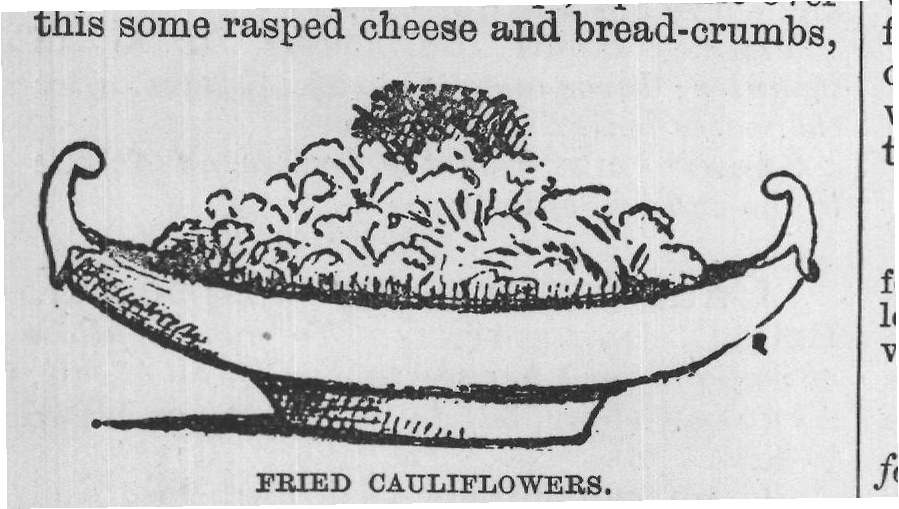
A straightforward Victorian treatment of cauliflower: a long soak in salted water to flush out insects, then a hard, uncovered boil. The soak is optional today; the boiling times are not, and they run long by modern taste.
- The hinge: don't cover the panBoiling uncovered lets the sulphurous compounds cauliflower releases escape rather than condense back into the water. A lid gives you the grey colour and cabbagey smell that make boiled cauliflower unpopular.
- Salt proportionOne heaped tablespoon per gallon is about 1 tablespoon per 4.5 litres (an imperial gallon) — a light seasoning, not a brine. Use the same ratio whatever size pan you cook in.
- The salt-water soakAn hour head-down in salted water was insect control for garden produce sold with leaves and soil attached. Commercially grown cauliflower needs a rinse at most; if you buy from a market stall with the jacket leaves on, twenty minutes is ample.
- TimingTwelve to fifteen minutes for a small head, twenty to twenty-five for a large one, gives fully soft florets in the Victorian manner. Whole heads of a modern size are tender in roughly fifteen minutes; broken into florets, six to eight minutes is enough, and the stalk should meet a knife tip with slight resistance.
- BroccoliThe broccoli of this book is purple or white sprouting broccoli, a loose-headed spring vegetable, not the tight green calabrese sold today. Calabrese needs four to five minutes for florets and should be drained the moment the colour turns vivid.
- "Take them up with a slice"A slice is a broad flat skimmer or fish slice. It matters here because a whole boiled head collapses if lifted by the stalk or tipped into a colander; support it from beneath and let it drain florets-down before turning it upright in the dish.
- Melted butterVictorian "plain melted butter" is a thin flour-thickened butter sauce rather than butter simply melted. Butter warmed with a spoonful of the cooking water and a squeeze of lemon does the same job and tastes cleaner.
- Yield and costOne medium head serves three to four as a side. The threepence-to-sixpence price is period detail only.
Cauliflower reached English kitchens from the eastern Mediterranean by way of Italy, and eighteenth- and nineteenth-century writers often called it "Cyprus colewort" or noted its Italian origin; the name itself is simply the Latin caulis, stalk or cabbage, with flower. By Mrs Beeton's day it was a summer market vegetable, generally reckoned to be in season from about June to September before glasshouse and imported supply flattened the calendar, and the instruction to soak the head downwards in salt water is a reminder of what unwashed field produce carried home with it. The pairing with melted butter sauce is the standard English fate of nearly every boiled vegetable in this book, and the insistence on a brisk, uncovered boil is one of the few points where Victorian practice and modern advice agree exactly.