Celery Soup
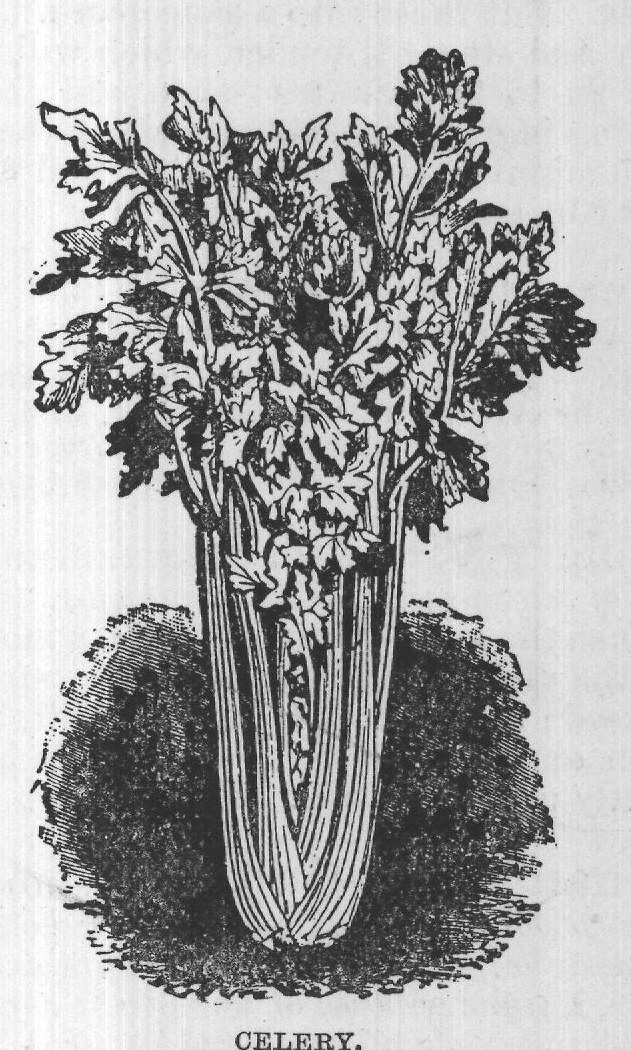
INGREDIENTS for soup for 9 or 10 persons.-9 heads of celery, 1 teaspoonful of salt, nutmeg to taste, 1 lump of sugar, 1/2 pint of strong stock, a pint of cream or milk, and 2 quarts of boiling water.
AVERAGE COST, with cream, 3s. 6d.
Cut the celery into small pieces; throw it into the water, seasoned with the nutmeg, salt and sugar. Boil it till sufficiently tender; pass it through a sieve, add the stock, and simmer it for half an hour. Now put in the cream, bring it to the boilingpoint, and serve immediately. TIME.-1 hour.
SEASONABLE from September to March.
Note. This soup can be made brown instead of white, by omitting the cream, and colouring it a little. When celery cannot be procured, half a drachm of the seed, finely pounded, will give a flavour to the soup, if put in a quarter of an hour before it is done. A little of the essence of celery will answer the same purpose.
CELERY, STEWED.
Celery, Stewed, à la Crême.- INGREDIENTS for dish for 6 persons. -4 heads of celery; to each 1/2 gallon of water allow 1 heaped tablespoonful of salt, 1 blade of pounded mace, & pint of cream. AVERAGE COST, 1s. 4d.
Wash the celery thoroughly; trim and boil it in salt and water until tender. Put the cream and pounded mace into a stewpan, shake it over the fire until the cream thickens, dish the celery, pour over the sauce and serve.
TIME.--Large heads of celery, 25 minutes; small ones, 15 to 20 minutes.
SEASONABLE from October to April.
CELERY.
Celery, Stewed, with White Sauce. INGREDIENTS for large dish. -6 heads of celery, 1 oz. of butter; to each half gallon of water allow 1 heaped teaspoonful of salt, 1/2 pint of white sauce (see WHITE SAUCE). AVERAGE COST, 1s. 4d.
Have ready sufficient boiling water just to cover the celery, with salt and butter in the above proportion. Wash the celery well, cut off the decayed outside leaves, trim away the green tops, and shape the root into a point; put it into the boiling water, let it boil rapidly until tender, then take it out, drain well, place it upon a dish, and pour over it about 1/2 pint of white sauce, made by recipe. It may also be plainly boiled as above, placed on toast, CELERY, STEWED. and melted butter poured over, the same as asparagus is dished.
TIME.-Large heads of celery, 25 minutes; small ones 15 to 20 minutes, after water boils.
SEASONABLE from October to April. of Celery, Stewed, with White Sauce. INGREDIENTS for sufficient for 6 or 8 persons.-6 heads of celery, pint of white stock or weak broth, 4 tablespoonfuls cream, thickening of butter and flour, 1 blade of pounded mace, a very little grated nutmeg; pepper and salt to taste. AVERAGE COST, 1s. 8d.
Wash the celery, strip off the outer leaves, and cut it into lengths of about 4 inches. Put these into a saucepan with the broth, and stew till tender, which will be in from 20 to 25 minutes; then add the remaining ingredients, simmer altogether for 4 or 5 minutes, pour into a dish, and serve.
It may be garnished with sippets of toasted bread.
TIME.-Altogether, hour.
SEASONABLE from October to April.
Note. By cutting the celery into smaller pieces, by stewing it a little longer, and, when done, by pressing it through a sieve, the above stew may be converted into a Purée of Celery.
A white celery soup built on stock and cream, followed here by three versions of stewed celery. The quantities are Victorian household scale, and the vegetable itself has changed more than the method.
- What a "head" of celery isA head means the whole bunch, root and all, not a single rib. Victorian celery was usually trench-blanched and slimmer than modern green Pascal celery, and the flavour was different rather than simply stronger; nine heads of today's supermarket celery would give a very large pot. Fewer bunches, trimmed, is likely closer to the intended weight.
- Ambiguous stock quantityThe stock is printed as "1/21 pint", which cannot be read with confidence as either half a pint or one and a half pints. Half a pint (10 fl oz / about 300 ml) of strong stock suits the proportions, since the celery is already boiled in two quarts of water.
- The cream is the hingeThe recipe says to bring it to boiling point; if you prefer, add the cream at the end and take it only to steaming, since cream held at a rolling boil can separate and leave the soup grainy.
- Sieve or blender"Pass it through a sieve" was the only route to a smooth purée. A blender does it in seconds, but celery strings survive blending; pass the blended soup through a sieve anyway if you want the texture Beeton had in mind.
- Half a drachm of celery seedA drachm is an eighth of an ounce, so half a drachm is roughly 1.5-2 g, about three-quarters of a teaspoon of ground celery seed. That is a fair amount; it is pungent, and fifteen minutes' infusion is enough.
- "Colouring it a little"For the brown version she means gravy browning or a spoonful of caramel. Browning the celery in butter before adding liquid gives colour and more flavour than a colouring agent.
- Mace in the stewed versionsMace is the dried outer casing (aril) of nutmeg; a blade is usually reckoned at about a quarter teaspoon ground. The recipe calls for it pounded, so nothing needs lifting out before serving.
- Cooking times for the stewsTwenty-five minutes for large heads gives thoroughly soft celery, which is the point of the dish. If you want it to keep some bite, eight to twelve minutes in simmering stock is enough.
- YieldThe soup is stated for nine or ten persons; scaled to modern portions it serves six to eight generously. The stewed dishes are given as for six, for a large dish, and for six or eight.
Celery reached English kitchens as a winter vegetable, sown in trenches and earthed up so the stalks blanched pale and tender, which is why every one of these entries is marked seasonable from autumn into spring: before glasshouse and imported supply, celery simply was not there in summer. That seasonal gap explains the note on celery seed and "essence of celery", both standard grocer's items in the nineteenth century for flavouring soups out of season. The cream soup belongs to the family of white purée soups that dominated Victorian first courses, thickened by the vegetable itself and enriched at the last moment rather than built on a roux. The average costs are given in shillings and pence, the soup at 3s. 6d. with cream against the stewed celery at 1s. 4d., though the two dishes differ in more than dairy: the soup calls for nine heads of celery, strong stock and a pint of cream, the stew for four heads.