Charlotte Russe
INGREDIENTS for dish for 6 persons. About 18 Savoy biscuits, pint of cream, flavouring of vanilla, liqueurs, or wine, 1 tablespoonful of pounded sugar, 1/4 oz. of isinglass. AVERAGE CosT, 2s. 2d.
Procure about 18 Savoy biscuits, or ladies'-fingers, as they are sometimes called; brush the edges of them with the white of an egg, and line the bottom of a plain round mould, placing them like a star or rosette. Stand them upright all round the edge, carefully put them so closely together that the white of egg connects them firmly, and place this case in the oven for about 5 minutes, just to dry the egg. Whisk the cream to a stiff froth, with the sugar, flavouring and melted isinglass; fill the charlotte with it, cover with a slice of sponge-cake cut in the shape of the mould; place it in ice, where let it remain till ready for table; then turn it on a dish, remove the mould, and serve. 1 tablespoonful of liqueur of any kind, or 4 tablespoonfuls of wine, would nicely flavour the above proportion of cream. For arranging the biscuits in the mould, cut them to the shape required, so that they fit in nicely, and level them with the mould at the top, that, when turned out, there may be something firm to rest upon. Great care and attention is required in the turning out of this dish, that the cream does not burst the case; and the edges of the biscuits must have the smallest quantity of egg brushed over them, or it would stick to the mould, and so prevent the charlotte from coming away properly.
TIME.-5 minutes in the oven.
SEASONABLE at any time.
Cheese. Cheese is the curd formed from milk by artificial coagulation, pressed and dried for use. Curd, called also casein and caseous matter, or the basis of cheese, exists in the milk, and not in the cream, and requires only to be separated by coagulation: the coagulation, however, supposes some alteration of the curd. By means of CHEESE. the substance employed to coagulate it, it is rendered insoluble in water. When the curd is freed from the whey, kneaded and pressed to expel it entirely, it becomes cheese; this assumes a degree of transparency, and possesses many of the properties of coagulated albumen. If it be well dried, it does not change by exposure to the air; but if it contain moisture, it soon putrefies; it therefore requires some salt to preserve it, and this acts likewise as a kind of seasoning. All our cheese is coloured more or less, except that made from skimmed milk.
The colouring substances employed are arnatto, turmeric, or marigold, all perfectly harmless unless they are adulterated; and it is said that arnatto sometimes contains red lead.
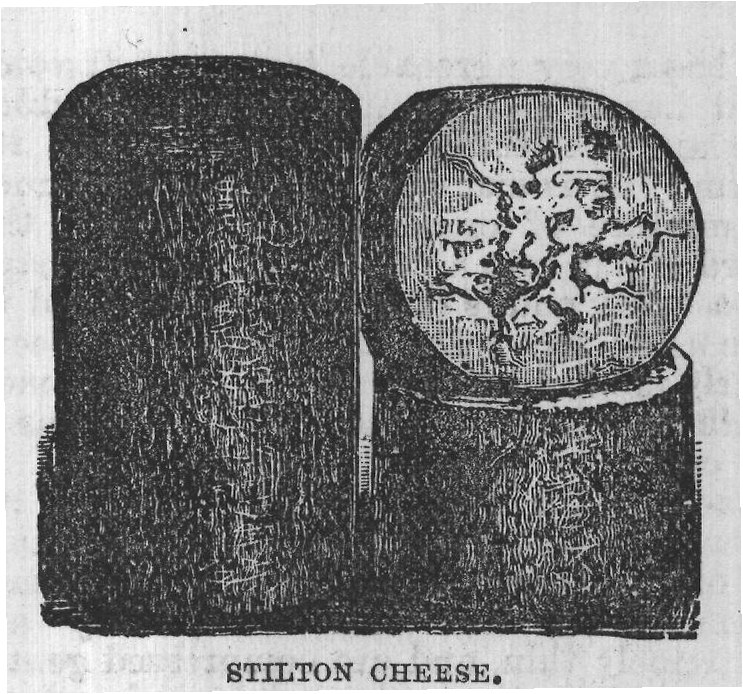
Cheese varies in quality and richness according to the materials of which it is STILTON CHEESE. composed. It is made-1. Of entire milk, as in Cheshire; 2. of milk and cream, as at Stilton; 3. of new milk mixed with skimmed milk, as in Gloucestershire; 4. of skimmed milk only, as in Suffolk, Holland, and Italy.
The principal varieties of cheese used in England are the following: Cheshire cheese, famed all over Europe for its rich quality and fine piquant flavour. It is made of entire new milk, the cream not being taken off. Gloucester cheese is much milder in its taste than the Cheshire. There are two kinds of Gloucester cheese, single and double: :skimmed milk, or of the milk deprived of Single Gloucester is made of half the cream; Double Gloucester is a cheese that pleases almost every palate; it is made of the whole milk and cream.
Stilton cheese is made by adding the cream of one day to the entire milk of the next: it was first made at Stilton, in Leicestershire. Sage cheese is so called from the CHEESE. practice of colouring some curd with bruised sage, marigold-leaves and parsley, and mixing this with some uncoloured curd.
With the Romans, and during the middle ages, this practice was extensively adopted.
Cheddar cheese much resembles Parmesan.
CHEDLAR CHEESE.
It has a very agreeable taste and flavour, and has a spongy appearance. Brickbat cheese has nothing remarkable except its form. It is made by turning with rennet a mixture of cream and new milk; the curd is put into a wooden vessel the shape of a brick, and is then pressed and dried in the usual way. Dunlop cheese has a peculiarly mild and rich taste: the best is made entirely from new milk. New cheese (as it is called in London) is made chiefly in Lincolnshire, and is either made of all cream, or, like Stilton, by adding the cream of one day's milking to the milk that comes immediately from the cow: they are extremely thin, and are compressed gently two or three times, turned for a few days, and then eaten new, with radishes, salad, &c. Skimmed milk cheese is made for sea voyages principally. An excellent. but little known English cheese is called Wensleydale, taking its name from the small village in Yorkshire where it is made.
GORGONZOLA CHEESE.
CREAM CHEESE.
Dorsetshire produces a very good cheese called Blue Veiny, from its blue veined appearance. Both these cheeses resemble Stilton. Parmesan cheese is made in Parma and Piacenza. It is the most celebrated of all cheeses; it is made entirely of skimmed cow's milk; the high flavour which it has is supposed to be owing CHEESE BISCUITS. to the rich herbage of the meadows of the Po, where the cows are pastured. The best Parmesan is kept for three or four years, and none is carried to market till it is at least six months old. Dutch cheese derives its peculiar pungent taste from the practice adopted in Holland of coagulating the milk with muriatic acid instead of rennet. Swiss cheeses, in their several varieties, are all remarkable for their fine flavour; that from Gruyère, a bailiwick in the canton of Fribourg, is best known in England; it is flavoured by the dried herb of melilotos officinalis in powder. Cheese from milk and potatoes is manufactured in Thuringia and Saxony. Camembert is a very much esteemed cheese coming from Brittany, it is small and flat, with a dark rind. Roquefort is a rich cheese made in the south of France, from the milk of sheep and goats. Cream cheese, although so called, is not properly cheese, but is nothing more than cream dried sufficiently to be cut with a knife.
Cheese. In families where much cheese is consumed, and it is bought in large quantities, a piece from the whole cheese should be cut, the larger quantity spread with a thickly-buttered sheet of white paper, and the outside occasionally wiped. To keep cheeses moist that are in daily use, when they come from table a damp cloth should be wrapped round them, and the cheese put into a pan with a cover to it, in a cool but not very dry place. To ripen cheeses, and bring them forward, put them into a damp cellar; and to check too large a production of mites, spirits may be poured into the parts affected. Pieces of cheese which are too near the rind, or too dry to put on table, may be made into Wal Welsh rarebits, or grated do down and mixed with macaroni. Cheeses may be preserved in a perfect state for years, by covering them with parchment made pliable by soaking in water, or by rubbing them over with a coating of melted fat. The cheeses selected should be free from cracks or bruises of any kind.
A moulded cold cream set with isinglass inside a wall of sponge fingers. The construction is the whole difficulty; the filling itself takes minutes.
- The quantities have lost their fractionsThe ingredient list reads "pint of cream" and "oz. of isinglass" where the original printing carried fractions the text has dropped; the cream figure may itself have been a fraction of a pint. Treat the printed figures as incomplete rather than literal, and judge the setting agent by the method: enough to hold the cream when turned out.
- IsinglassIsinglass is dried swim bladder, chiefly sturgeon, sold in leaf or shred and soaked, then dissolved over heat. Powdered or leaf gelatine stands in for it, though the exact weight has to be judged by the set: enough to unmould cleanly without going rubbery.
- Fold the gelatine in warm, not hotMelted isinglass poured hot into cold whipped cream seizes into threads. Let it cool to just above setting point and add it in a thin stream while whisking, or the charlotte will be stringy rather than smooth.
- Savoy biscuitsThese are ladyfingers or boudoir biscuits — the dry, crisp kind, not soft sponge fingers. Trim them square-sided so they stand flush and cut them level with the rim of the mould, since that cut edge becomes the base the turned-out charlotte rests on.
- The five minutes in the ovenThis is only to set the egg white gluing the biscuits together. The book gives no temperature; a cool oven is all that is wanted, since anything hotter colours the biscuits and dries them into brittleness.
- Egg white sparinglyThe warning in the text is the hinge of the whole dish. Brush the merest film on the biscuit edges only. Any that reaches the mould wall cements the case in place and the charlotte tears when turned out.
- "Place it in ice"An ice pail does the work of a refrigerator. Leave it until the cream is fully set before attempting to unmould; an under-set cream will burst the biscuit wall.
- Turning outLoosen with the briefest warmth at the mould base, invert onto a chilled serving dish and lift straight up. Do not twist.
- Flavouring and yieldOne tablespoon of liqueur or four of wine to the quantity of cream given, plus vanilla. Serves six; it will not hold more than a few hours on the table before the biscuits soften.
Charlotte russe is generally traced to Antonin Carême, who is said to have devised it in the early nineteenth century and named it for a Russian patron — the dish appears in his own writing as a cold variant of the older apple charlotte, which was a hot pudding of buttered bread and fruit baked in a deep mould. The cold version replaces bread with Savoy biscuits and fruit with whipped cream set by isinglass. Isinglass was the standard household setting agent of the period, sold by the ounce at the grocer and prized because it clarified as it dissolved and left no flavour of its own; commercial powdered gelatine displaced it over the following decades. The average cost of 2s. 2d. given here places it among the more expensive sweets in the book, cream being the dear item.