Home › F › Fowls, Boiled, to Carve
Fowls, Boiled, to Carve
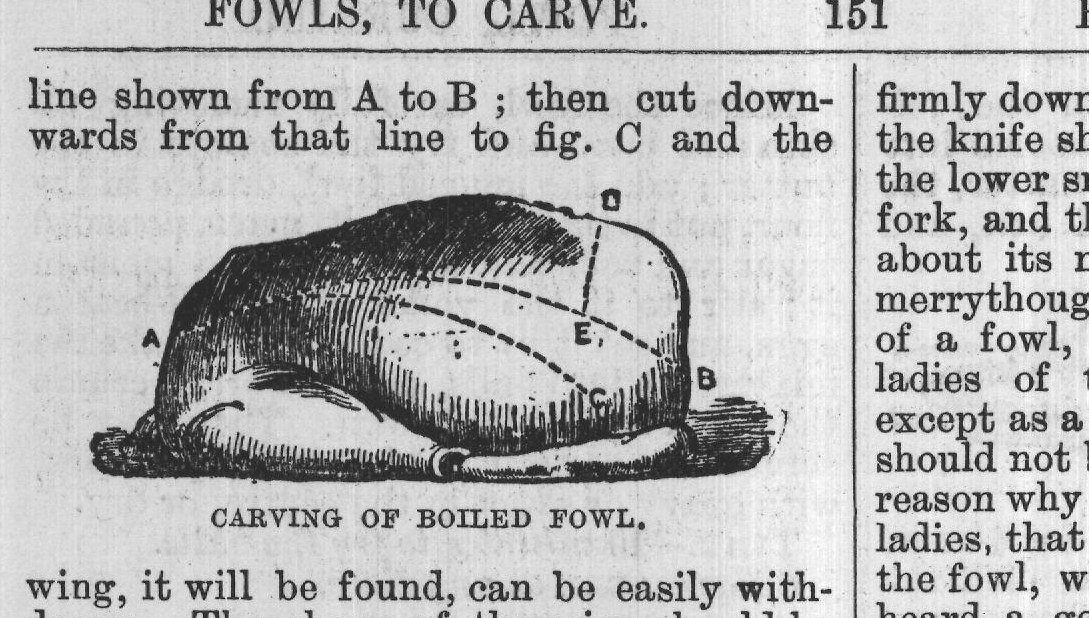
This will not be found a very difficult member of the poultry family to carve, unless, as may happen, a very old farmyard occupant, useless for egg-laying purposes, has, by some unlucky mischance, been introduced into the kitchen as a "fine young chicken." Skill, however, and the application of a small amount of strength, combined with a fine keeping of the temper, will even get over that difficulty. Fixing the fork firmly in the breast, let the knife be firmly passed along the FOWLS, TO CARVE. line shown from A to B; then cut downwards from that line to fig. Cand the 0 CARVING OF BOILED FOWL.
AND B wing, it will be found, can be easily with drawn. The shape of the wing should be like the accompanying engraving. Let the fork be placed inside the leg, which should be gently forced away from the body of the fowl; and the joint, being thus discovered, the carver can readily cut through it, and the leg can be served. When the leg is displaced, it should be of the same shape as that shown in the annexed woodcut. The legs and wings on either side having been taken off, the carver should draw his knife through the flesh in the direction of the line D to E; by this means the NECKBONE LEG, WING AND OF FOWL. knife can be slipped underneath the merrythought, which, being lifted up and pressed backward, will immediately come off. The collar or neck-bones are the next to consider; these lie on each side of the merrythought, close under the upper part of the wings; and, in order to free these from the fowl, they must also be raised by the knife at their broad end, and turned from the body towards the breast-bone, until the shorter piece of the bone, as shown in the cut, breaks off. There will now be left only the breast, with the ribs.
The breast can be, without difficulty, disengaged from the ribs by cutting through the latter, which will offer little impediment. The side bones are now to be taken off: and to do this, the lower end of the back should be turned from the carver, who should press the point of the knife through the top of the backbone, near the centre, bringing it down towards the end of the back completely through the bone. If the knife be now turned in the opposite direction, the joint will be easily separated from the vertebræ. The backbone being now uppermost, the fork should be pressed FOWLS, BROILED. firmly down on it, whilst at the same time the knife should be employed in raising up the lower small end of the fowl towards the fork, and thus the back will be dislocated about its middle. The wings, breast and merrythought are esteemed the prime parts of a fowl, and are usually served to the ladies of the company, to whom legs, except as a matter of paramount necessity, should not be given. Byron gave it as one reason why he did not like dining with the ladies, that they always had the wings of the fowl, which he himself preferred. We heard a gentleman who, when he might have had a wing, declare his partiality for a leg, saying that he had been obliged to eat legs for so long a time that he had at last come to like them better than the other more prized parts. If the fowl is, caponlike, very large, slices may be carved from its breast in the same manner as from a turkey's.
Fowls, Boiled, with Oysters. (Excellent). INGREDIENTS for dish for 4 persons.--1 young fowl, 2½ dozen oysters, the yolks of 2 eggs, 1/4 pint of cream. AVERAGE COST, 5s.
Truss a fowl as for boiling; fill the inside with oysters which have been bearded and washed in their own liquor; secure the ends of the fowl, put it into a jar, and plunge it into a saucepan of boiling water.
Keep it boiling for 1 hour, or rather longer; then take the gravy that has flowed from the oysters and fowl, of which there will be a good quantity; stir in the cream and yolks of eggs, add a few oysters scalded in their liquor; let the sauce get quite hot, but do not allow it to boil; pour some of it over the fowl, and the remainder send to table in a tureen. A blade of pounded mace added to the sauce, with the cream and eggs, will be found an improvement.
TIME.-1 hour.
SEASONABLE from September to April.
The carving directions and the recipe for a boiled fowl stuffed with oysters both belong to a period when a plain boiled chicken with a rich egg-and-cream sauce was everyday good eating. The recipe works as written; the two things needing attention are the sealed-jar cooking method and the sauce, which will curdle if it boils.
- Do not let the sauce boilEgg yolks thicken at around 150-160F and scramble not far above that. Whisk the yolks into the cream first, add the hot oyster and fowl liquor gradually, and hold the sauce below a simmer until it coats a spoon.
- The jar methodThe fowl goes into a stoneware or glass jar, and the jar stands in a pan of boiling water. This is a bain-marie, not preserving: the point is that the bird cooks in its own juices rather than being diluted by the water. A deep casserole dish in a pan of water does the same job. The recipe does not say whether the jar was covered; in any case do not seal or clamp a lid down.
- Fowl size and timeA "young fowl" for four was probably somewhere in the region of 3 to 3½ lb, though the recipe gives no weight. One hour of gentle cooking suits that size, but check the thigh joint reads 165F before serving; a larger bird will need appreciably longer.
- MeasuresA quarter of an imperial pint is 5 fl oz, a generous half cup. Two and a half dozen oysters is 30, which will give roughly a pint to a pint and a half of shucked oysters with their liquor, depending on size.
- Bearding oysters"Bearded" means the frilly gill fringe has been trimmed off. Strain the liquor through muslin as you work; grit in it will spoil the sauce.
- Oyster timingThe oysters scalded for the sauce need only to plump and their edges to ruffle, well under two minutes. Held longer they turn rubbery. Those cooked inside the bird for the full hour are there for flavour, not texture.
- Pounded maceA blade of mace is a piece of the dried lacy covering of nutmeg. About a quarter teaspoon of ground mace stands in for one blade; add it with the cream so it has time to infuse.
- Seasonable September to AprilThe old oyster season, the months with an R. Modern farmed oysters are sold year round, so the restriction no longer applies, though wild natives are still at their best in cold weather.
- YieldAs stated, four servings, with the remaining sauce sent to table separately in a tureen, as the recipe directs.
Boiled fowl was the safe, respectable centre of the Victorian dinner table: gentler on a tough bird than roasting, and producing the pale, mild flesh that nineteenth-century taste prized. Oysters were then cheap enough to be used by the dozen as stuffing rather than as a luxury, which is why they turn up inside fowls, in beefsteak puddings and in sauces throughout Beeton. The carving notes that accompany the recipe are as much about social order as knife work: the wings, breast and merrythought (the wishbone, its name traditionally explained by the custom of two diners pulling it, the winner getting a wish) went to the ladies, and the legs, the text implies, to the men. The book itself attributes to Byron the complaint that the ladies always had the wings of the fowl, which he preferred; how firmly that is documented is another matter, and it survives here because the household manuals of the 1860s taught etiquette and cookery in the same breath.