Home › F › Forcemeat (for Baked Pike)
Forcemeat (for Baked Pike)
INGREDIENTS sufficient for good-sized fish.- 3 oz. of bread-crumbs, 1 teaspoonful of minced savoury herbs, 8 oysters, 2 anchovies (these may be dispensed with), 2 oz. of suet; salt, pepper and pounded mace to taste; 6 tablespoonfuls of cream or milk, the yolks of 2 eggs. AVERAGE COST, 1s. 1d.
Beard and mince the oysters, prepare and mix the other ingredients, and blend the whole thoroughly together. Moisten with the cream and eggs, put all into a stewpan, and stir it over the fire till it thickens, when put it into the fish, which should have previously been cut open, and sew it up.
TIME.-4 or 5 minutes to thicken.
Forcemeat, or Quenelles (for Turtle Soup.) (SOYER'S Recipe). - Take a pound and a half of lean veal from the fillet, and cut it in long thin slices; scrape with a knife till nothing but the fibre remains; put it into a mortar, pound it 10 minutes, or until in a purée; pass it through a wire sieve (use the remainder in stock); then take 1 lb. of good fresh beef suet, which skin, shred and chop very fine; put it into a mortar and pound it; then add 6 oz. of panada (that is, bread soaked in milk and boiled till nearly dry) with the suet; pound them well together, and add the veal; season with a teaspoonful of salt, a quarter one of pepper, half that of nut meg; work all well together; then add 4 FORCEMEAT, VEAL. eggs by degrees, continually pounding the contents of the mortar. When well mixed,. take a small piece in a spoon, and poach it in some boiling water; and if it is delicate, firm, and of good flavour, it is ready for use.
FOWL, TRUSSING OF.
Shred the ham or bacon, chop the suet, lemon-peel, and herbs, taking particular care that all be very finely minced; add a seasoning to taste of salt, cayenne. and mace, and blend all thoroughly together with the bread-crumbs, before wetting.
Now beat and strain the eggs; work these up with the other ingredients, the is made into balls, fry of a nice brown, in boiling lard, or put them on a tin and bake Forcemeat, Veal, or Veal Que- forcemeat will be ready for use. When it nelles. INGREDIENTS.-Equal quantities of veal, panada and calf's udder, 2 eggs, seasoning to taste of pepper, salt and pounded mace or grated nutmeg; a little flour.
Take the fleshy part of veal, scrape it with a knife, till all the meat is separated from the sinews, and allow about ½ lb. for an entrée. Chop the meat, and pound it in a mortar till reduced to a paste; then roll it into a ball; make another of panada the same size, and another of udder, taking care that these three balls be of the same size. (It is to be remembered, that equality of size, and not of weight, is here necessary.) When the three ingredients are properly prepared, pound them all together in a mortar for some time; for the more quenelles are pounded, the more delicate they are.
Now moisten with the eggs, whites and yolks, and continue pounding, adding a seasoning of pepper, spices, &c. When the whole is well blended together, mould it into balls, or whatever shape is intended, roll them in flour, and poach in boiling water, to which a little salt should have been added. If the quenelles are not firm enough, add the yolk of another egg, but omit the white, which only makes them hollow and puffy inside. In the preparation of this recipe, it would be well to bear in mind that the ingredients are to be well pounded and seasoned, and must be made hard or soft according to the dishes they are intended for. For brown or white ragoûts they should be firm, and when the quenelles are used very small, extreme delicacy will be necessary in their preparation. Their flavour may be varied by using the flesh of rabbit, fowl, hare, pheasant, grouse, or an extra quantity of mushroom, parsley, &c.
Forcemeat (for Veal, Turkeys, Fowls, Hare, &c.) - INGREDIENTS for sufficient for a turkey of moderate size. -2 oz. of ham or lean bacon, 1/4 lb. of suet, the rind of half a lemon, 1 teaspoonful of minced parsley, 1 teaspoonful of minced lemon thyme, salt, cayenne and pounded mace to taste; 6 oz. of bread-crumbs, 2 eggs. AVERAGE COST, 7d. for 1/21 hour in a moderate oven. As we have stated before, no one flavour should predominate greatly, and the forcemeat should be of sufficient body to cut with a knife, and yet not dry and heavy. For very delicate forcemeat, it is advisable to pound the ingredients together before binding with the eggs; but for ordinary cooking, mincing very finely answers the purpose.
Note. In the forcemeat for hare, the liver of the animal is sometimes added. Boil for 5 minutes, mince it very small, and mix it with the other ingredients. If it should be in an unsound state, it must be on no account made use of.
Fowl, Trussing of, for Boiling. -It is a more difficult task to truss a fowl for boiling than for roasting, for it is not LOOSENING SKIN OF LEGS. easy to draw the skin over the legs without breaking it.
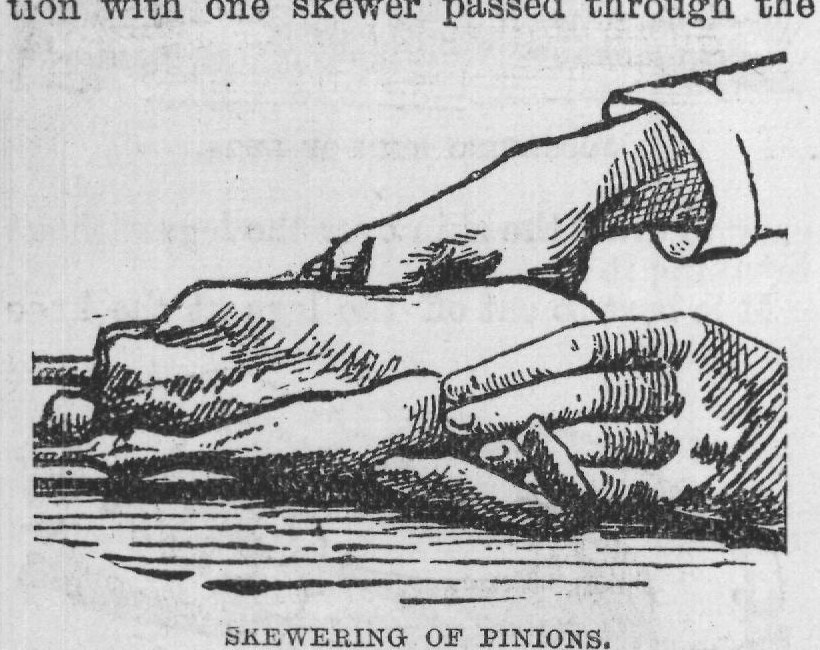
It is best to cut off the legs at the knee DRAWING SKIN OVER LEGS. joint, than to loosen the skin as shown, then the skin must be drawn over the legs as in illustration, next skewer the pinions FOWLS, TRUSSING OF. and legs as shown, remembering it should be the aim of all good cooks to make a SKEWERING OF PINIONS. boiled fowl look as neat, plump, and compact as possible. FOWLS, TO CARVE.
To skewer the legs, take a long skewer and having put it through the skin of the back, run it through the first joint of the الله FOWL TRUSSED FOR BOILING.
Fowl, Trussing of, for Roasting. Having drawn the fowl, dip the legs in boiling water, and after scraping them, cut off the claws or the whole feet if preferred, and the tips of pinions. Skewer the pinions as shown in illustration with one skewer passed through the SKEWERING OF PINIONS. first joint of the one on the right side (the middle of the leg being brought close to it), then through the body and the left pinion.
Next draw the skin over the neck, and skewer it back with a small skewer, SKEWERING OF LEGS. leg, taking up a small piece of skin, then on through the leg on the right side in the same manner, see illustration.
Fowls, Boiled, à la Béchamel. -INGREDIENTS. - A pair of fowls, 1 pint of Béchamel, a few bunches of boiled broccoli or cauliflower. AVERAGE COST, 5s. per pair.
Truss and boil the fowls; make a pint of Béchamel sauce; pour some of this over the fowls, and the remainder send to table in a tureen. Garnish the dish with bunches of boiled cauliflowers or broccoli, and serve very hot. The sauce should be made sufficiently thick to adhere to the fowls; that for the tureen should be thinned by adding a spoonful or two of stock. size.
TIME. From to 1 hour, according to SEASONABLE all the year, but scarce in early spring.
A rich oyster-and-suet stuffing for a whole baked pike, thickened on the stove before it goes into the fish. The quantities suit a fish of about 3-4 lb.
- What "beard" meansThe beard is the dark frill of gill tissue around the edge of a shucked oyster. Trim it off with scissors before mincing; it is tough and holds grit.
- Oysters go in barely cookedThe stuffing is stirred only until it thickens, 4 to 5 minutes, and finishes cooking inside the fish. Do not let the mixture simmer or the minced oysters turn to rubber before the pike is even in the oven.
- SuetBeef suet, finely shredded, is what keeps the forcemeat moist. Ask a butcher, or use frozen grated suet; packaged shredded suet works but is often part vegetable fat and gives a slightly waxier set. Cold butter, grated, is the nearest domestic substitute.
- AnchoviesTwo whole salted anchovies, mashed to a paste; anchovies of the period were generally sold whole and salted rather than filleted. The recipe expressly allows you to leave them out, though they add savoury depth; anchovy paste or a teaspoon of fish sauce does a similar job.
- Pounded maceMace is the lacy covering of the nutmeg seed, sold either as blades (which the recipe's 'pounded' assumes you will pound yourself) or ready ground. A pinch is enough for this quantity; more and it dominates, which the book elsewhere warns against.
- Breadcrumbs and creamThree ounces is about 1 1/2 cups of fresh soft crumbs, not dried ones, which would drink up the liquid and go pasty. Six tablespoonfuls of cream or milk is roughly 90 ml.
- Sewing up the fishUse a trussing needle and undyed cotton kitchen twine along the belly cavity. Cocktail sticks laced with twine work if you have no needle; remove everything before serving.
- OvenNo baking instruction is given here because the stuffed pike is baked separately. The book's own term for this sort of dish is a 'moderate oven', which is usually taken today as somewhere around 350F/180C; allow roughly 10 minutes per pound plus 10 minutes as a rough guide, and cook until the flesh at the thickest part flakes from the bone.
- Cost noteThe "average cost, 1s. 1d." is a Victorian price for the forcemeat alone and reflects a time when oysters were cheap everyday food rather than a luxury.
Forcemeat derives ultimately from the French farce, a stuffing, the English 'force' being an alteration of earlier 'farce/farced meat' that seems to have been encouraged by the association with forcing a filling into a bird or fish. Pike is a lean, bony freshwater predator and a familiar catch in English rivers and ponds, and English cookery books commonly treat it as a fish needing help: dry-fleshed and full of fine bones, it was frequently split, stuffed and baked so that a fatty, well-seasoned filling could compensate. Oysters here are unlikely to be extravagance, since oysters were still landed in quantity and sold cheaply in Victorian towns. Beeton's insistence, stated at the end of the neighbouring forcemeat entries, that no single flavour should predominate and that the mixture should be firm enough to cut with a knife yet not dry, is the governing principle of the stuffings in this section.