Home › G › Goose, Roast, to Carve
Goose, Roast, to Carve
It would not be fair to say that this dish bodes a great deal of happiness to an inexperienced carver, especially if there is a large party to serve and the slices off the breast should not suffice to satisfy the desires and cravings of many wholesome appetites, produced, may be, by the various sports in vogue at Michaelmas and Christmas. The beginning of the task, however, is not in any way difficult. Evenly-cut slices, not too thick or too thin, should be carved from the breast in the direction of the line A B D ROAST GOOSE.
E from B to C; after the first slice has been cut, a hole should be made with the knife in the part called the apron, passing it round the line as indicated by the figures A, A by the figures A, Α; here the stuffing is located, and some of this should be served on each plate, unless it is discovered that it is not agreeable to the taste of some one guest. If the carver manages cleverly, he will be able to cut a very large number of fine slices off the breast, and the more so if he commences close down by the wing and carves upwards towards the ridge of the breastbone.
Select a goose with a clean white skin, plump breast and yellow feet: if these latter are red, the bird is old. Should the weather permit, let it hang for a few days; by so doing the flavour will be very much improved. Pluck, singe, draw and carecarefully wash and wipe the goose. Make a suge-and-onion stuffing of the above ingredients, put it into the body of the goose, and secure it firmly at both ends by passing the rump through the hole made in the skin, and the other end by tying the skin of the neck to the back: by this means the seasoning will not escape. Put it down to a brisk fire, keep it well basted, and roast from 1 to 2 hours, according to the size. Remove the skewers, and serve with a tureen of good gravy, and one of well-made apple sauce. Should a very highly-flavoured seasoning be preferred, the onions should not be parboiled, but minced raw of the two methods the mild seasoning is far superior. A ragout, or pie, should be made of the giblets, or they may be stewed down to make gravy. Be careful to serve the goose before the breast falls, or its appearance will be spoiled by coming flattened to table. As this is rather a troublesome bird to carve, a very little gravy should be poured round the goose, but more served in a tureen.
TIME. A large goose, 1½ hour; a moderate-sized one, 14 to 1½ hour. SEASONABLE from September to March; in perfection from Michaelmas to Christmas.
Note. A teaspoonful of made mustard, a saltspoonful of salt, a few grains of with a glass of port wine, are sometimes poured into the goose by a slit made in the apron. This SENCE is by many considered an improvement.
As many slices as can be taken from the breast being carved, the wings should be cut off, and the same process as described in carving boiled fowl is made use of in this instance, only more dexterity and greater force will most probably be required. The shape of the leg, when disengaged from the body of the goose, should be like that LEG, WING AND NECK- BONE OF GOOSE. shown in the accompanying engraving. It will be necessary perhaps, in taking off the leg, to turn the goose on its side, and then, pressing down the small end of the leg, the knife should be passed under it from the top quite down to the joint; the leg being now turned back by the fork, the knife must cut through the joint, loosening the thigh- GOOSE STUFFING. bone from its socket. The merrythought, which in a goose is not so large as might be expected, is disengaged in the same way as that of a fowl-by passing the knife under it, and pressing it backwards towards the neck. The neck-bones, of which we give a cut, are freed by the same process as are those of a fowl; and the same may be said of all the other parts of this bird.
The breast of a goose is the part most esteemed; all parts, however, are good, and full of juicy flavour.
Goose Stuffing. (SOYER'S Recipe.) -Take 4 apples peeled and cored, 4 onions, 4 leaves of sage, and 4 leaves of lemonthyme not broken, and boil them in a stewpan with sufficient water to cover them; when done, pulp them through a sieve, removing the sage and thyme; then add sufficient pulp of mealy potatoes to cause it to be sufficiently dry without sticking to the hand; add pepper and salt, and stuff the bird.
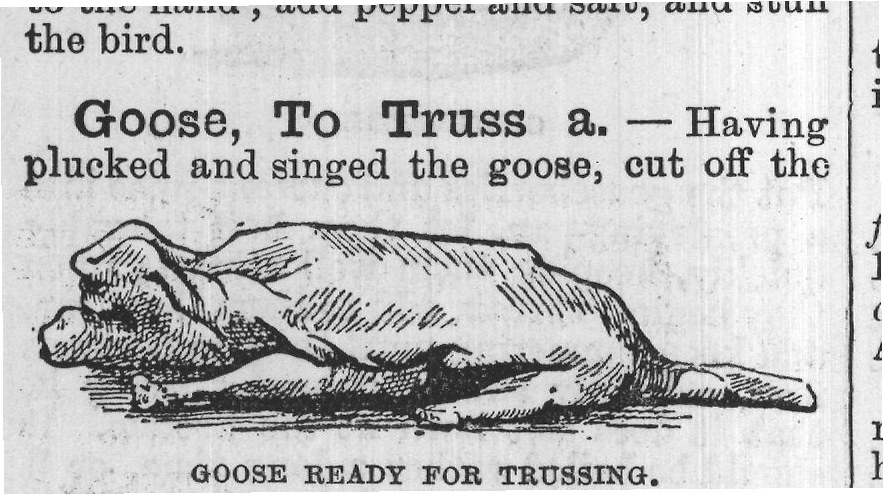
Goose, To Truss a. Having plucked and singed the goose, cut off the GOOSE READY FOR TRUSSING. feet at the joints, the pinions at the first joint, and the neck close to the back, leaving enough skin to turn over it.
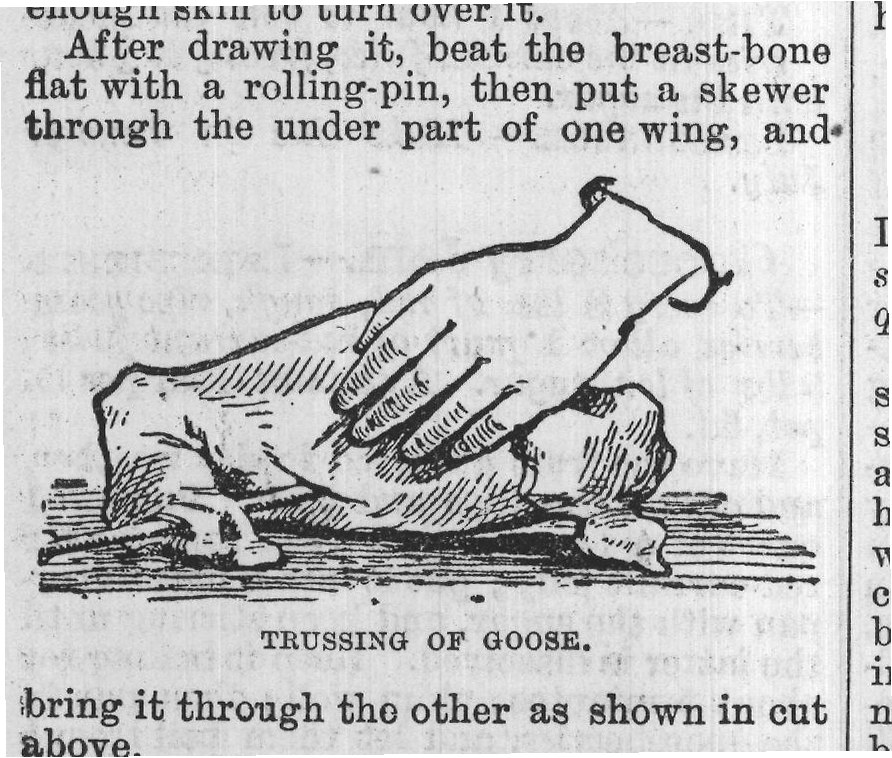
After drawing it, beat the breast-bone flat with a rolling-pin, then put a skewer through the under part of one wing, and TRUSSING OF GOOSE. bring it through the other as shown in cut above.
Skewer the legs as shown in illustration, with one skewer passed through the first joint, then through the body to catch the other leg.
GOOSEBERRIES, COMPÔTE OF.
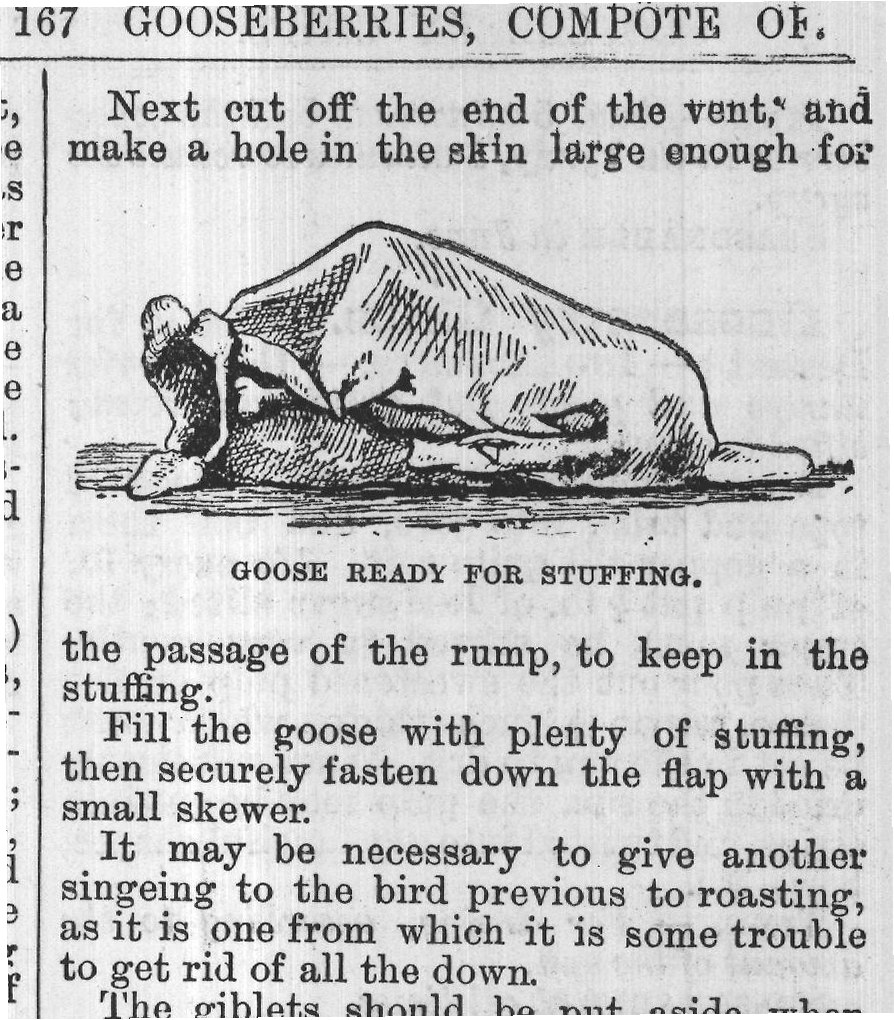
Next cut off the end of the vent, and make a hole in the skin large enough for GOOSE READY FOR STUFFING. the passage of the rump, to keep in the stuffing.
Fill the goose with plenty of stuffing, then securely fasten down the flap with a small skewer.
It may be necessary to give another singeing to the bird previous to roasting, as it is one from which it is some trouble to get rid of all the down.
The giblets should be put aside when trussing, and afterwards washed and put in water till they are needed.
This entry runs carving directions, the roasting method, Soyer's stuffing and trussing notes together. The cooking guidance itself is brief, and a few of its figures need translating before you light the oven.
- The hinge: serve it before the breast fallsBeeton's own warning is the practical one. The text does not say why; the usual explanation is that a goose carries a great deal of fat under the skin, and once it has rendered out the breast collapses and the bird arrives flattened. Rest it no more than 20 minutes, breast up, and carve at table.
- TimingThe roasting times in the text were checked against the printed page and read as given. For a modern oven it is still easier to work by weight and temperature: a 9-11 lb goose takes roughly 2 to 2 1/2 hours, and the thigh should read 165-175F.
- "A brisk fire"In a range-and-spit kitchen this meant close, strong heat. In an oven, start at 425F for 20-30 minutes to set and colour the skin, then drop to 350F for the remainder.
- Basting, and the fatA goose bastes itself and then floods the pan. Pour or ladle the rendered fat off two or three times during cooking or the drippings will scorch and the gravy will be unusable. Keep the fat; refrigerated, it lasts months and is excellent for potatoes.
- Stuffing quantitiesThe instruction to "make a sage-and-onion stuffing of the above ingredients" refers to a list that does not appear here. For a bird this size, reckon on about 2 large onions, 1 lb of breadcrumbs, a good tablespoon of chopped sage, and seasoning. Beeton's note is worth heeding: parboiled onions give the milder, better result; raw minced onion gives a fierce one.
- Soyer's stuffingHis version is essentially an apple-onion pulp bound with mashed potato and is a genuinely good alternative. "Mealy potatoes" means floury baking types, not waxy. Add the potato gradually until the mixture just holds its shape.
- HangingSkip the instruction to hang the bird for a few days. That assumed a cold larder and an untouched, undressed bird; a modern dressed goose should go straight into the refrigerator.
- Yellow feet and red feetThe selection test is sound but useless at a supermarket, where geese arrive dressed and footless. Judge instead by a plump, unbruised breast and a fresh, clean smell; most birds sold now are young in any case.
- YieldA goose gives far less meat for its weight than a turkey. A 10 lb bird serves six generously, eight at a stretch. Reserve the giblets for gravy, as directed, and serve apple sauce alongside.
Roast goose was the fixed English bird of Michaelmas and, before the turkey took over, of Christmas too, which is exactly the season Beeton gives: "in perfection from Michaelmas to Christmas." Geese fattened on stubble after the harvest were ready by late September, and Michaelmas goose was traditionally linked to quarter-day rents and fairs across England. The elaborate carving diagrams reflect a Victorian household expectation that the host would carve at table before his guests, a skill treated as a small social test; here Beeton shows her sympathy for the "inexperienced carver." The stuffing credited here to Soyer is Alexis Soyer, the celebrated chef of the Reform Club, whose recipes were widely reprinted in nineteenth-century household manuals; the sage-and-onion pairing with goose, and the apple sauce beside it, are both older still, cutting the richness of a very fatty bird.