Home › H › Hams, to Smoke at Home
Hams, to Smoke at Home
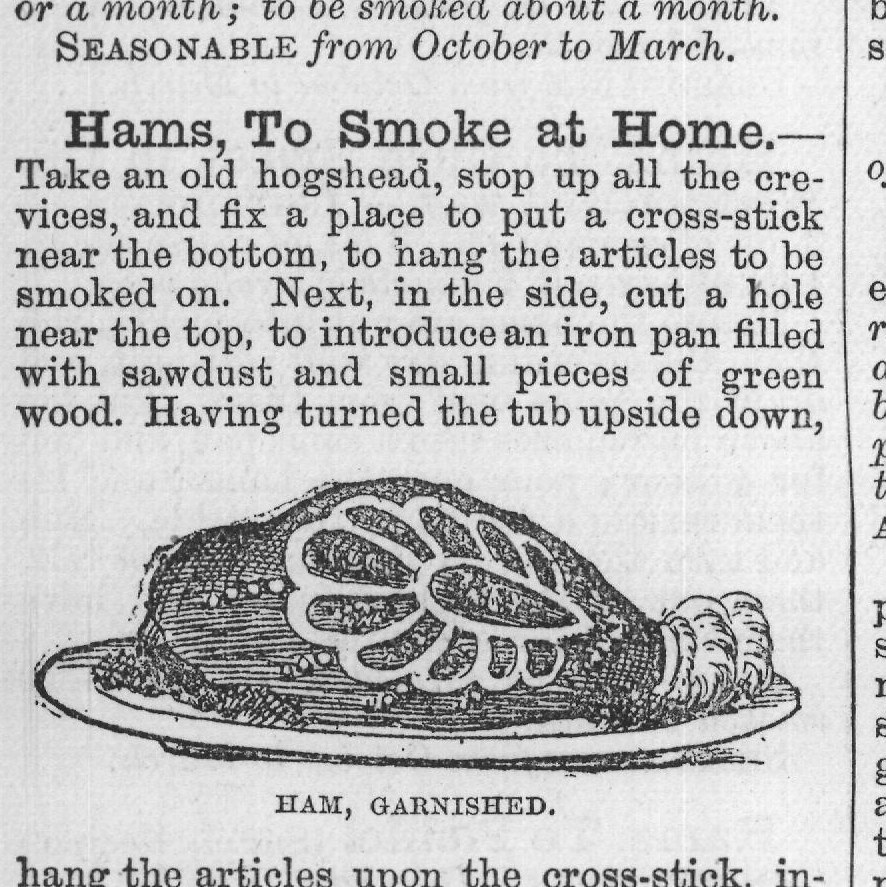
Take an old hogshead, stop up all the crevices, and fix a place to put a cross-stick near the bottom, to hang the articles to be smoked on. Next, in the side, cut a hole near the top, to introduce an iron pan filled with sawdust and small pieces of green wood. Having turned the tub upside down, HAM, GARNISHED. hang the articles upon the cross-stick, introduce the iron pan in the opening, and place a piece of red-hot iron in the pan, cover it with sawdust, and all will be complete. Let a large ham remain 40 hours, and keep up a good smoke. Fish may be smoked in the same manner.
HARE, JUGGED. stock, bread-crumbs. AVERAGE COST, exclusive of the cold hare, 6d. Mince the hare as fine as possible, and season it well; soak the bread in the stock, then place it in a stewpan on the fire, add the butter and the yolk of one egg, and beat the mixture to a paste; add the hare and another egg, stir all well together and set aside to cool. Form the mixture into balls or cones, dip them in beaten egg, then in bread-crumbs, and fry of a nice brown colour. A good brown gravy may be served with these, or some Italian sauce.
TIME.-10 minutes to fry the croquettes.
SEASONABLE from September to the end of February.
Hare, Hashed. (Cold Meat Cookery.) - INGREDIENTS. - The remains of cold roast hare, 1 blade of pounded mace, 2 or 3 allspice, pepper and salt to taste, 1 onion, a bunch of savoury herbs, 3 tablespoonfuls of port wine, thickening of butter and flour, 2 tablespoonfuls of mushroom ketchup. AVERAGE COST, 8d.
Cut the cold hare into neat slices, and put the head, bones and trimmings into a stewpan, with pint of water; add the mace, allspice, seasoning, onion and herbs, stew for nearly an hour and strain the gravy; thicken it with butter and flour, add the wine and ketchup, and lay in the pieces of hare, with any stuffing that may be left. Let the whole gradually heat by the side of the fire, and when it has simmered for about 5 minutes, serve and garnish the dish with sippets of toasted bread. Send red-currant jelly to table with it.
TIME-Rather more than 1 hour.
SEASONABLE from September to the end Hare, Broiled. (A Supper or Lun- of February. cheon Dish.)- INGREDIENTS.-The legs and shoulders of a roast hare, cayenne and salt to taste, a little butter.
Cut the legs and shoulders from a roast hare, season them highly with salt and cayenne, and broil them over a very clear fire for 5 minutes. Dish them on a hot dish, rub over them a little cold butter, and send to table very quickly.
TIME.-5 minutes.
Hare, Jugged. (Very good.)-INGREDIENTS for dish sufficient for 7 or 8 persons. -1 hare, 1 lb. of gravy beef, lb. of butter, 1 onion, 1 lemon, 6 cloves; pepper, cayenne and salt to taste 1/4 pint of port wine. AVERAGE COST, 6s. 6d.
Skin, paunch and wash the hare, cut it into pieces, dredge them in flour, and fry in boiling butter. Have ready 1½ pint of SEASONABLE from September to the end gravy made from the above proportion of of February.
Hare, Croquettes of. INGREDIENTS for small dish sufficient for 4 persons. 1/2 lb. of the remains of cold roast hare, 1/2 b. of bread, 3 eggs, pepper, salt and cayenne to taste, 1 oz. of butter, 2 er, 2 tablespoonfuls of beef, and thickened with a little flour. Put this into a jar; add the pieces of fried hare, an onion stuck with six cloves, a lemon peeled and cut in half, and a good seasoning of pepper, cayenne and salt; cover the jar down tightly, put it up to the neck into a stewpan of boiling water.
HARE, JUGGED. and let it stew until the hare is quite tender, taking care to keep the water boiling. When nearly done, pour in the wine, and add a few forcemeat balls; these must be fried or baked in the oven for a few minutes before they are put to the gravy.
Serve with red-currant jelly.
TIME.-3 to 4 hours. If the hare is very old allow 4 hours.
SEASONABLE from September to the end of February.
HARE, ROAST. stew very gently until the hare is tender, and the flesh will separate easily from the bones. When done enough take it up, remove the bones, and pound the meat with the bacon, in a mortar, until reduced to a perfectly smooth paste. Should it not be sufficiently seasoned, add a little cayenne, salt and pounded mace, but be careful that these are well mixed with the other ingredients. Press the meat into potting-pots, pour over clarified butter, and keep in a dry place. The liquor that the hare was stewed in should be saved for hashes, soups, &c., &c. Remains of cold hare answer equally well for potting.
Hare, Jugged. (A Quicker and more Economical Way.) - INGREDIENTS for dish sufficient for 8 persons.-1 hare, a bunch of sweet herbs, 2 onions, each stuck with 3 cloves, 6 whole allspice, teaspoonful of black pepper, a strip of lemon-peel, thicken- of February. ing of butter and flour, 2 tablespoonfuls of mushroom ketchup, 1/4 pint of port wine.
AVERAGE COST, 5s. 6d.
Wash the hare nicely, cut it up into joints (not too large), and flour and brown them as in the preceding recipe; then put them into a stewpan with the herbs, onions, cloves, allspice, pepper and lemonpeel; cover with hot water, and when it boils, carefully remove all the scum, and let it simmer gently till tender, which will be in about 1 hour, or longer, should the hare be very old. Take out the pieces of hare, thicken the gravy with flour and butter, add the ketchup and port wine, let it boil for about 10 minutes, strain it through a sieve over the hare and serve.
A few fried forcemeat balls should be added at the moment of serving, or instead of frying them, they may be stewed in the gravy about 10 minutes before the hare is wanted for table. Do not omit to serve red-currant jelly with it.
TIME.-Altogether 2 hours.
TIME. About 2 hours to stew the hare.
SEASONABLE from September to the end
This is a barrel smokehouse: a large cask inverted over a hanging joint, with a pan of smouldering sawdust fed through a hole in the side. It describes the apparatus only, and that omission is the whole problem.
- No cure is given at allA ham destined for smoking would normally have spent one to several weeks in a salt or brine cure (commonly salt, often with saltpetre) beforehand, and that step is what does the preserving. This entry begins at the smoking stage and never states the cure, so following it as printed means smoking fresh, uncured pork.
- Forty hours in the danger zoneSawdust and green wood over a lump of hot iron produce a cool smoke, well under 60C/140F. Uncured meat held for 40 hours at those temperatures gives spoilage and pathogenic bacteria ample time to multiply; smoke deposits surface phenols but does not sterilise or preserve the interior.
- No temperature controlThere is no thermometer, no vent adjustment and no way to know whether the cask is at 20C or 70C. Modern cold-smoking depends on holding the chamber below a measured ceiling while the cure does the preserving work; hot-smoking depends on bringing the meat to a measured safe internal temperature (commonly given as at least 63C/145F for pork). This method achieves neither reliably.
- The vesselA hogshead is a large cask, roughly 50 to 55 imperial gallons depending on the trade, in practice usually a used wine, beer or spirit barrel. Reused staves carry residues of whatever the barrel last held and whatever has grown in the wood, and end grain is very hard to clean.
- "Fish may be smoked in the same manner"Cold-smoked fish is the classic vehicle for botulism from C. botulinum type E and for Listeria. Salmon and trout smoked this way, without a measured salt cure and controlled temperature, are riskier than the ham.
- If you want smoked hamUse a current, tested curing recipe that gives weights of salt and curing salt per weight of meat, cure times, and chamber and internal temperatures. Do not treat this passage as a working method.
Before the middle of the nineteenth century most English bacon and ham was cured and smoked at home or by the village butcher, and improvised smokehouses of exactly this kind an old cask, a chimney recess, a disused outhouse are described in household manuals throughout the period. The instruction to hang the meat on a cross-stick and feed smoke from a pan of sawdust and green wood is a domestic scaling-down of the smoke loft, and the choice of green wood is deliberate: sappy wood smoulders and smokes rather than flaming. What the passage takes for granted is the long salt cure that preceded it, which Victorian readers would have found in the neighbouring entries on pickling and salting pork; by the time this compilation appeared, factory-cured hams were widely bought instead, and the home smokehouse survived mainly in rural districts.