Important: Safety Warning
This recipe calls for animal brains or related nervous-system tissue. Cattle brain and spinal tissue can transmit bovine spongiform encephalopathy (BSE), the cause of variant Creutzfeldt-Jakob disease in humans, which is fatal and has no treatment.
In addition, this page gives advice for salvaging or disguising food that has begun to spoil. Spoiled food can carry dangerous bacteria and toxins that no washing, soaking, or seasoning removes; it should be discarded.
This information has been left in for historical purposes but should not be acted upon.
Hare, Roast
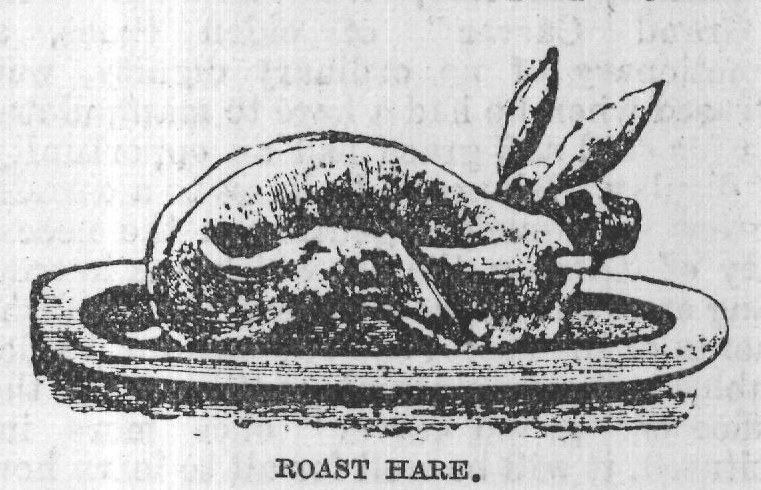
INGREDIENTS.-Hare, forcemeat, a little milk, butter.
Choose a young hare; which may be known by its smooth and sharp claws, and by the cleft in the lip not being much spread. To be eaten in perfection, it must hang for some time; and, if properly taken ROAST HARE. care of, it may be kept for several days. It is better to hang without being paunched; but should it be previously emptied, wipe SEASONABLE from September to the end the inside every day, and sprinkle over it a of February.
Note. Should there be any left, re-warm it the next day by putting the hare, &c., into a covered jar, and placing this jar in a saucepan of boiling water; this method prevents a great deal of waste.
Hare, Potted. (A Luncheon or Breakfast Dish.) - INGREDIENTS for 6 small pots.-1 hare, a few slices of bacon, a large bunch of savoury herbs, 4 cloves, ½ teaspoonful of whole allspice, 2 carrots, 2 onions, salt and pepper to taste, 1 pint of water, 2 glasses of sherry. AVERAGE COST, 5s. 6d.
Skin, empty and wash the hare; cut it down the middle, and put it into a stewpan with a few slices of bacon under and over it; add the remaining ingredients, and little pepper and ginger, to prevent the musty taste which long keeping in the damp occasions, and also which affects the stuffing. After it is skinned, wash it well, and soak for an hour in warm water to draw out the blood; if old, let it lie in vinegar for a short time, but wash it well afterwards in several waters. Make a forcemeat, wipe the hare dry, fill the belly with it, and sew it up. Wrap the ears in a piece of buttered paper. The hare should be kept at a distance from the fire when it is first laid down, or the outside will become dry and hard before the inside is done. Baste it well with milk for a short time, and afterwards with butter; and particular attention must be paid to the basting, so as to preserve the meat or HARE, ROAST, TO CARVE. the back juicy and nutritive. When it is almost roasted enough, flour the hare, and baste well with butter. When nicely frothed, dish it, remove the skewers, and send it to table with a little gravy in the dish, and a tureen of the same. Red-currant jelly must also not be forgotten, as this is an indispensable accompaniment to roast hare. For economy, good beef dripping may be substituted for the milk and butter to baste with; but the basting, as we have before stated, must be continued without intermission. If the liver is good, it may be parboiled, minced and mixed with the stuffing; but it should not be used unless quite fresh. Plenty of good gravy should always be served with hare, which otherwise would be rather dry, the juice of the flesh being extracted in the cooking.
TIME. A middling-sized hare, 1 hour; a large hare, 1½ to 2 hours.
SEASONABLE from September to the end of February.
Hare, Roast, To Carve. The "Grand Carver" of olden times, a functionary of no ordinary dignity, was pleased when he had a hare to manipulate, for his skill and grace had an opportunity of display. Dinners à la Russe to a certain extent save modern gentlemen the necessity of learning the art which was in auld lang syne one of the necessary accomplishments of the useful squire; but, until sidetables become universal, or till we see the office of "grand carver" once more instituted, it will be well for all to learn how ROAST HARE.
HARE, TRUSSING OF. indicated by the letters E to F. The shoulders will then be taken off by passing the knife round from Gto H. The back of the hare should now be divided by cutting quite through its spine, as shown by the line A to B, taking care to feel with the point of the knife for a joint where the back may be readily penetrated. It is the usual plan not to serve any bone in helping hare; and thus the flesh should be sliced from the legs and placed alone on the plate. In large establishments, and where men-cooks are kept, it is often the case that the backbone of the hare, especially in old animals, is taken out, and then the process of carving is, of course considerably facilitated. Stuffing is served with it; and the ears, which should be nicely crisp, and the brains of the hare, are esteemed as delicacies by many connoisseurs.
The page as printed is a tangle: the roast hare instructions have been interleaved by the typesetter with a separate recipe for potted hare, so read past the bacon, cloves and sherry, which belong to the potted version. What survives is a straightforward spit-roast of a lean animal that lives or dies by its basting.
- The hinge: fat, constantlyHare has very little intramuscular fat and dries out readily. Beeton's insistence on basting "without intermission" is the whole technique; in an oven, bard the animal with bacon or pork fat and baste every 10 minutes, or the saddle will be sawdust.
- Hanging and soakingThe instruction to hang a hare unpaunched for several days assumes a cold larder in winter. Game is still hung, but at 0-4C (a dedicated fridge), never at room temperature, and a modern dealer will supply it already hung and paunched. Skip the hour-long warm-water soak; it does nothing a cold rinse will not.
- Fire to ovenThis was written for a joint turning before an open fire, hence "kept at a distance from the fire when it is first laid down." In an oven, start at 220C/425F for 15 minutes to colour, then drop to 160C/325F for the remainder, covered loosely with foil if the ears and legs darken too fast.
- TimingsOne hour for a middling hare and up to two for a large one reflects a fire of unknown strength. Go by temperature: 65-70C/150-160F at the thickest part of the hind leg for a young hare. Beeton's young hare has smooth, sharp claws and a lip whose cleft is not much spread; rough claws and a widely spread cleft mean an old animal, which no amount of roasting will make tender -- those go into a braise or the potted recipe.
- ForcemeatThe recipe assumes you know Beeton's standard veal forcemeat: breadcrumbs, chopped suet or bacon fat, lemon zest, parsley, thyme, and egg to bind, seasoned hard. Any bread-and-fat stuffing works. If you use the liver, parboil it only if it is genuinely fresh, as she says.
- "Nicely frothed"Flouring the joint and basting with hot butter at the end raises a blistered, crisp surface; that is frothing. It works in a hot oven for the last five to ten minutes, and only if the fat is hot when it goes on.
- Buttered paper on the earsParchment does the job. The ears were served crisp as a delicacy, so the paper is there to stop them charring outright rather than to keep them soft.
- Gravy and jelly"Plenty of good gravy" is not optional with a lean roast. Deglaze the pan with stock and a little port, and serve red-currant jelly alongside, which is the one accompaniment she treats as non-negotiable.
- Yield and costA hare of 2.5-3 kg (5½-6½ lb) undressed feeds four to six. The 5s 6d given on this page belongs to the potted recipe, not the roast.
- SourcingSupermarkets do not stock hare. Order from a game dealer, in Britain generally from September into winter, which matches the book's "seasonable September to the end of February."
Under the Game Laws of the period, taking hares was tightly restricted, poaching prosecutions were common, and the animal carried a whiff of the squire's estate about it. That is why Beeton pairs the roast with a carving lecture nostalgic for the "Grand Carver" and grumbling about dinners a la Russe, the newer fashion in which food was portioned by servants at a sideboard rather than dismembered by the host in front of his guests. Her insistence on hanging the hare, on the pepper and ginger against mustiness, and on red-currant jelly all point to the same thing: a strong, dark, dry meat that the period liked well-ripened and sweetened at the edges. The blood drawn out by soaking here was, in the related dish of jugged hare, saved deliberately to thicken the sauce.