Home › L › Lemon Cream, Economical
Lemon Cream, Economical
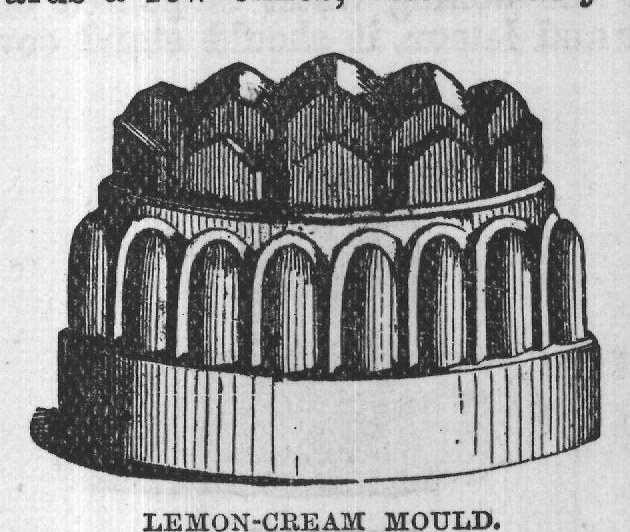
INGREDIENTS for two 1½-pint moulds.-1 quart of milk, 8 bitter almonds, 2 oz. of gelatine, 2 large lemons, 3/4 lb. of lump sugar, the yolks of 6 eggs. AVERAGE COST, 2s.
Put the milk into a lined saucepan with the almonds, which should be well pounded in a mortar, the gelatine, lemon-rind and lump sugar and boil these ingredients for about 5 minutes. Beat up the yolks of the eggs, strain the milk into a jug, add the eggs and pour the mixture backwards and forwards a few times, until nearly cold; LEMON-CREAM MOULD. then stir briskly to it the lemon-juice, which should be strained, keep stirring until the cream is almost cold; put it into an oiled mould and let it remain until perfectly set.
The lemon-juice must not be added to the cream when it is warm and should be well stirred after it is put in.
TIME.-5 minutes to boil the milk.
SEASONABLE at any time.
This is a Victorian set cream, and two things in it put it outside what a modern kitchen should attempt: the bitter almonds and the uncooked yolks. The notes below explain the problems rather than work around them.
- Bitter almonds are the blocking issueBitter almonds contain amygdalin, which releases hydrogen cyanide when the nut is crushed and wetted — exactly what pounding them in a mortar and steeping them in milk achieves. Their sale for domestic use is restricted or prohibited in a number of countries, including the United States, and the toxic dose for a child is small. There is no safe household way to judge the strength of a given batch.
- The boiling does not make them safeFive minutes at a boil will drive off some hydrogen cyanide, but the amount remaining depends on the nuts, the grind and the pot. The recipe treats them purely as a flavouring, which is how the period understood them; the toxicology was not.
- Gelatine strength is not comparableTwo ounces of nineteenth-century gelatine, which was of variable quality and not sold to any fixed standard, cannot be read across to two ounces of modern powdered gelatine. Followed literally against the roughly three pints the recipe makes, the quantity would give a very firm, rubbery mould even setting the other problems aside.
- If you want the dishUse a current recipe for lemon cream or lemon posset, one that either cooks the custard to temperature or omits eggs entirely, and flavour it with lemon zest and sweet almond extract.
- Reading the originalThe one piece of technique here that has aged well is the warning at the end: acid added to a warm dairy mixture curdles it. Modern lemon custards still hold the juice back until the base has cooled.
Bitter almonds run through English cookery books of the eighteenth and nineteenth centuries as a matter of course — in ratafia, in macaroons, in blancmange and creams of this kind — because they carry the strong marzipan note that sweet almonds lack. That flavour is benzaldehyde, and in the nut it comes bound up with amygdalin, the compound that also yields cyanide; commercial almond essence today supplies the benzaldehyde alone. Bitter almonds were sold alongside sweet ones and used in small numbers as a seasoning — this recipe calls for eight to a quart of milk. The mould itself is typical of the period's ambition for a middle-class table: gelatine had become cheap and reliable enough by the second half of the century for turned-out creams and jellies to be everyday dinner-party sweets rather than confectioners' work, and the recipe's two 1½-pint moulds and costing of two shillings show it being pitched squarely at a cook feeding a family and guests.