Home › Bread-Making › Coffee Bread
Coffee Bread
Take two teacups of hop-yeast dough, and add two eggs well beaten up, three tablespoonfuls of sugar, two of butter. Mix them well. Roll out and place on a buttered tin. Spread a little butter on the top, sprinkle with white sugar, add cinnamon. Set to rise and bake quite slowly. This is nice for lunch, dipped in hot coffee and cream.
TAKE partly cooked oatmeal, sold by all grocers, add water enough to saturate it, and a very little salt. Pour it into a baking tin half an inch or three-quarters deep, shake it down level, and when this is done it should be so wet that two or three spoonfuls of water should run freely on the surface. Put it in a quick oven and bake twenty minutes. Eat warm. It will be as light and tender as the best "Johnny cake," unless you have wet it too much or baked it too long. If you have only the ordinary oatmeal, that requires long cooking, it may be partly cooked the night before. Scarcely any wholesome thing in the bread line can be prepared more readily. It can be made still thinner and baked quicker. It is good, either crisp or moist, For emergencies every housekeeper will find it convenient to be able to make the breakfast cake. Many use partly cooked oatmeal mixed with buckwheat, wheat or corn-meal mush for griddle-cakes. Take one-half pint of the porridge or the mush, diffuse it in one quart of water and add the wheat or buckwheat meal, sifting it in and stirring slowly.
XIII. Rusks and Rolls.
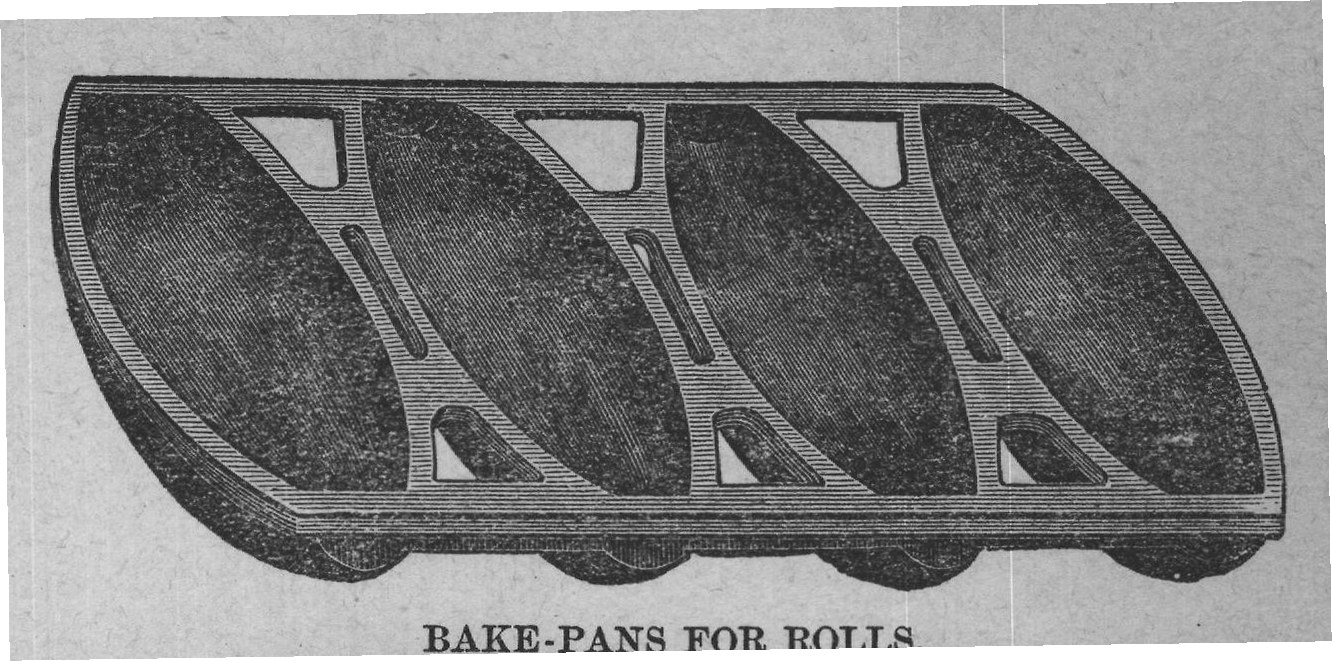
THREE-FOURTHS of a pound of sugar; one-half pound of butter; one pint of sweet milk; five eggs; three and a half pounds of flour. Beat the eggs very light. put milk, sugar and butter together over the fire till the butter is melted; when cooled, add onehalf pint of yeast, then the eggs and flour. Mix quickly and set to rise. Mould by hand in round cakes, about half an inch in thickness. The cakes should be placed in the pan in a double layer-one cake on top of another.
A sweetened, enriched flatbread built on a piece of already-risen bread dough — the sort of thing made on baking day from whatever sponge was in the crock. The page also carries stray text from neighboring entries and an illustration caption for a $1,100 cottage; the coffee bread proper ends at "hot coffee and cream."
- Hop-yeast doughHop yeast was a home-brewed leaven kept going in a jar; the "dough" here is simply risen bread dough made with it. Use any plain risen white bread dough at the end of its first rise — perhaps three-quarters of a pound, though the original gives only a cup measure.
- TeacupsA period teacup is variously reckoned anywhere from about 4 to 8 fl oz, so the measure is loose; and here it is measuring dough by volume, not liquid, so treat "two teacups" as an approximate quantity of dough rather than a precise cup measure.
- Working the doughThis is the hinge. Eggs, sugar and butter added to finished dough will make it slack and slippery before they are absorbed; keep kneading past the point where it looks hopeless, five to eight minutes, until it comes back together and pulls cleanly from the bowl.
- "Bake quite slowly"The recipe names no temperature; a slow oven is usually reckoned at roughly 300–325°F. The sugar on top scorches long before an enriched dough of any thickness is cooked through, so the slow oven looks deliberate.
- Thickness and panThe recipe says only to roll it out onto a buttered tin, without a thickness or a pan size; about half an inch on a rectangular tin works. Thinner gives a crisper sheet; thicker needs a longer, still-slow bake.
- The second rise"Set to rise" means a full proof after shaping — 45 minutes to an hour in a warm room, until visibly puffed. Enriched, sugared dough rises more sluggishly than plain bread, so judge by the dough and not the clock.
- ToppingSoft butter dabbed over the risen dough, then sugar and cinnamon; melted butter will pool and slide off. Coarse or pearl sugar holds its shape better than fine white.
- Timing and yieldThe original gives no time; expect roughly 25 to 35 minutes at about half an inch thick, and cut the sheet into squares to serve.
Coffee bread is one English name used in nineteenth-century American cookbooks for sweetened yeast sheets of the sort associated with German and Scandinavian immigrant households (Kaffeekuchen, kaffebröd). Its logic is thrift: it starts from dough already made for the day's loaves, so the cook pays only for the eggs, butter and sugar worked into it. The hop yeast it depends on was a domestic product, a hop-and-potato or hop-and-flour ferment kept alive on a shelf, of a kind that packaged compressed yeast gradually displaced over the later part of the century. The closing instruction to dip it in hot coffee and cream suggests the bread was meant to be softened in the cup.