Home › Ice Creams, Etc › Corn Soup
Corn Soup
Take eight large ears, cut off the grains and scrape the cobs. Cover this with water, (not too much) and boil until perfectly done. Add two quarts of milk, let it come to a boil; stir in two tablespoonruis of butter rolled in a tabiespoonful of flour, let the whole boil ten minutes; have ready the yolks of three eggs well beaten, pour the soup on them, stirring hard all the time. Serve immediately after seasoning to taste.
Pea Soup. This may be made with any meat. It is generally made with a fowl. Take half of a fried or broiled chicken and simmer for two and a half hours in a gallon of water and with a quart of clean shells of green peas. Strain through a colander and thicken with two tablespoonfuls of flour, one cup of cream; to be cooked half an hour before serving. A quart of green peas may be cooked with the soup, and when done, mashed and returned to the soup.
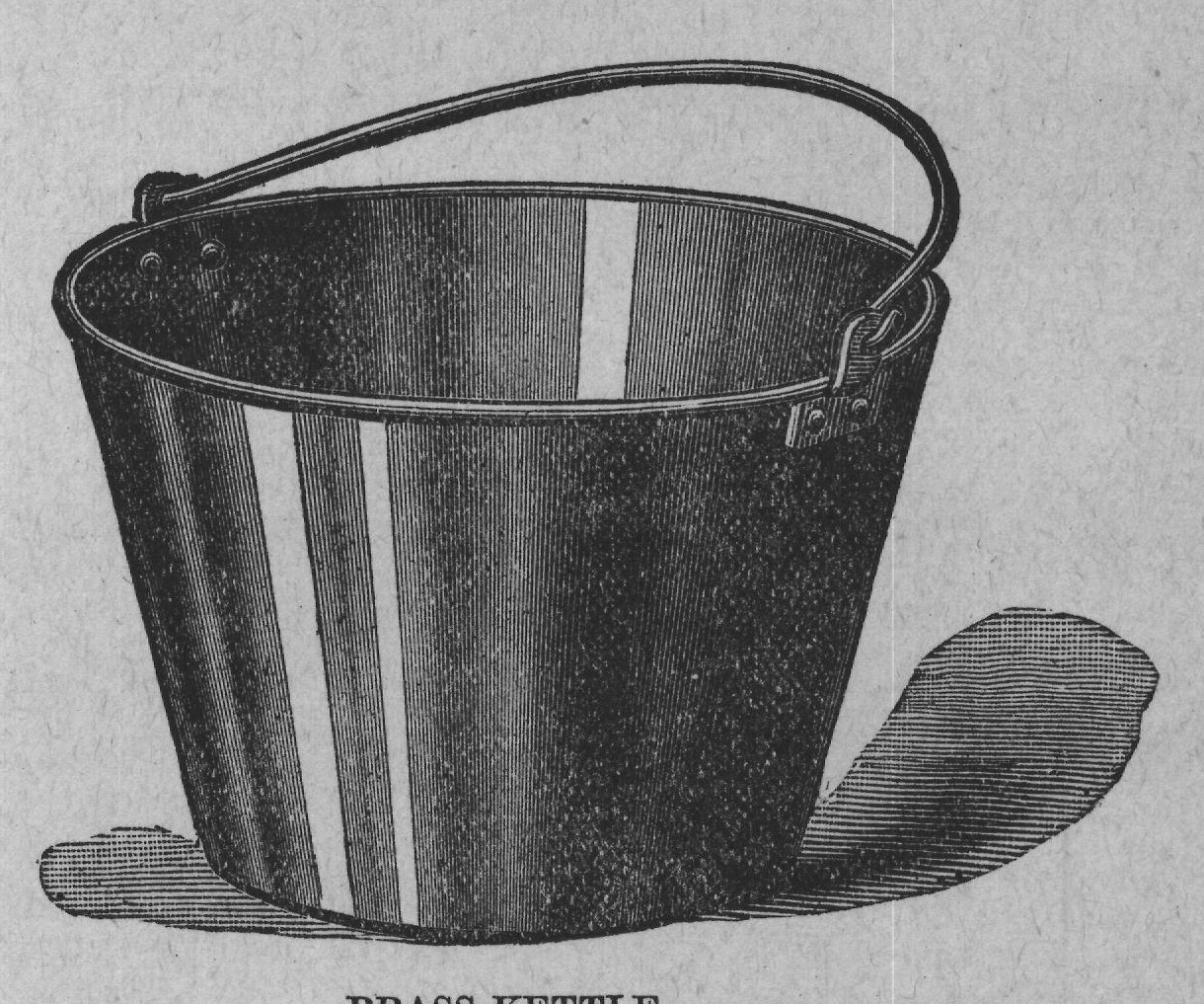
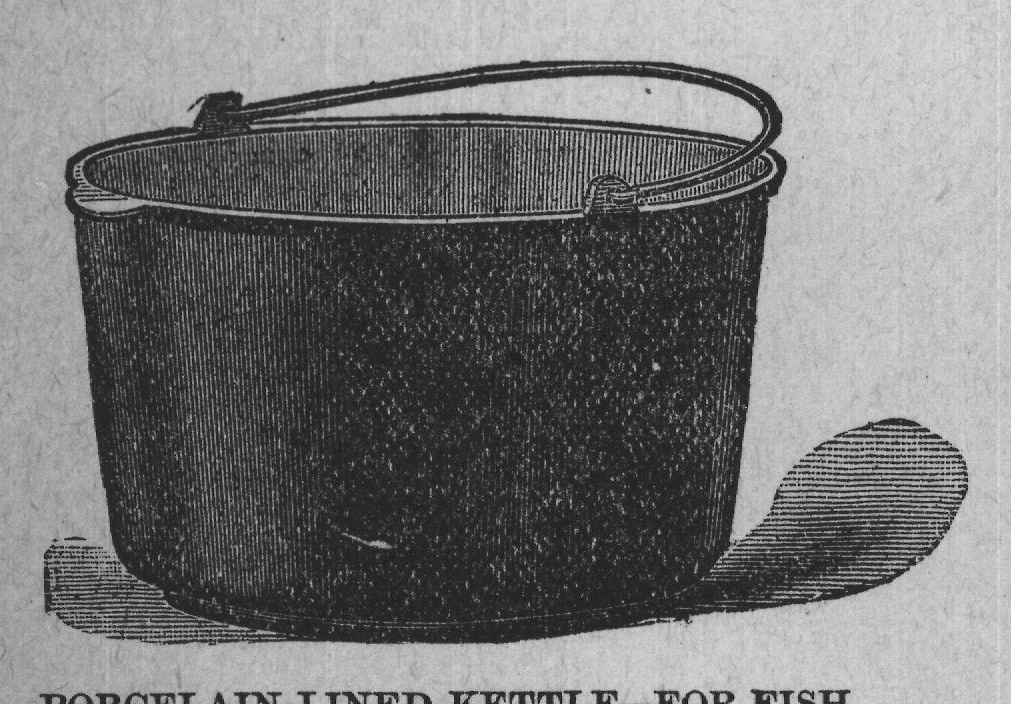
Two soups run together here, both built on the sweetest part of a summer vegetable — the milky pulp scraped from corn cobs, and the pods usually thrown away when shelling peas. The stray capitals ("PORCELAIN-LINED KETTLE-FOR FISH", "BRASS KETTLE") are captions from engravings on the same page, not instructions.
- The hinge: the yolksOnce the beaten yolks go in, the soup must not return to a boil or it will curdle into scrambled egg. Pull the pan off the heat, ladle a cup of hot soup into the yolks while whisking, then return that mixture to the pot and hold it below a simmer.
- Scraping the cobsCut the kernels off, then run the back of a knife down each cob to press out the starchy liquid. That scraping supplies much of the thickening and a good deal of the flavor; without it the soup is thinner and merely sweet.
- Eight large earsRoughly 4 to 6 cups of kernels. Modern sweet-corn hybrids are sweeter than the varieties grown a century ago, so season assertively with salt and white pepper to keep the soup from reading as dessert.
- Milk and scorchingTwo quarts of milk in a thin pan will catch on the bottom. Use a heavy-bottomed pot, scald the milk separately if you like, and stir the base while the milk goes in.
- "Butter rolled in flour"A beurre manié — 2 tablespoons butter worked into 1 tablespoon flour with the fingers and dropped into the simmering soup in small lumps. Ten minutes of boiling after it goes in is needed to cook out the raw flour taste.
- YieldAbout 3 quarts, serving eight to ten as a first course.
- The pea soupA quart of pod shells simmered with half a chicken is a pod stock; strain it hard, pressing the solids, then discard them -- the pods are too fibrous to serve. Two and a half hours at a bare simmer, not a rolling boil, keeps it clear.
- Half a fried or broiled chickenThe bird goes in already cooked, not raw, so leftovers will serve. A gallon of water will reduce considerably over two and a half hours; expect roughly two to three quarts of finished soup.
Corn soups thickened with the scrapings of the cob belong to a family of American dishes whose technique is generally traced to Native cooking, where green corn was grated or scraped rather than served on the cob; the same scraped pulp gives corn pudding and the older "green corn" fritters their body. The egg-yolk liaison at the end follows continental European practice and suggests a dish for company rather than everyday fare. The pea soup that follows shows the other face of the same kitchen: pea pods and half an already-cooked chicken, both of which might otherwise have been thrown out, stretched into a gallon of soup.