Home › Cake-Making › Turk's-Head Cake-Mould
Turk's-Head Cake-Mould
VII. Fruit Cake-Dark.
THE quantity of fruit is according to how rich the cake is to be made. The proportions for a rich, dark cake may be: Two pounds of raisins (stoned), two pounds of currants, one pound of almonds (blanched), one pound of citron or candied peel and fruit, one pound of moist sugar, one pound of butter, one pound of flour, one dozen eggs, one teaspoonful of mace, one tablespoonful of cinnamon, one nutmeg, one wineglassful of brandy, and one of wine. The fruit should be cut up rather coarse, and the almonds in not more than three pieces. Roll the fruit in flour to separate it, reserving some almonds and citron for sticking in the top of the cake, but entirely out of sight. Beat the fruit into the eggs after they have been perfectly whisked; also the butter and sugar after they are creamed together. Let the rest of the flour be lightly stirred in just before putting the cake to rise. Put embers under it, and let it rise for three hours. Bake slowly for three hours, or until, by trying with a straw, you find it quite done. When taken from the oven, let the cake stand in the pan at least two hours, or if it is very large, leave it in a warm place all night. It will then be ready for frosting, and will keep indefinitely in a dark, cool place. The pan in which it is baked must be lined with buttered white paper. The white paper is also used for pound cake.
VIII. Rich Pound-Cake.
TAKE one pound each of white sugar, butter, and flour; ten eggs, a wineglassful of brandy, half a nutmeg, and a teaspoonful of vanilla or essence of lemon. Beat the sugar and butter to a cream, whisk the eggs to a froth, and beat all the ingredients together until perfectly light. Bake in a moderately heated oven an hour. Turn the cake out of the tin, invert it, and set the cake on the bottom to cool. Put on the frosting when cold.
Cocoanut Pound-Cake. This is made with one pound of sugar, half a pound of butter, one teacupful of fresh milk, one pound of flour, one cocoanut grated, four eggs, the peel of half a lemon grated, or half a teaspoonful of essence of lemon, and a teaspoonful of carbonate of soda. Make as directed for pound-cake, but put in the cocoanut last. Bake in buttered tins, the cake-batter being put in an inch deep. The heat should be rather quick, and the cake is to be iced as directed for fruit cake.
Three cakes in one entry, all built on the English pound-cake principle of equal weights and a great deal of egg. The measurements are by weight, which makes them easy to follow with a scale and nearly impossible to follow with cups.
- Scale of the fruit cakeTwo pounds of raisins, two of currants, and a pound each of almonds and candied peel means roughly six pounds of fruit and nuts against one pound of flour. That is around ten pounds of batter, enough for two 9-inch round tins or one very large mould, and it will not fit an ordinary cake pan.
- Moist sugarNineteenth-century "moist sugar" is soft, partly refined brown sugar. Light or dark brown sugar is the direct equivalent; the darkness of the cake comes from it and from the fruit rather than from any added colouring.
- Wineglassful and teacupfulA wineglass in these books is about 2 fluid ounces, a quarter cup. The teacupful in the coconut cake is smaller than a modern measuring cup, roughly three-quarters of one.
- Carbonate of sodaBaking soda, and in the coconut cake it is the only leavening besides the eggs. With no acid ingredient other than a little milk it does very little; a teaspoon of baking powder is what a modern cook would reach for.
- Oven temperaturesThe book gives no figures, so these are approximations only: "bake slowly" for the fruit cake is roughly 300F, "a moderately heated oven" for the pound cake around 350F, and the "rather quick" heat for the shallow coconut layers hotter still, perhaps 400F or so. The fruit cake at 300F may need longer than the stated three hours; go by the straw.
- Embers, and the three-hour riseThe direction appears to belong to hearth and brick-oven baking, the filled pan standing in gentle bottom heat. What "rise" means here is unclear, since the batter contains no yeast. A modern cook would do better to bake the batter as soon as it is mixed.
- Buttered white paperParchment, cut to line base and sides and standing an inch or two above the rim. On a cake this size wrap the outside of the tin in a double collar of paper or foil as well, or the fruit at the edges will scorch long before the centre sets.
- Keeping"Keeps indefinitely" is optimistic but not far wrong for a cake this rich, provided it is wrapped closely and stored cool and dark. The brandy and wine act as preservative as much as flavouring, though this recipe gives no instruction to feed the cake with more spirit.
- FrostingThe recipe does not say what icing is meant; a hard icing of egg white and powdered sugar is the likeliest reading, and would account for the reserved almonds and citron being set in the top "entirely out of sight."
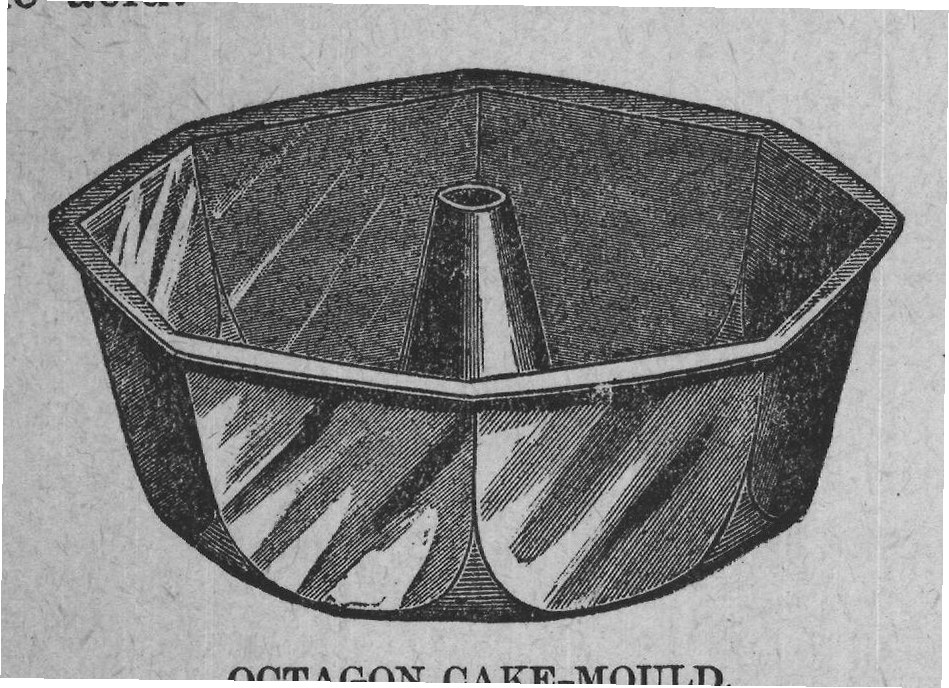
The dark fruit cake described here is the English plum cake in its American form: currants, raisins, citron, mace and nutmeg bound with a pound each of butter, sugar and flour, the proportions that gave pound cake its name and that are often said to have shaped much rich cake before chemical leavening became common. Cakes on this scale were occasion baking, made for weddings, Christmas and christenings, and the instruction to hide almonds and candied peel beneath the icing belongs to that ceremonial tradition. The Turk's-head mould of the section heading is a deep fluted pan with a swirled, turban-like profile, generally regarded as an ancestor of the modern bundt tin; the octagon mould named at the start of the entry is another of the patterned pans in which such a cake might be baked.