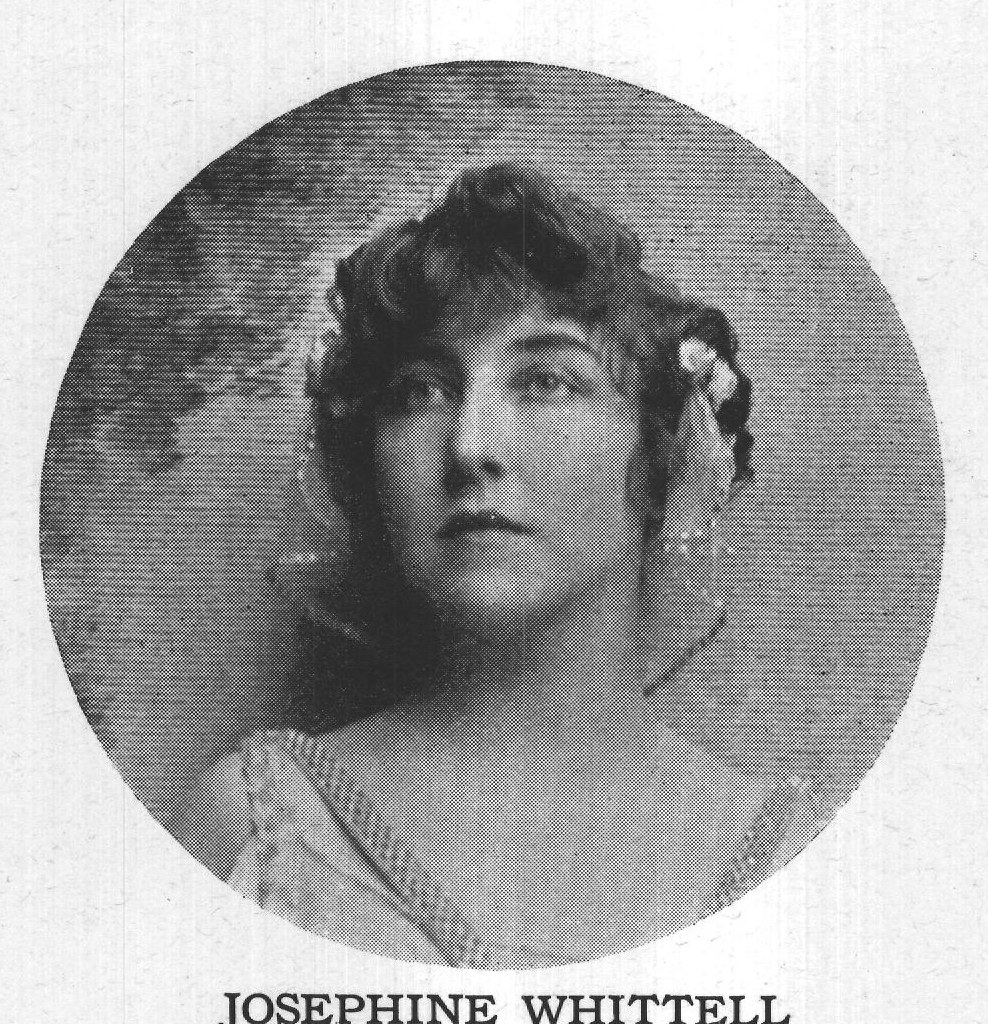
Josephine Whittell

ELEANORA DE CISNEROS
ROEDE GRITZE
One quart red currants. Boil in one cup hot water, strain and add two cups sugar, one tablespoon corn starch. Dissolve the corn starch first in cold water. Cook all together, pour in mold, place on ice.
Serve with plain cream or custard sauce.
Josephine Whittell
CHARLOTTE RUSSE
Soak a half package of Knox gelatine in pint of milk ten minutes. Place over fire and stir until gelatine is dissolved. Remove and when nearly cold beat thoroughly with egg beater. Flavor one quart of cream with a large teaspoon of extract of vanilla and one wineglassful of wine or brandy, with fine sugar to taste. Pour the two mixtures together and whip thoroughly again. Pour into molds lined with lady-fingers and put to cool. Trim with Maraschino cherries before serving. "'Twas caviar to the million."
Two contributions on one page: a red currant pudding of the Scandinavian-German type, and a moulded Charlotte Russe. Both are set desserts, and both depend on getting the setting agent right.
- "Roede Gritze"The name is a phonetic rendering of Danish rødgrød / German rote Grütze, red groats. Traditionally thickened with semolina or sago; the cornstarch here is the American shortcut.
- A quart of currantsRoughly 1¼ lb / about 550 g of fresh red currants, stems and all. Frozen currants work; thaw and use the juice. Straining after boiling removes skins and seeds, so no need to stem them first.
- One tablespoon of cornstarch is lightFor roughly three cups of sweetened juice that gives a soft, spoonable set rather than a sliceable mould. If you want it to turn out of a mould cleanly, expect to use two tablespoons or more; the original is closer to a thick sauce.
- Cook the starch outBring the juice to a full boil for a minute after the slurry goes in, stirring. Cornstarch thickens before it loses its raw taste.
- "Place on ice"The refrigerator. Four hours for the currant pudding, overnight for the Charlotte, which needs the gelatine fully set before unmoulding.
- "Half package of Knox gelatine"Genuinely ambiguous. Knox was sold both as single envelopes and as boxes of four; half a modern envelope (about 1 tsp / 3.5 g) will not set a pint of milk plus a quart of cream. For that volume you want two full envelopes, about 14 g.
- Dissolving the gelatineSoak in the cold milk, then warm gently only until no grains remain on the back of a spoon. Boiling weakens gelatine's setting power. Cool it to barely warm before it meets the cream, or it will seize into threads.
- A wineglassfulAbout two fluid ounces, a quarter cup, of sherry, Madeira or brandy. That much alcohol in a quart of cream is noticeable but not overwhelming.
- Whipping and volumeWhip the cream to soft peaks only; the gelatine does the setting. A quart of cream roughly doubles when whipped, and the pint of gelatine milk goes in on top of that, so line two large moulds or a dozen individual ones with the ladyfingers, trimmed flat at the base so they stand upright.
- YieldThe currant pudding serves six; the Charlotte, as written, serves twelve to sixteen.
Charlotte Russe is generally traced to Antonin Carême in the early nineteenth century, a cold cream set in a wall of ladyfingers and named, by tradition, for the Russian court he served; by 1900 it was a fixture of American hostess cookery, and in the twentieth century it could be bought by the cup from New York bakeries. The red currant pudding beside it belongs to a different world entirely, the Danish and North German rødgrød that arrived with immigrant kitchens and was written down as best the ear could manage. Their appearance side by side in a cookbook of contributed recipes from performers is the point of such books: contributors were asked for whatever they actually made or remembered. The closing tag, "'Twas caviar to the million," echoes Hamlet's "caviare to the general" — a dish too fine for the crowd.