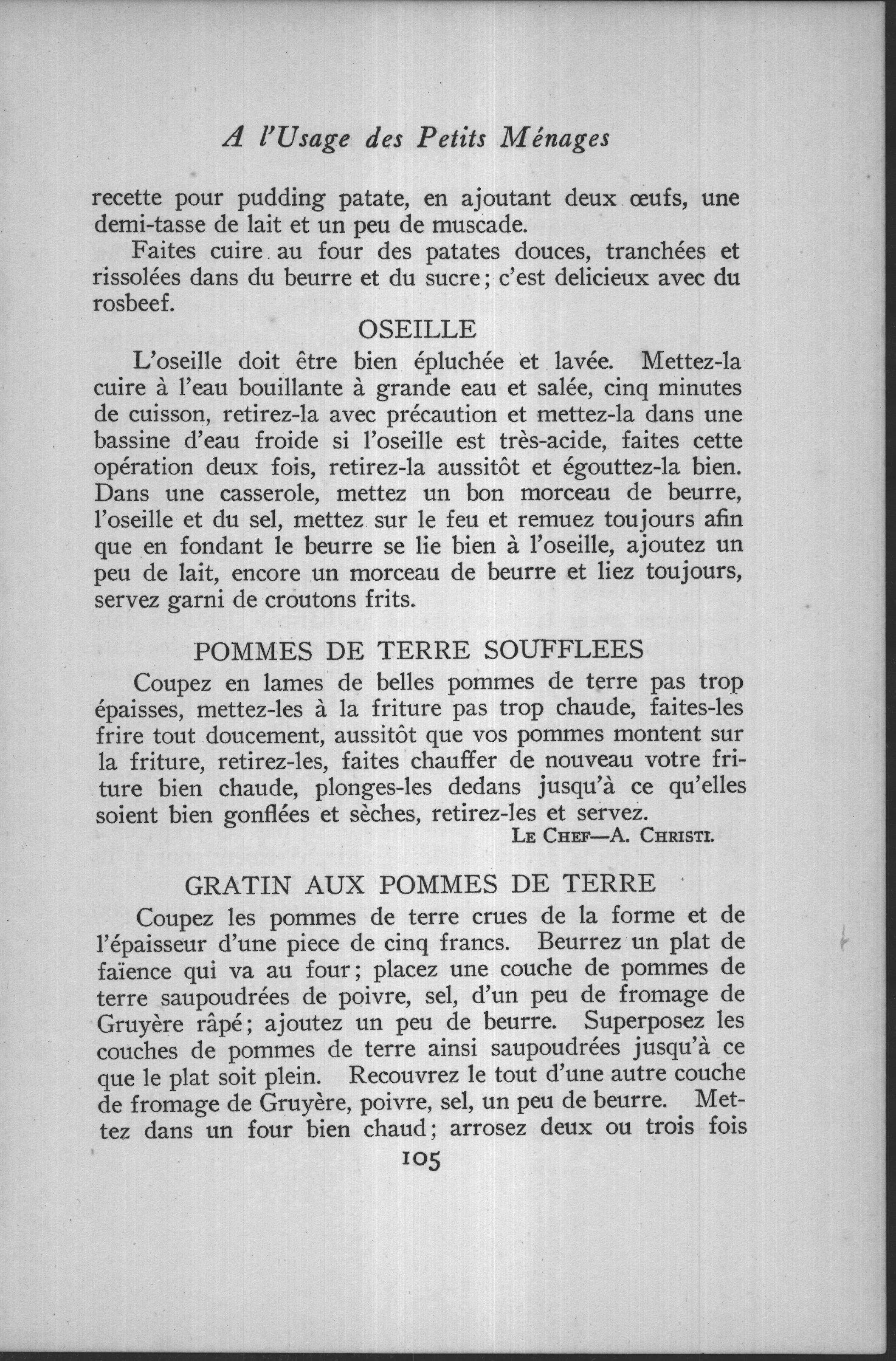
Pommes de Terre Soufflees
Le Chef—A. Christi
Coupez en lames de belles pommes de terre pas trop épaisses, mettez-les à la friture pas trop chaude, faites-les frire tout doucement, aussitôt que vos pommes montent sur la friture, retirez-les, faites chauffer de nouveau votre friture bien chaude, plonges-les dedans jusqu'à ce qu'elles soient bien gonflées et sèches, retirez-les et servez.
The magic trick of the potato world — thin slices fried twice so they puff into crisp, hollow pillows.
- Two fries, two temperaturesThis is the whole secret. Fry the slices gently first, at a lower heat (about 300°F/150°C), let them rest, then plunge into very hot oil (375–400°F/190–205°C) to make them balloon.
- Why they puffThe cool first fry cooks the interior and sets a skin; the hot second fry flashes the moisture inside to steam, which inflates each slice into a hollow puff.
- Cut them evenlySlice a firm potato an even ⅛ inch thick — too thin or too thick and they won’t inflate. Uniformity matters more than anything.
- Dry the slicesPat the slices thoroughly dry before the first fry; surface water fights the puff and spatters in the oil.
- Expect some dudsEven in a good kitchen not every slice inflates — the successes are worth it. Salt and serve at once.
Pommes soufflées come with one of French cooking’s favorite origin legends. As the story goes, a chef awaiting guests for the 1837 opening of the Paris–Saint-Germain railway dropped his fried potatoes back into the oil when the train ran late; refried, they puffed up, and a classic was born. Like most such tales it’s impossible to verify and probably too tidy to be wholly true — but the double-fry science it describes is exactly right, which is perhaps why the story has lasted so well. This version is credited to a chef, A. Christi.
From page 105 of the 1904 edition.
Original page from the book