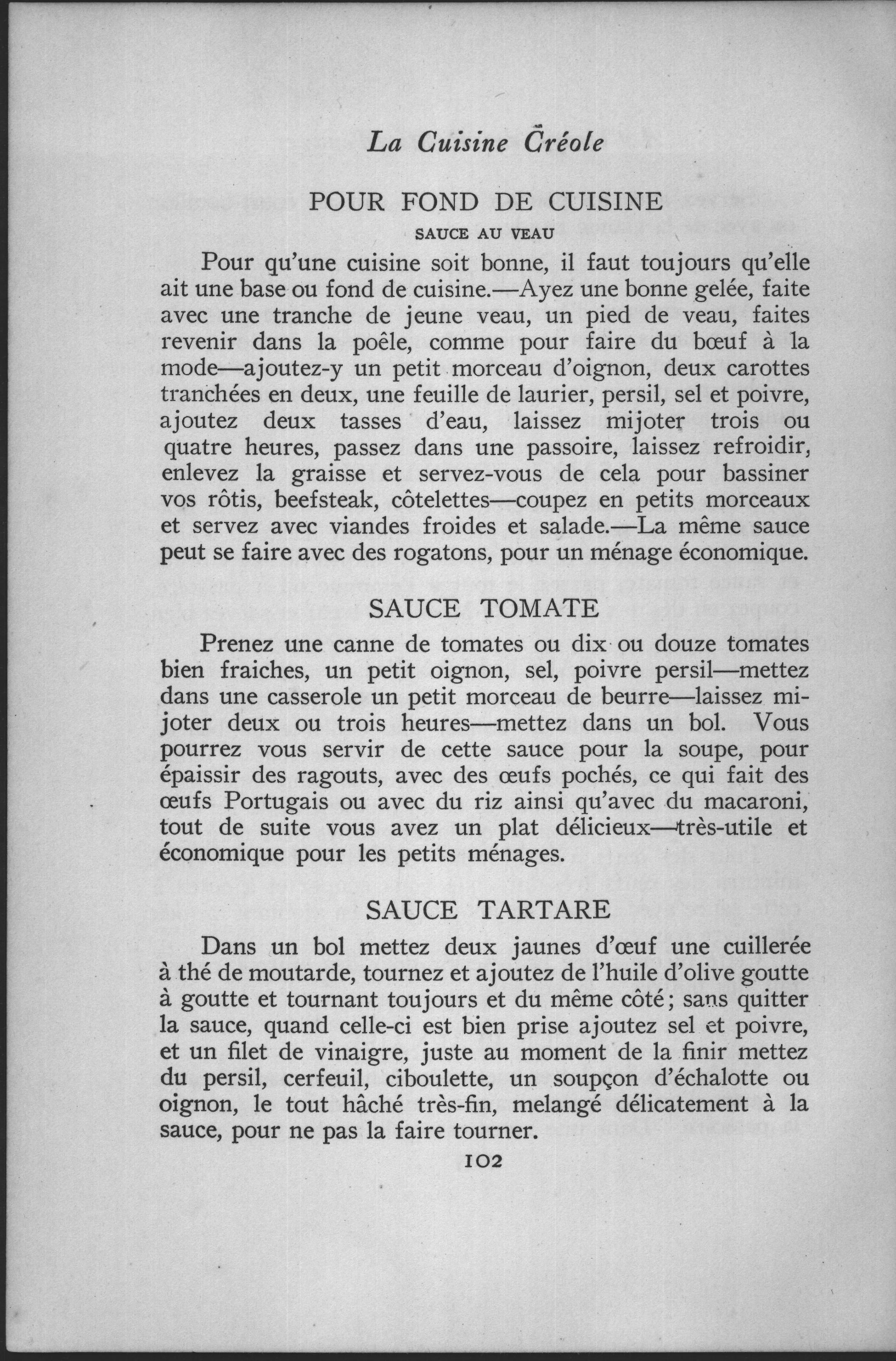
Sauce Tomate
Prenez une canne de tomates ou dix ou douze tomates bien fraiches, un petit oignon, sel, poivre persil—mettez dans une casserole un petit morceau de beurre—laissez mijoter deux ou trois heures—mettez dans un bol. Vous pourrez vous servir de cette sauce pour la soupe, pour épaissir des ragouts, avec des œufs pochés, ce qui fait des œufs Portugais ou avec du riz ainsi qu'avec du macaroni, tout de suite vous avez un plat délicieux—très-utile et économique pour les petits ménages.
A thrifty, do-everything tomato sauce — and proof that by the 1880s the canned tomato had already earned a place in the Creole pantry.
- “Une canne de tomates”That’s a can of tomatoes (an Americanism creeping into the French) — today a 14–28 oz can — or 10 to 12 fresh tomatoes when they’re in season.
- Long, slow reductionTwo to three hours at a gentle simmer cooks off the raw edge and thickens the sauce; stir now and then so it doesn’t catch.
- “Œufs Portugais” decodedPoach eggs right in the sauce and you have the dish the recipe names — eggs Portuguese, a close cousin of what we’d call eggs in purgatory.
- Simple enrichmentA knob of butter and one small onion are the only richness; salt, pepper and parsley finish it.
- Sauce, base, or supperUse it to thicken stews and soups, over rice or macaroni, or spooned onto poached eggs — a genuinely economical workhorse.
When this book appeared, commercial canning was transforming the American kitchen. Tomatoes were among the first vegetables put up at scale after the Civil War, and by the 1880s a “can of tomatoes” was a cheap, year-round staple — which is exactly why a Creole cook could reach for one in a recipe. The tomato itself had taken generations to shed its reputation as a suspect nightshade; here it is utterly domesticated, the humble backbone of soups, sauces and a quick supper of eggs.
From page 102 of the 1904 edition.
Original page from the book