Sally Lunn
Lauderdale, Virginia
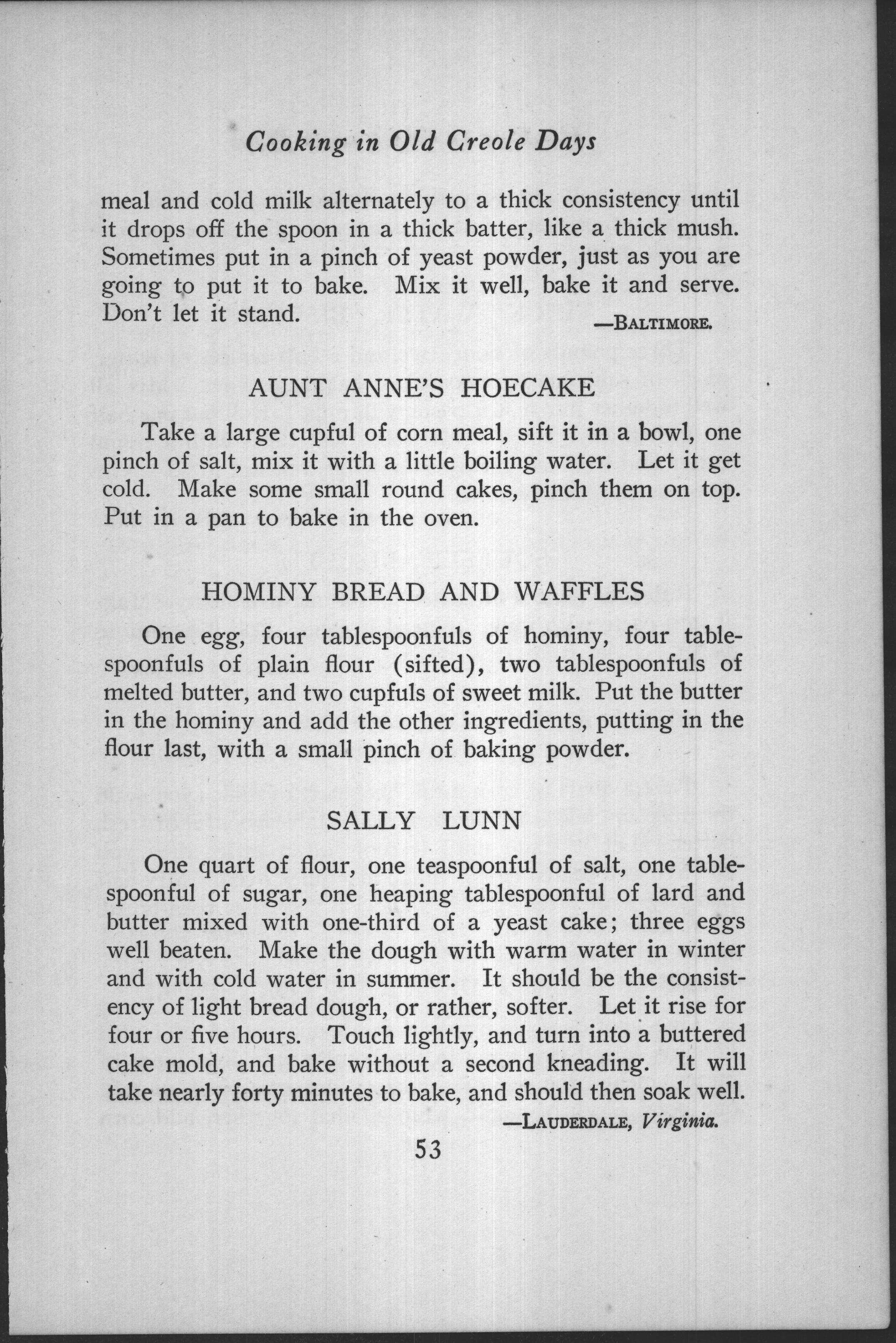
One quart of flour, one teaspoonful of salt, one tablespoonful of sugar, one heaping tablespoonful of lard and butter mixed with one-third of a yeast cake; three eggs well beaten. Make the dough with warm water in winter and with cold water in summer. It should be the consistency of light bread dough, or rather, softer. Let it rise for four or five hours. Touch lightly, and turn into a buttered cake mold, and bake without a second kneading. It will take nearly forty minutes to bake, and should then soak well.
A rich, yeast-raised tea bread — closer to a plain brioche than a quick bread, and worth the long rise.
- “One quart of flour”That’s about 4 cups of flour.
- “One-third of a yeast cake”A cake of yeast was roughly one modern packet, so a third is about ¾ tsp active dry yeast; proof it in the warm water.
- Water temperatureThe winter/summer note is about dough warmth — aim for lukewarm liquid (about 100–110°F) either way to wake the yeast gently.
- Bake in a tube or Bundt panThe traditional “cake mold” is a fluted or tube pan; butter it well and bake at about 350°F for the 40 minutes.
- “Should soak well”An old baker’s term: leave the loaf a little longer in the falling oven heat so the dense center finishes cooking through before you turn it out.
Sally Lunn is one of those breads whose name carries a legend that history can’t quite confirm. By tradition it honors a young woman — often placed in 18th-century Bath, England — who sold rich, round buns in the streets; but no such baker can be documented, and many suspect the name is an English reshaping of the French sol et lune, “sun and moon,” for the golden top and pale crumb. However it got its name, the buttery, egg-enriched loaf crossed the Atlantic and became a cherished fixture of the Virginia tea table.
From page 53 of the 1904 edition.
Original page from the book