Home › C › Calf's Feet, Boiled, and Pars- ley and Butter
Calf's Feet, Boiled, and Pars- ley and Butter
INGREDIENTS for dish for 4 or 5 persons.-2 calf's feet, 2 slices of bacon, 2 oz. of butter, 2 tablespoonfuls of lemon-juice, salt and whole pepper to taste, 1 onion, a bunch of savoury herbs, 4 cloves, 1 blade of mace, water, parsley and butter.
AVERAGE COST, 2s.
Procure 2 white calf's feet; bone them as far as the first joint, and put them into warm water to soak for 2 hours. Then put the bacon, butter, lemon-juice, onions, herbs, spices and seasoning into a stewpan; lay in the feet, and pour in just sufficient water to cover the whole. Stew gently for about 3 hours; take out the feet, dish them and cover with parsley and butter.
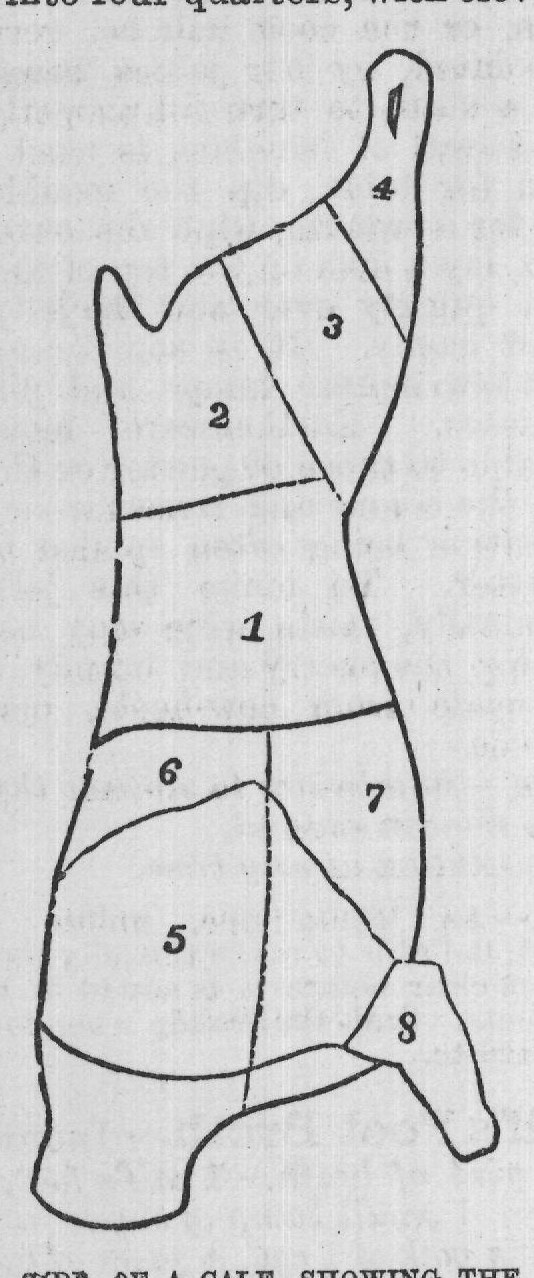
The liquor they were boiled in should be strained and put by in a clean basin for use: it will be found very good as an ad- 2. The chump, consisting of the rump dition to gravies, &c. and hock-bone. 3. The fillet. 4. The hock, or hind knuckle.
Fore Quarter:- 5. The shoulder. 6. The neck. 7. The breast. 8. The fore knuckle.
The several parts of a moderately-sized well-fed calf, about eight weeks old, are nearly of the following weights:-loin and chump 18 lbs., fillet 12 lbs., hind knuckle 5 lbs., shoulder 11 lbs., neck 11 lbs., breast 9 lbs., and fore knuckle 5 lbs.; making a total of 144 lbs. weight. The London mode of cutting the carcase is considered TIME. Rather more than 3 hours.
SEASONABLE from March to October.
A slow braise of calf's feet, served hot under parsley sauce, with the gelatinous cooking liquor saved as stock. Nothing here is difficult, but the raw material now needs ordering ahead.
- Sourcing the feetCalf's feet are a butcher's order rather than a supermarket item; ask for them split lengthwise and cleaned. Pig's trotters are the usual substitute and behave much the same, though they are fattier and give a stronger flavour.
- "Bone them as far as the first joint"This means removing the long leg bones up to the ankle joint, leaving the foot itself intact so it holds its shape. A butcher will do it if asked; otherwise the feet can be cooked whole and boned after stewing, when the bones slip out easily.
- The soak mattersTwo hours in warm water helps draw out blood and loosen any remaining hair or scurf. The recipe gives no reason for it, but it is a sensible step if the liquor is to be kept and used.
- Keep it at a bare tremble"Stew gently" is the hinge. A rolling boil emulsifies the fat into the liquor and turns it opaque and greasy; you want the surface barely shivering rather than boiling, for the full three hours until the feet are yielding but not collapsing.
- Parsley and butterIn Beeton this is a specific preparation, not just melted butter with herbs in it: a plain white sauce or thickened butter sauce with a good quantity of blanched, chopped parsley stirred in at the end. Make it while the feet finish so it goes on hot.
- Whole pepper, blade of maceWhole peppercorns (the recipe leaves the amount to taste; a teaspoon or so is reasonable) and one blade of mace, which is the dried aril that wraps the nutmeg seed, sold in flat shards; about a quarter teaspoon of ground mace stands in. Tie them with the cloves and herbs in muslin so they can be lifted out.
- The saved liquorStrained and chilled, it sets to a firm jelly, and the fat lifts off the top in a solid cap. It keeps three or four days refrigerated, freezes well, and is the same gelatine-rich base once used for aspic and for enriching gravies.
- Yield and costThe original serves four or five as a modest hot dish; served with plain boiled potatoes it is closer to three. "Average cost, 2s." is a mid-Victorian price and carries no useful meaning now.
Calf's feet earned their place in Victorian cookery books less as a dish than as a raw material: boiled down they gave calf's-foot jelly, the standard restorative fed to invalids and convalescents throughout the nineteenth century, and the household source of gelatine before packaged leaf and powdered gelatine became cheap and reliable. Serving the boiled feet themselves under parsley and butter, and keeping the liquor for the stockpot, is the thrifty logic that runs through the whole of Beeton: the same three hours on the stove produces a dinner and a week's worth of gravy base. The seasonable note, March to October, is given without explanation in the recipe itself, though it is often supposed to reflect the old calving year, when veal was plentiful; the reference to "the London mode of cutting the carcase" points to the fact that butchery differed markedly from city to city, and a housekeeper needed to know which set of names her own butcher used.