Carrots, Boiled
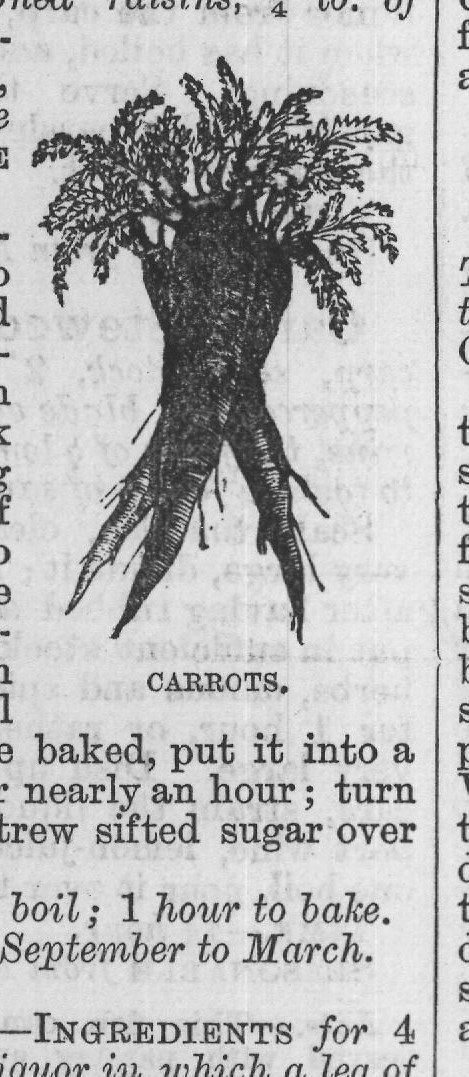
INGREDIENTS.- To each 1/21 gallon of water, allow one heaped tablespoonful of salt; carrots. AVERAGE COST, 6d. for large bunch.
Cut off the green tops, wash and scrape the carrots, and should there be any black specks, remove them. If very large, cut them in halves, divide them lengthwise into four pieces, and put them into boiling water, salted in the above proportion; let them boil until tender, which may be ascertained by thrusting a fork into them: dish, and serve very hot. This vegetable is an indispensable accompaniment to boiled beef. When thus served, it is usually boiled with the beef; a few carrots are placed round the dish as a garnish, and the remainder sent to table in a vegetable-dish. Young carrots do not require nearly so much boiling, nor should they be divided: these make a nice addition to stewed veal, &c.
TIME.-Large carrots, 1 to 2¼ hours; young ones, about 1/2 hour.
SEASONABLE. -Young carrots from April to July, old ones at any time.
A plain boiled vegetable from the era when carrots were expected to sit beside boiled beef. The main thing to adjust is the cooking time, which was written for large, mature winter roots.
- Salt proportionThe measure is printed as "1/21 gallon", almost certainly half a gallon of water to one heaped tablespoon of salt, which is roughly a tablespoon to a little over 2 litres. That is a well-salted but not briny pot, and it is worth keeping.
- TimingModern carrots, even large ones, are tender in 15-25 minutes cut into quarters lengthwise. The long times in the original belong to old field carrots stored through winter, which had woody cores; an hour or more will reduce a supermarket carrot to mush.
- Young carrotsHalf an hour is still too long for slim spring carrots. Whole young carrots take 8-12 minutes in boiling salted water. The instruction not to divide them is sound: less cut surface means less leaching into the water.
- Black specksMost likely fungal spotting or bruise marks in stored roots. Cut them out with the tip of a knife rather than peeling deeply, and discard any carrot that is soft or grey through the middle.
- Scraping versus peelingThe recipe asks for scraping rather than peeling, which suits thin-skinned, freshly pulled carrots. A vegetable peeler is fine, and on very young carrots a scrub is enough.
- Boiled with the beefCooking the carrots in the beef broth is the better version of this dish and still worth doing. Add them for the last 25-30 minutes only, or they will fall apart in the long-simmering pot.
- YieldThe recipe gives no weight, only a price for a large bunch. A large modern bunch will serve four to six as a side.
Mrs Beeton's household books treat the carrot most often as an adjunct to boiled beef, though they also carry carrot soup, stewed carrots and carrots dressed in butter; the beef pairing was near-automatic in Victorian English cooking: the beef pot supplied the liquid, the carrots supplied colour on the platter, and any surplus went to the table in a separate vegetable dish. The distinction she draws between young carrots from April to July and old ones available at any time reflects a real seasonal divide before cold storage and imports flattened it out. Winter carrots were pulled in autumn, clamped in sand or earth, and grew progressively tougher and more fibrous through the season, which is why her boiling times run so long. The recipe's own cost line hints at the pricing: sixpence for a large bunch was ordinary greengrocer's money for a vegetable regarded as plain, cheap and useful rather than a delicacy.