Home › C › Cod's Head and Shoulders
Cod's Head and Shoulders
INGREDIENTS.- Sufficient water to cover the fish; 5 oz. of salt to each gallon of water.
AVERAGE COST, 6d. per lb.
Cleanse the fish thoroughly, and rub a little salt over the thick part and inside of the fish 1 or 2 hours before dressing it, as this very much improves the flavour. Lay it in the fish-kettle, with sufficient cold water to cover it. Be very particular not to pour the water on the fish, as it is liable to break it, and only keep it just simmering. If the water should boil away, add a little by pouring it in at the side of the kettle, and not on the fish. Add salt in the above proportion, and bring it gradually to a boil. Skim very carefully, draw it to the side of the fire, and let it gently simmer till done.
Take it out and drain it; serve on a hot napkin, and garnish with cut lemon and parsley.
TIME. According to size, an hour more or less.
SEASONABLE from November to March.
Note. Oyster or shrimp sauce and plain melted butter should be served with this.
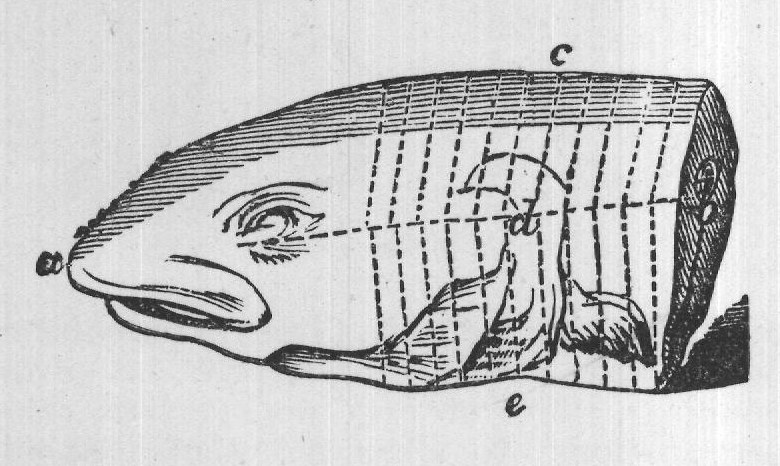
Cod's Head and Shoulders, To Carve. First run the knife along the centre of the side of the fish, namely, from d to b, down to the bone; then carve it in unbroken slices downwards from d to e, or upwards from d to c, as shown in the engraving.
The carver should ask the guests if they would like a portion of the roe and liver.
Note. Of this fish, the parts about the backbone and shoulders are the firmest and most esteemed by connoisseurs. The sound, which lines the fish beneath the backbone, is considered a delicacy, as are also the gelatinous parts about the head and neck.
This is a poached whole fish joint, and the whole recipe hinges on temperature: the water must never reach a rolling boil or the flakes separate and the gelatinous parts around the head break up. Almost everything else is a matter of finding the right vessel and ignoring the stated time.
- The brine proportion5 oz salt to each gallon works out at about 140 g per 4.5 litres, roughly a 3 per cent brine — close to seawater. Salting the thick part an hour or two ahead is a dry brine and does genuinely firm the flesh; do not skip it.
- "Just simmering" means poachingHold the water at 160–170°F (70–77°C), where the surface barely shivers. Beeton's instruction to draw the kettle to the side of the fire is the Victorian way of getting a bare tremble; on a modern hob, the lowest setting plus a diffuser does the same.
- Ignore the hour"An hour more or less" reflects a fish joint far larger than most fishmongers now cut, and a kettle heating from cold on a range. Reckon on about 10 minutes per inch of thickness at the shoulder; a 3 lb head-and-shoulder piece is usually done in 20 to 30 minutes, when the flesh parts cleanly from the backbone.
- No fish kettleA deep roasting tin across two burners works, or a large lidded stockpot if the piece will curl to fit. Lay the fish on a folded strip of muslin or a length of foil with the ends left long, so you can lift it out without breaking it — this is what the kettle's perforated tray was for.
- "Plain melted butter"In Beeton this is not clarified butter but a thin flour-and-butter sauce; her own version is loosened with water, though milk appears in variants. Oyster sauce is the same base with oysters and their liquor stirred in off the heat, no more than a minute or two, or they toughen.
- The head and shoulders themselvesFew counters cut this joint now; it must be ordered. A thick loin section from a large cod poaches the same way, but you lose the sound, the roe and the collar gelatin that the note singles out as the best of it.
- Seasonality and stocksNovember to March was the North Sea cod season, when the fish were in roe. Atlantic cod is now a managed and in places depleted stock; certified cod, or Pacific cod, hake or pollock, all take this treatment.
- YieldA 3 to 4 lb joint serves four to six as a main course, allowing for the head, which is largely bone.
Boiled cod's head and shoulders was a set piece of the English dinner table from the eighteenth century into the early twentieth, and Beeton treats it as one — hence the carving diagram, the hot napkin under the fish, and the carver's duty to offer the roe and liver. Cod came south from the great winter fisheries of the North Sea and the northern grounds, and at sixpence a pound it was affordable but respectable enough to head a table; the head-and-shoulder joint was prized precisely because it held the sound, the collar and the gelatinous flesh around the neck, the parts a modern fillet counter discards. Serving it on a folded napkin was practical as well as decorative: the linen soaked up the water that drains from a poached fish and would otherwise flood the dish. The pairing with oyster sauce belongs to the same period, when oysters were still cheap.