Home › Ice Creams, Etc › Brass Kettle
Brass Kettle
Soup may be made of any hard-fleshed fish. They should be carefully cleaned, skinned and cut into fillets Then cut out of the fillets, with a cutter, as many round pieces, an inch in size, as possible. Put the head, bones, and all the trimmings into a saucepan, with one quart of stock, a large handful of parsley, a piece of celery, one onion stuck with two cloves, a blade of mace, and pepper and salt to taste. Let this boil slowly from three to four hours, skim and strain the liquor, put it on the fire again, and when it boils, put in the cut pieces. When they are cooked, take them out, put them into the soup tureen with a little chopped parsley (blanched); then strain the soup into the tureen, and serve at once.
Eel Soup. This may be made of two pounds of eels, one pound of other hardfleshed fish, a bunch of celery, one onion, six cloves, a bunch of parsley and sweet herbs. Season with a blade of mace, and pepper and salt to the taste. The fish must be skinned as well as the eels, and well cleaned. Cover with a quart of water in the stew-pan, add the pepper and salt, the onion with the cloves stuck in it, the bunch of herbs, the celery cut up and the parsley minced. Let it simmer for an hour and a half, covered close. Then strain. This is stock, and may be thinned as desired. If brown soup is wanted, fry the fish in butter before boiling.
Two related fish soups, printed under headings that belong to a list of cooking vessels rather than to the dishes themselves. The first is a clear fish broth garnished with rounds of poached fillet; the second is an eel-based stock meant as a base.
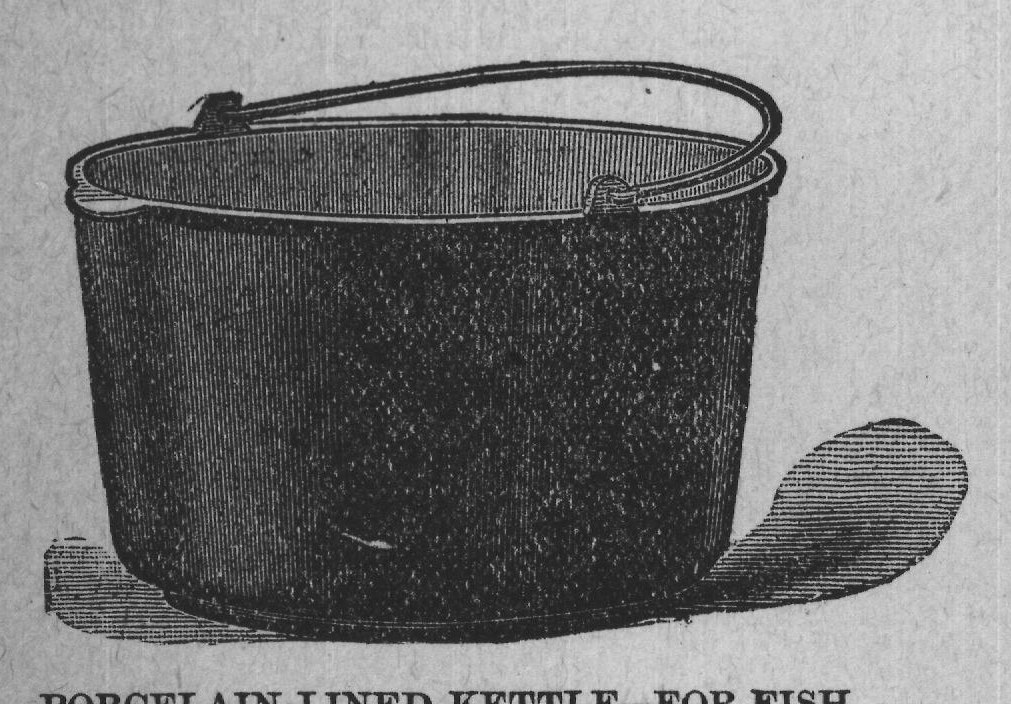
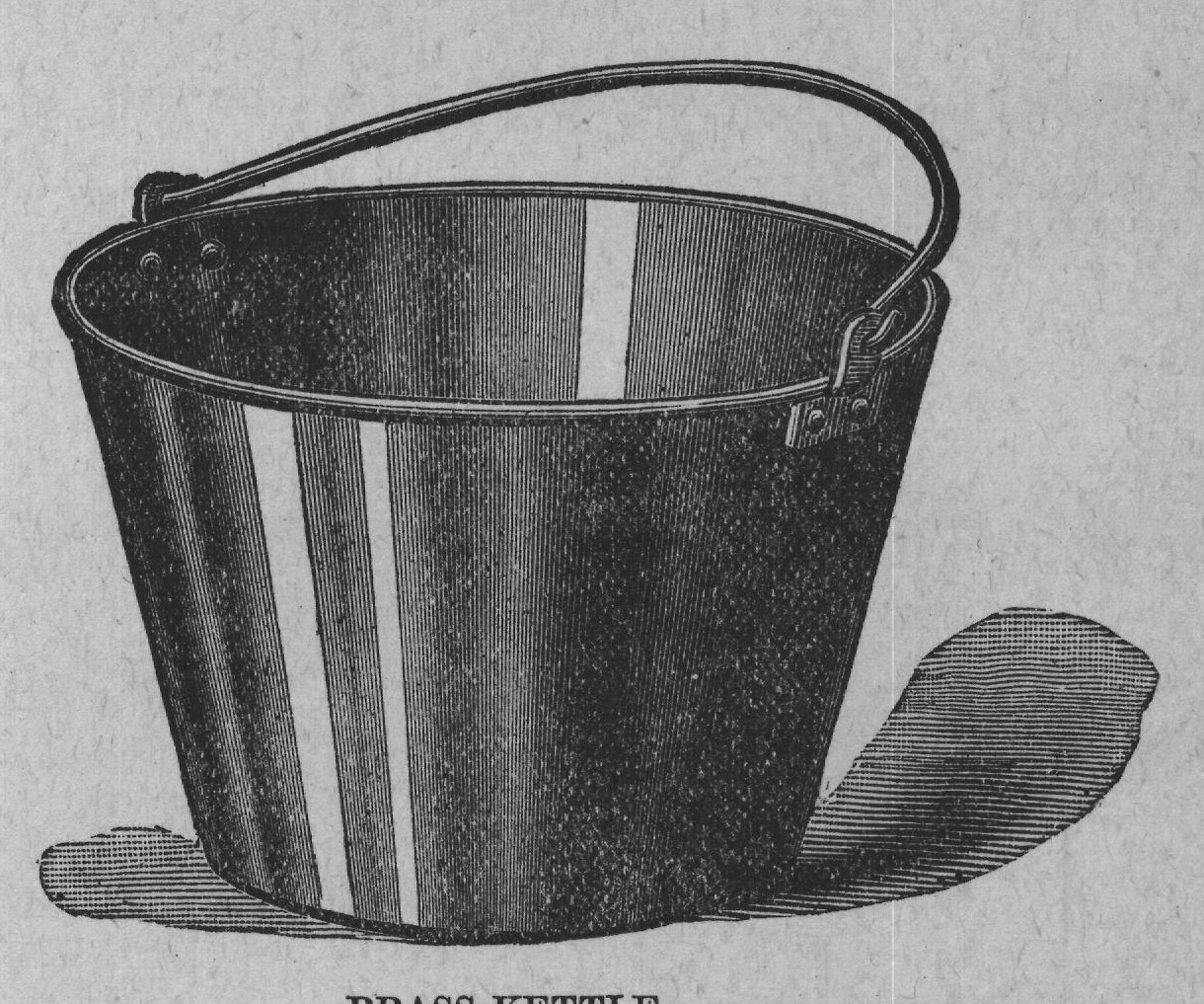
- The headings are vessel notesThe headings are vessel names -- "Porcelain-lined kettle" and "Brass kettle" appear to be stray headings or captions from the book's run of cooking utensils, not part of the method. Fish stock is faintly acidic and can pick up metal from bare copper or brass; use stainless steel or enamel.
- Three to four hours is far too longThis is the one instruction to overrule. Fish heads, bones and trimmings give everything they have in 30 to 45 minutes; past that the stock turns bitter and glue-like from the collagen and small bones. Simmer gently, skim, strain, and stop.
- The poached roundsCut the inch discs from the fillets with a plain round cutter, and drop them into the strained, simmering broth for two to three minutes only, until just opaque. They are done long before they look done, and they toughen quickly.
- A blade of maceOne dried piece of the outer covering (aril) of the nutmeg, sold whole in some spice shops. A scant 1/8 teaspoon of ground mace stirred in near the end is a rough equivalent; its flavour is close to nutmeg but generally reckoned more delicate and pungent, so treat the two as related rather than identical.
- Blanched parsleyChopped parsley dipped in boiling water for a few seconds, then drained. It sets the colour and softens the raw grassy edge, which matters in a clear soup where it is the only garnish.
- Quantities and thinningOne quart of stock or water is the base for both, which yields roughly four modest servings of clear soup. The eel version is explicitly a concentrate: taste before diluting, since a quart reduced under a tight lid for 90 minutes will be strongly flavoured.
- Sourcing eelEel is no longer a common market fish, and European eel in particular is under trade restriction; what is available varies by region and may be farmed or smoked. Fresh eel must be skinned, as the recipe says, and is best bought already cleaned. Any firm-fleshed fish and its bones will make the same style of stock.
- The brown versionFrying the fish in butter before adding liquid gives colour and a nuttier flavour. Do it in the same pot, let the fond build, then deglaze with a little of the water so nothing burns during the simmer.
Clear fish soups of this kind sit at the meeting point of the French kitchen and the Anglo-American household book: the aromatics named here -- onion stuck with cloves, a blade of mace, a bundle of parsley and sweet herbs, a piece of celery -- were common to both English and French practice in the nineteenth century. Eel soup earned its place because eel was cheap, abundant and gelatinous, giving body to a stock without flour or cream, and it was a fixture in river and estuary cooking on both sides of the Atlantic long before overfishing and habitat loss made eel a delicacy. The stray headings "Porcelain-lined kettle" and "Brass kettle" are a reminder of what such books had to teach: with unlined copper and brass still in ordinary use, telling a cook which metal was safe for which food was as practical a matter as the recipe itself.