Home › Some Useful Recipes › Fish and Oyster Pies
Fish and Oyster Pies
Fish, eels and oysters are made into pies. The seasoning for these is generally high, and includes various spices, parsley, thyme, basil and the yolks of hard-boiled eggs. A modification by which these are baked in rich gravy or stock, is generally preferred by American palates. Any fish may be used, but the hard-fleshed fish are preferred.
XXI. Dishes of Eggs.
MANY dishes are made of eggs. Broken in water just simmering, they are called poached eggs.
Fried Eggs. They are fried in hot lard or oil, first being broken into a dish and carefully turned into the frying-pan. While cooking, turn the hot fat over the tops of the eggs with an iron spoon to cook the tops, or turn them and fry both sides if this way is liked. They are nice boiled in the shell, three minutes by the watch, or somewhat less if wished very soft.
Two things are happening on this page: a short descriptive note on fish and oyster pies, which gives no quantities at all, and a genuinely usable set of egg methods. Treat the first as a sketch to work from and the second as instructions.
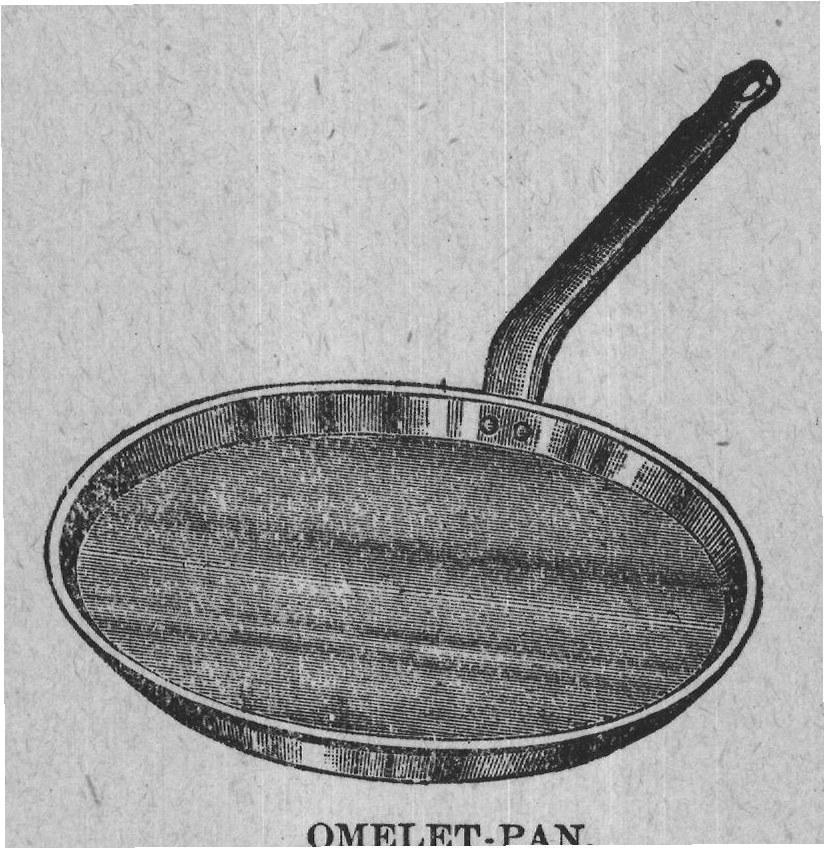
- The stray heading"OMELET-PAN" appears to be a stray caption, most likely from an illustration, that has landed in the text block, as has the chapter heading "XXI. Dishes of Eggs." Neither is part of the instructions.
- The pie is a template, not a recipeNo amounts, no crust, no oven are given. What the passage actually tells you is the flavour profile: a heavy hand with spice, plus parsley, thyme and basil, with hard-boiled yolks worked into the filling. The "modification preferred by American palates" is described only as baking the fish in rich gravy or stock; the text does not say what it is being contrasted with.
- "Hard-fleshed fish"Firm, low-fat white fish that holds its shape in liquid — cod, haddock, halibut, monkfish, hake. Delicate fish such as sole or flounder disintegrates. Eels were a common and inexpensive market fish in the period; they are now expensive and, in the case of European eel, a species of conservation concern.
- Oysters in a pieAdd them raw to the filling shortly before the crust goes on. Oysters need only a couple of minutes of heat; anything approaching a full bake turns them to rubber and weeps liquid into the gravy.
- Frying fatLard gives the flavour the book expects; butter, bacon fat or a neutral oil all work. The technique worth keeping is the basting — spooning hot fat over the tops sets the whites without flipping and leaves the yolk unbroken.
- "Just simmering" for poachingRead this as water barely trembling, around 180-190F, not a rolling boil. A boil shreds the white. A spoonful of vinegar in the water helps it set.
- Three minutes by the watchThe book does not say whether the water is already boiling or what size egg is meant. A modern large egg straight from the refrigerator wants closer to four to five minutes for a runny yolk and set white.
- Raw-yolk eggsThree-minute and "very soft" eggs leave the yolk essentially uncooked. Fine for most people from a reliably sourced egg; worth avoiding for anyone pregnant, elderly, very young or immunocompromised.
This page sits at the seam between two chapters, which is why a note on pies runs straight into a chapter on eggs. The fish-pie passage belongs to a long English tradition of spiced fish and eel pies. Hard-boiled yolks rubbed into a filling are an old thickening trick. The author's remark that Americans prefer the fish baked in "rich gravy or stock" is her own observation; how far it reflects a real divergence in national practice is not something this passage can establish.