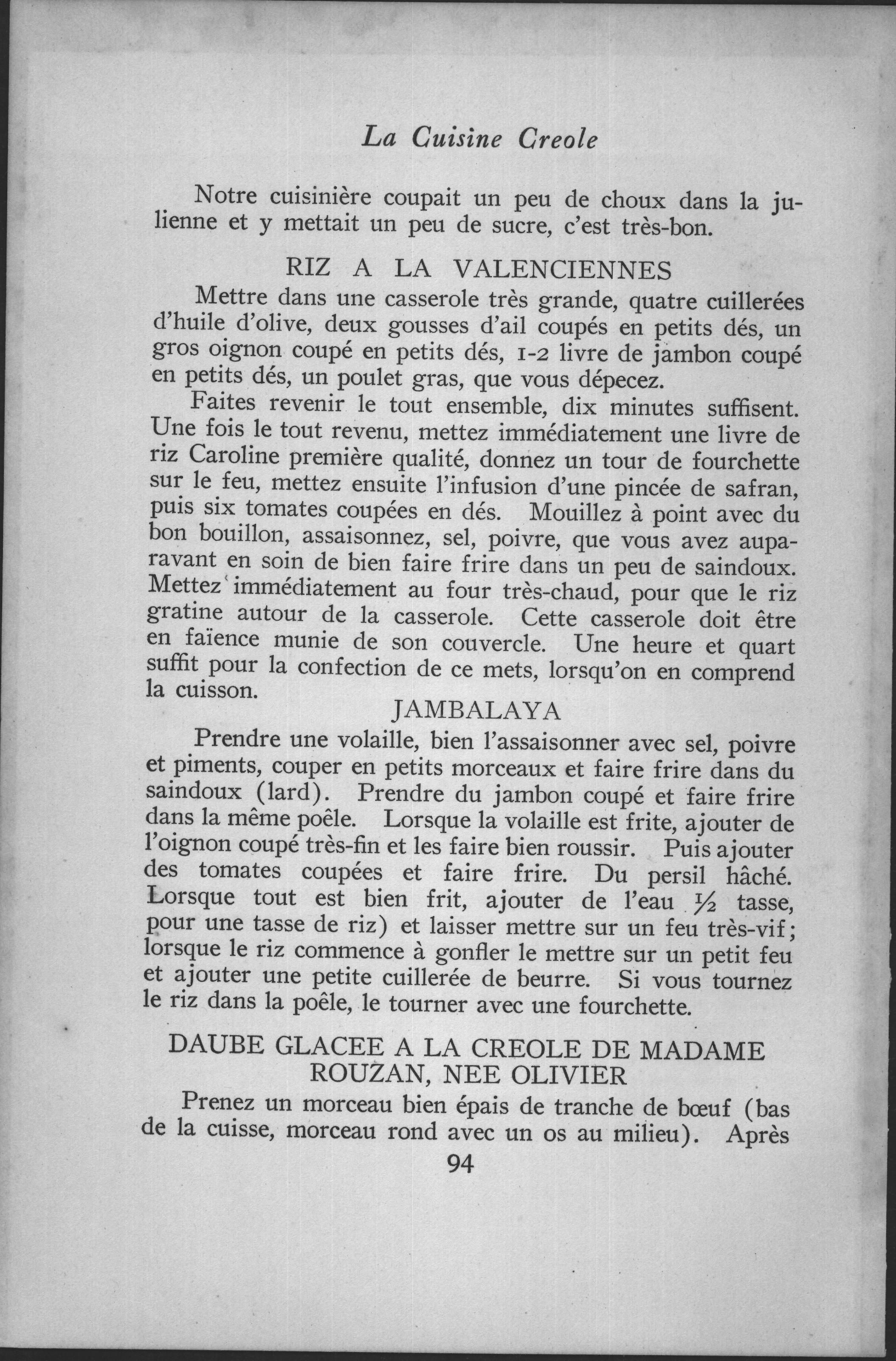
Riz à la Valenciennes
Mettre dans une casserole très grande, quatre cuillerées d'huile d'olive, deux gousses d'ail coupés en petits dés, un gros oignon coupé en petits dés, 1-2 livre de jambon coupé en petits dés, un poulet gras, que vous dépecez.
Faites revenir le tout ensemble, dix minutes suffisent. Une fois le tout revenu, mettez immédiatement une livre de riz Caroline première qualité, donnez un tour de fourchette sur le feu, mettez ensuite l'infusion d'une pincée de safran, puis six tomates coupées en dés. Mouillez à point avec du bon bouillon, assaisonnez, sel, poivre, que vous avez auparavant en soin de bien faire frire dans un peu de saindoux. Mettez immédiatement au four très-chaud, pour que le riz gratine autour de la casserole. Cette casserole doit être en faïence munie de son couvercle. Une heure et quart suffit pour la confection de ce mets, lorsqu'on en comprend la cuisson.
New Orleans’ cousin to paella — a saffron-gold rice baked with chicken, ham, garlic, and tomato until it crusts against the dish.
- A big, ovenproof potYou need a wide earthenware casserole with a lid; the goal is for the rice to gratiner — form a golden crust — around the sides.
- Carolina riceRiz Caroline première qualité is top-grade Carolina long-grain; a good long-grain rice is the modern equivalent. Use 1 lb (about 2¼ cups).
- Bloom the saffronSteep a pinch of saffron in a little warm liquid first (l’infusion…de safran) so its color and perfume spread evenly through the rice.
- Measure the fatQuatre cuillerées olive oil is about ¼ cup; brown the aromatics, ham, and cut-up chicken in it for ten minutes before the rice goes in.
- “Moisten to the point”Mouillez à point means adding just enough good broth for the rice to absorb — roughly twice the rice’s volume — not so much that it turns to soup.
- Hot oven, then leave itBake in a very hot oven (425–450°F); about an hour and a quarter, undisturbed, gives you the prized crust.
“À la Valenciennes” points straight to Valencia, the Spanish region that gave the world paella, and this dish is its Creole descendant. The link is no accident: Spain governed Louisiana from 1763 until 1803, and Spanish cooks, soldiers, and officials left a lasting mark on the New Orleans table — in its love of rice, saffron, tomatoes, and one-pot rice dishes cooked down until they crust. Where a Valencian might reach for rabbit or seafood, the Creole cook here uses chicken and ham, but the golden, saffron-scented soul of the dish is unmistakably Spanish.
From page 94 of the 1904 edition.
Original page from the book