Okra Gumbo
Mme. Eustis, Mère
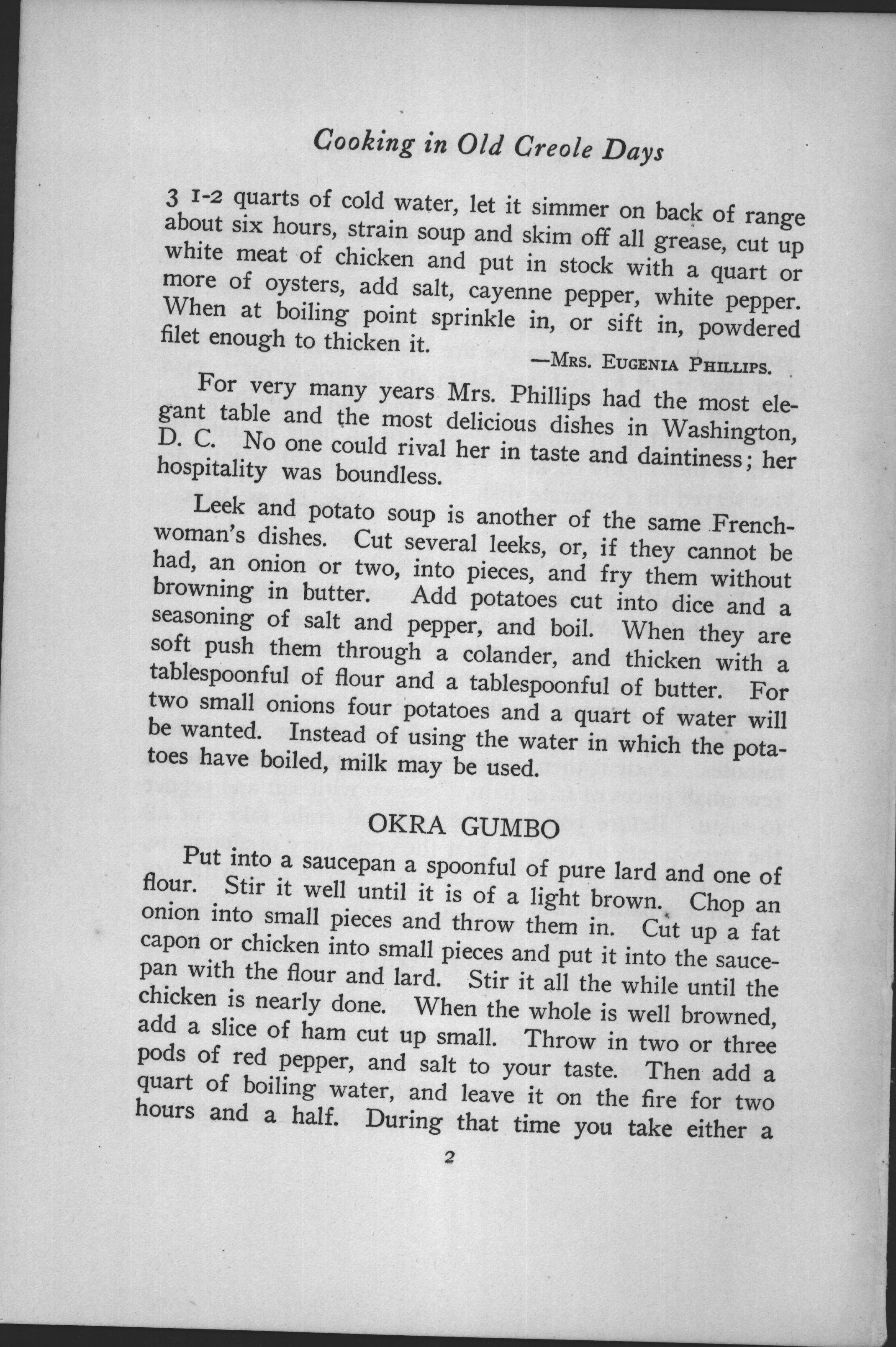
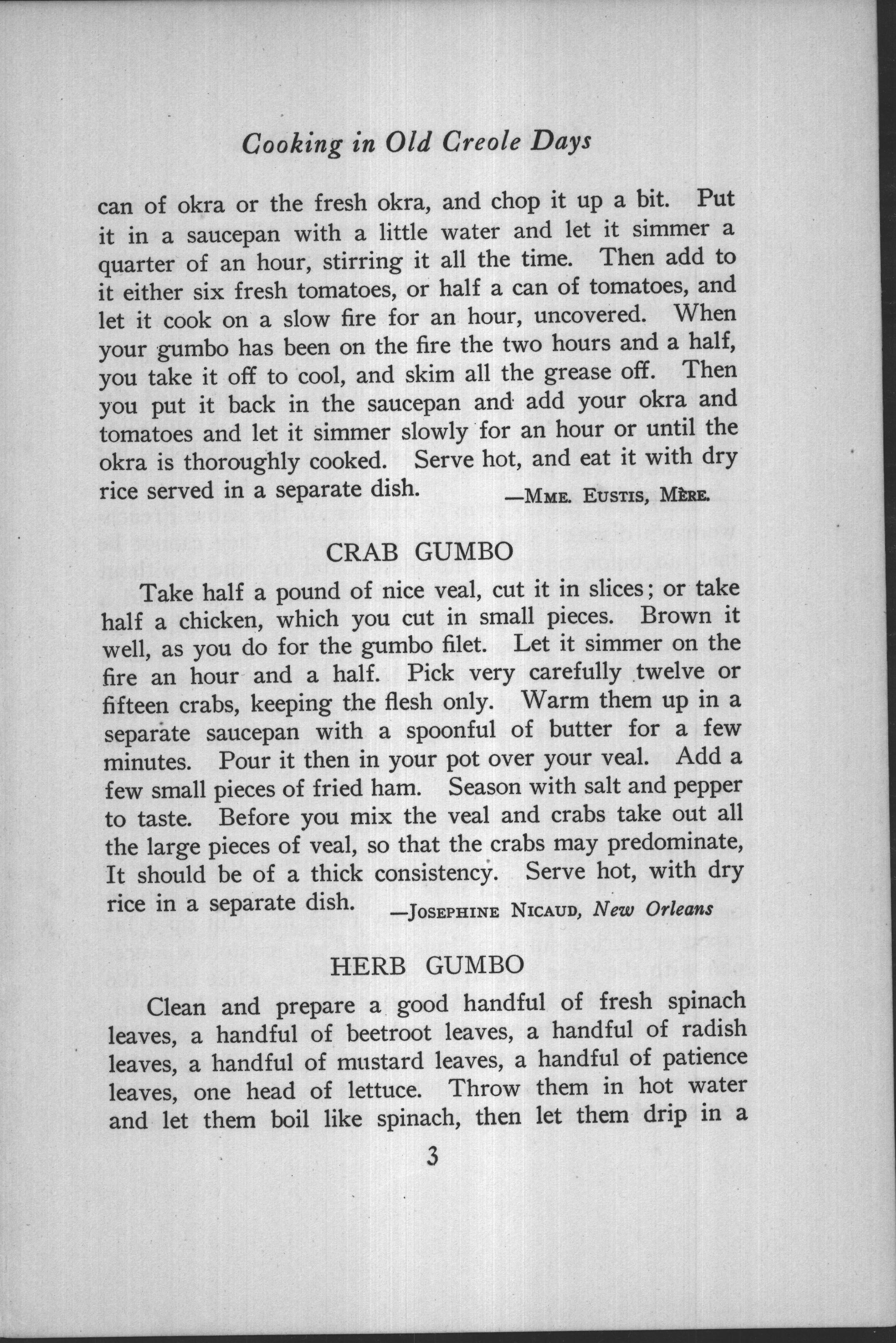
Put into a saucepan a spoonful of pure lard and one of flour. Stir it well until it is of a light brown. Chop an onion into small pieces and throw them in. Cut up a fat capon or chicken into small pieces and put it into the saucepan with the flour and lard. Stir it all the while until the chicken is nearly done. When the whole is well browned, add a slice of ham cut up small. Throw in two or three pods of red pepper, and salt to your taste. Then add a quart of boiling water, and leave it on the fire for two hours and a half. During that time you take either a can of okra or the fresh okra, and chop it up a bit. Put it in a saucepan with a little water and let it simmer a quarter of an hour, stirring it all the time. Then add to it either six fresh tomatoes, or half a can of tomatoes, and let it cook on a slow fire for an hour, uncovered. When your gumbo has been on the fire the two hours and a half, you take it off to cool, and skim all the grease off. Then you put it back in the saucepan and add your okra and tomatoes and let it simmer slowly for an hour or until the okra is thoroughly cooked. Serve hot, and eat it with dry rice served in a separate dish.
The other great gumbo — thickened with okra instead of filé. Everything about the base is the same; the difference is what does the thickening, and okra does it as it cooks.
- Okra is the thickener hereAs it simmers, okra releases a natural mucilage that gives the gumbo its silky body. Because of that, an okra gumbo needs no filé — the two thickeners are traditionally an either/or.
- Tame the “slime”If the okra’s texture worries you, sauté it first with a little acid (a splash of vinegar or the tomatoes) — that tightens it up. Long, slow cooking also smooths it out.
- The roux base1 Tbsp fat + 1 Tbsp flour cooked to light brown, then onion, chicken, ham, and chilies — identical to the filé gumbo until the thickening stage.
- Fresh or frozen okraBoth work. About 1 lb for a family pot; slice into rounds.
If filé gumbo speaks Choctaw, okra gumbo speaks West African — and it is the older claim on the dish’s very name. Okra came to the Americas through the transatlantic slave trade, and the word gumbo descends from Bantu terms for the pod (ki ngombo). Enslaved and free Black cooks made it the soul of the Louisiana kitchen. That this version comes from “Madame Eustis, mère” — the compiler’s own mother — is a reminder that by 1904 the dish had become the shared inheritance of every New Orleans table.
From page 2 of the 1904 edition.
Original pages from the book