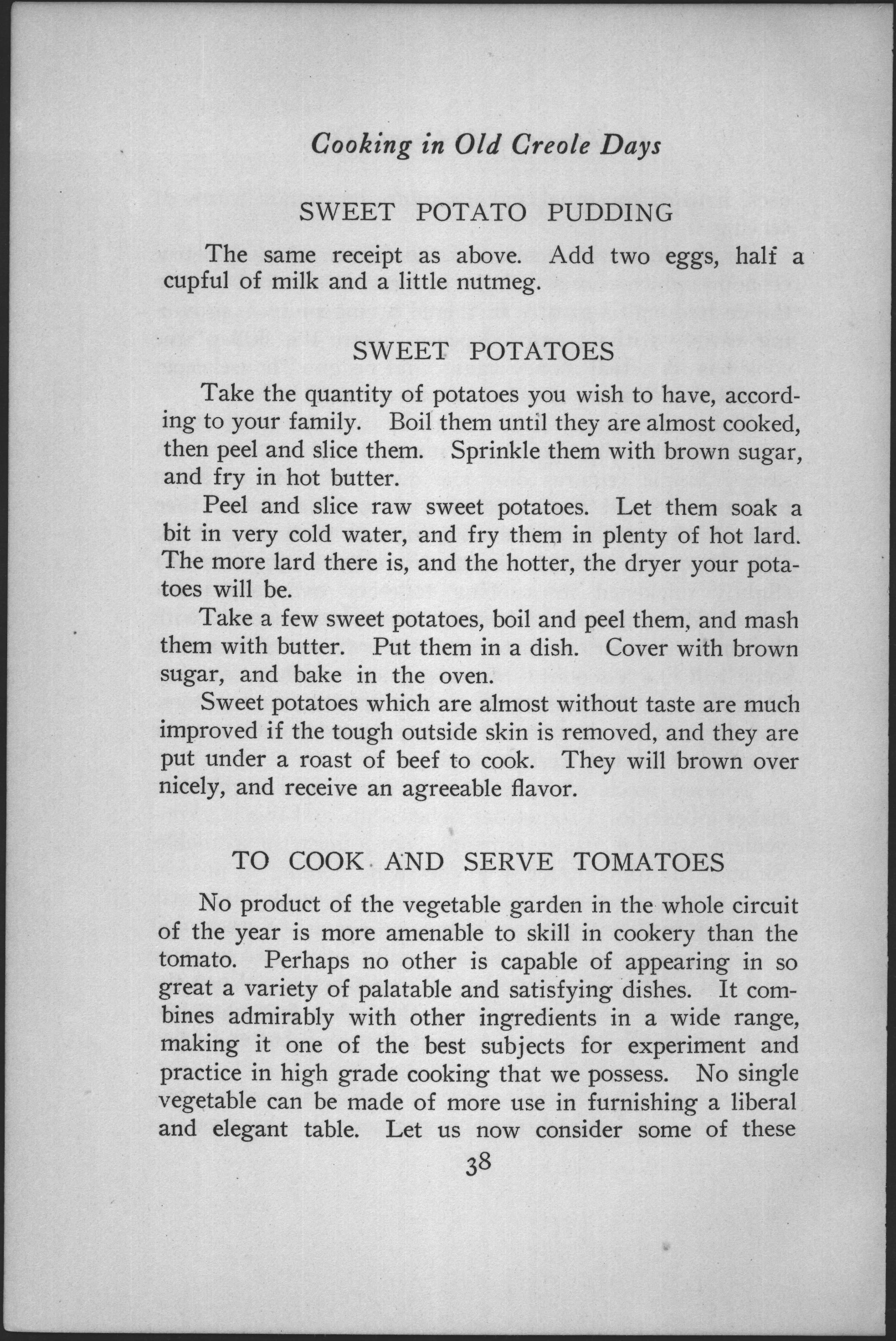
To Cook and Serve Tomatoes
No product of the vegetable garden in the whole circuit of the year is more amenable to skill in cookery than the tomato. Perhaps no other is capable of appearing in so great a variety of palatable and satisfying dishes. It combines admirably with other ingredients in a wide range, making it one of the best subjects for experiment and practice in high grade cooking that we possess. No single vegetable can be made of more use in furnishing a liberal and elegant table. Let us now consider some of these uses, both of the usual and the more uncommon forms of serving it.
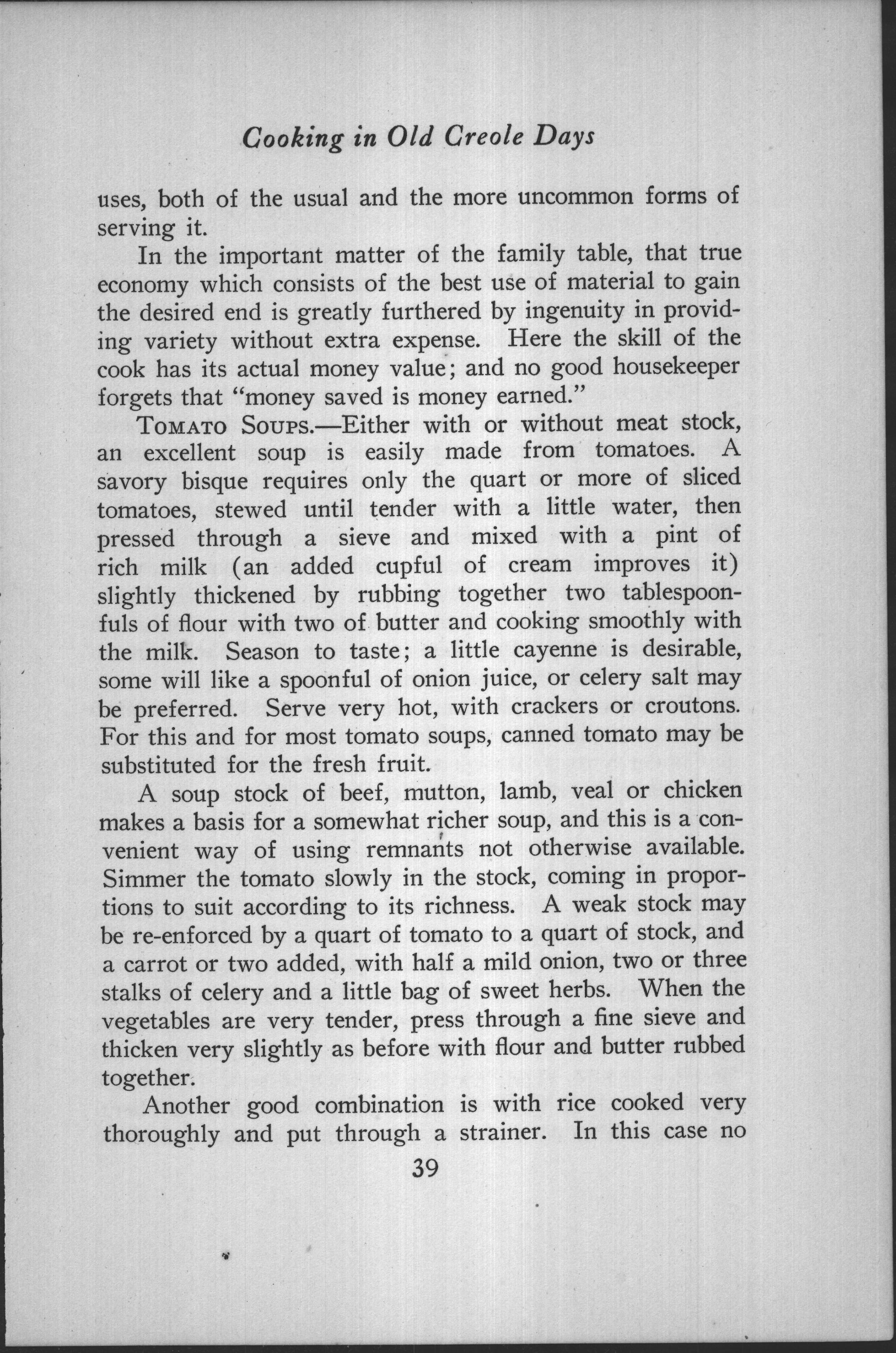
In the important matter of the family table, that true economy which consists of the best use of material to gain the desired end is greatly furthered by ingenuity in providing variety without extra expense. Here the skill of the cook has its actual money value; and no good housekeeper forgets that "money saved is money earned."
Tomato Soups.—Either with or without meat stock, an excellent soup is easily made from tomatoes. A savory bisque requires only the quart or more of sliced tomatoes, stewed until tender with a little water, then pressed through a sieve and mixed with a pint of rich milk (an added cupful of cream improves it) slightly thickened by rubbing together two tablespoonfuls of flour with two of butter and cooking smoothly with the milk. Season to taste; a little cayenne is desirable, some will like a spoonful of onion juice, or celery salt may be preferred. Serve very hot, with crackers or croutons. For this and for most tomato soups, canned tomato may be substituted for the fresh fruit.
A soup stock of beef, mutton, lamb, veal or chicken makes a basis for a somewhat richer soup, and this is a convenient way of using remnants not otherwise available. Simmer the tomato slowly in the stock, coming in proportions to suit according to its richness. A weak stock may be re-enforced by a quart of tomato to a quart of stock, and a carrot or two added, with half a mild onion, two or three stalks of celery and a little bag of sweet herbs. When the vegetables are very tender, press through a fine sieve and thicken very slightly as before with flour and butter rubbed together.
Another good combination is with rice cooked very thoroughly and put through a strainer. In this case no flour is needed. Especially good with chicken, and the bones of a pair of roast fowls will make a delicious tomato soup.
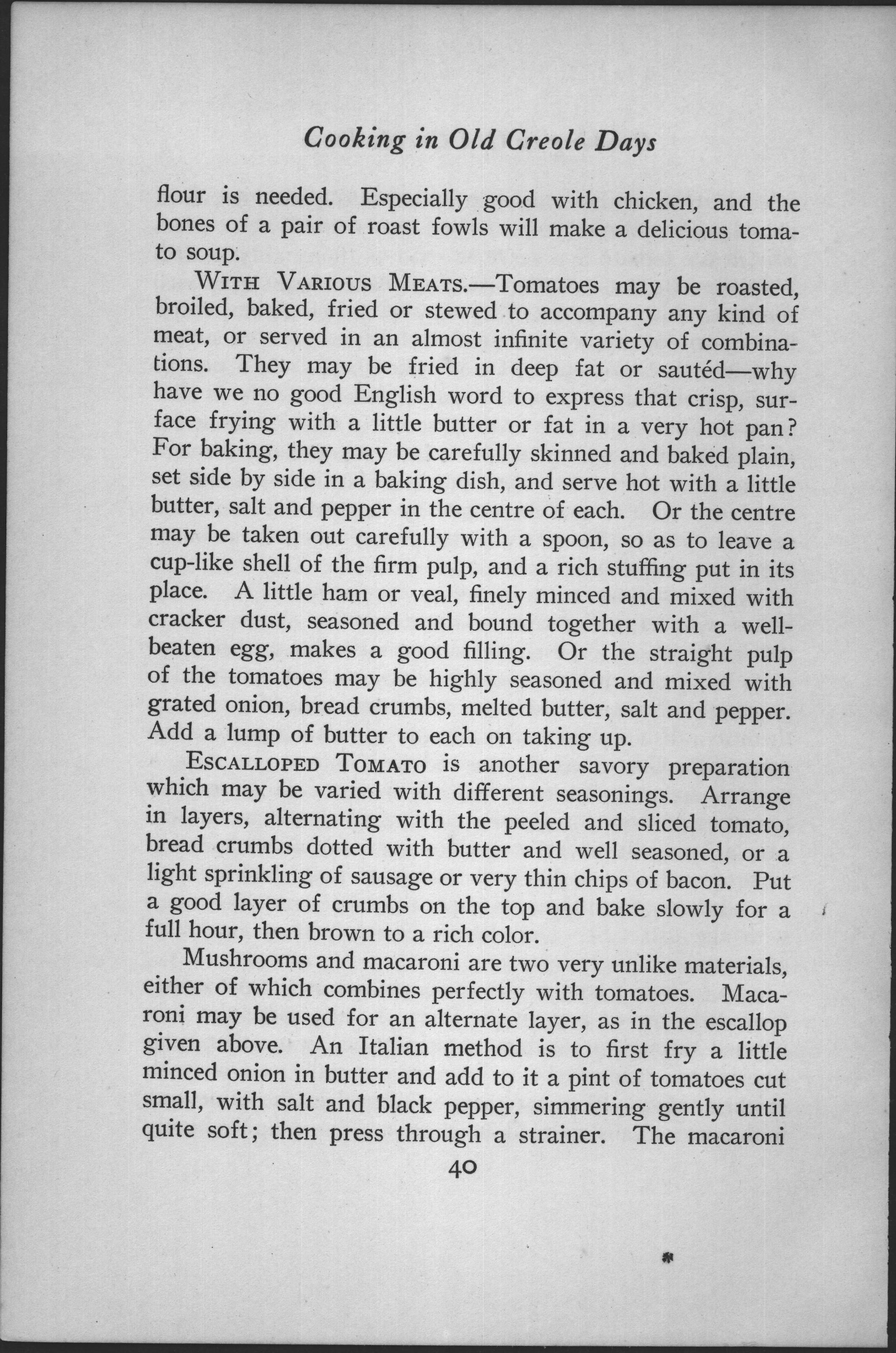
With Various Meats.—Tomatoes may be roasted, broiled, baked, fried or stewed to accompany any kind of meat, or served in an almost infinite variety of combinations. They may be fried in deep fat or sautéd—why have we no good English word to express that crisp, surface frying with a little butter or fat in a very hot pan? For baking, they may be carefully skinned and baked plain, set side by side in a baking dish, and serve hot with a little butter, salt and pepper in the centre of each. Or the centre may be taken out carefully with a spoon, so as to leave a cup-like shell of the firm pulp, and a rich stuffing put in its place. A little ham or veal, finely minced and mixed with cracker dust, seasoned and bound together with a well-beaten egg, makes a good filling. Or the straight pulp of the tomatoes may be highly seasoned and mixed with grated onion, bread crumbs, melted butter, salt and pepper. Add a lump of butter to each on taking up.
Escalloped Tomato is another savory preparation which may be varied with different seasonings. Arrange in layers, alternating with the peeled and sliced tomato, bread crumbs dotted with butter and well seasoned, or a light sprinkling of sausage or very thin chips of bacon. Put a good layer of crumbs on the top and bake slowly for a full hour, then brown to a rich color.
Mushrooms and macaroni are two very unlike materials, either of which combines perfectly with tomatoes. Macaroni may be used for an alternate layer, as in the escallop given above. An Italian method is to first fry a little minced onion in butter and add to it a pint of tomatoes cut small, with salt and black pepper, simmering gently until quite soft; then press through a strainer. The macaroni is cooked in another saucepan and carefully drained, then tossed with a liberal lump of good butter, until well cooled. Stir in the tomato and serve as soon as thoroughly heated.
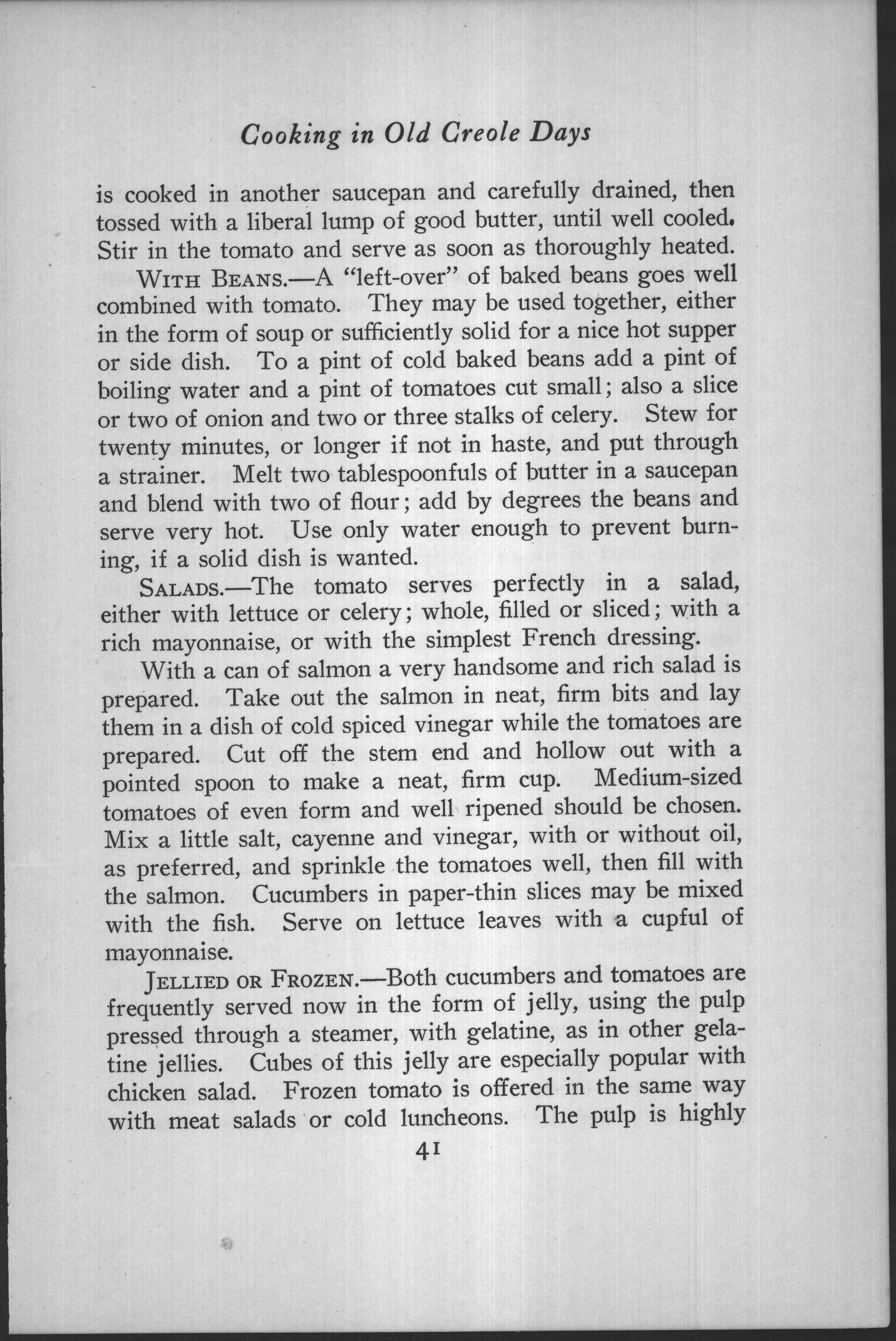
With Beans.—A "left-over" of baked beans goes well combined with tomato. They may be used together, either in the form of soup or sufficiently solid for a nice hot supper or side dish. To a pint of cold baked beans add a pint of boiling water and a pint of tomatoes cut small; also a slice or two of onion and two or three stalks of celery. Stew for twenty minutes, or longer if not in haste, and put through a strainer. Melt two tablespoonfuls of butter in a saucepan and blend with two of flour; add by degrees the beans and serve very hot. Use only water enough to prevent burning, if a solid dish is wanted.
Salads.—The tomato serves perfectly in a salad, either with lettuce or celery; whole, filled or sliced; with a rich mayonnaise, or with the simplest French dressing.
With a can of salmon a very handsome and rich salad is prepared. Take out the salmon in neat, firm bits and lay them in a dish of cold spiced vinegar while the tomatoes are prepared. Cut off the stem end and hollow out with a pointed spoon to make a neat, firm cup. Medium-sized tomatoes of even form and well ripened should be chosen. Mix a little salt, cayenne and vinegar, with or without oil, as preferred, and sprinkle the tomatoes well, then fill with the salmon. Cucumbers in paper-thin slices may be mixed with the fish. Serve on lettuce leaves with a cupful of mayonnaise.
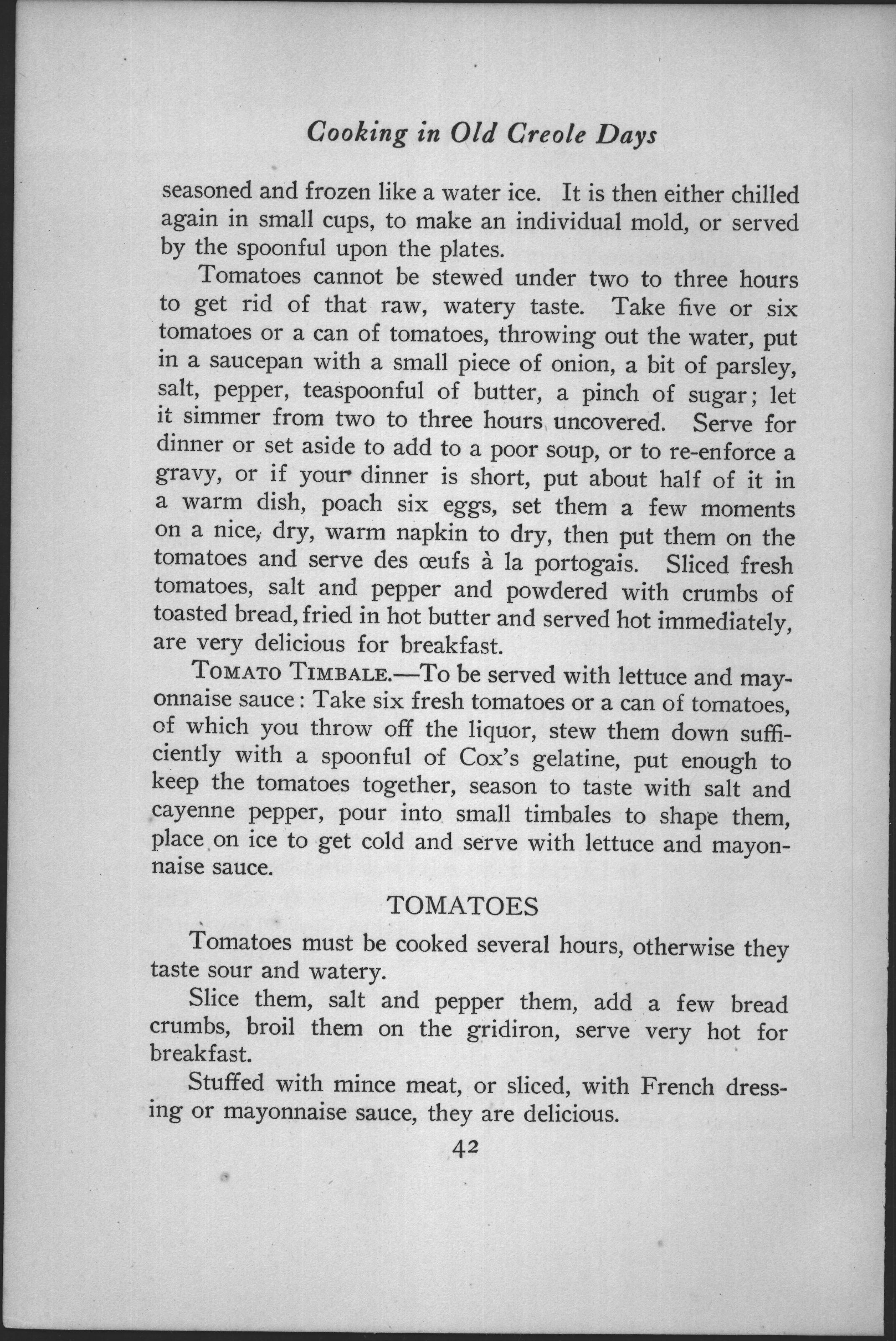
Jellied or Frozen.—Both cucumbers and tomatoes are frequently served now in the form of jelly, using the pulp pressed through a steamer, with gelatine, as in other gelatine jellies. Cubes of this jelly are especially popular with chicken salad. Frozen tomato is offered in the same way with meat salads or cold luncheons. The pulp is highly seasoned and frozen like a water ice. It is then either chilled again in small cups, to make an individual mold, or served by the spoonful upon the plates.
Tomatoes cannot be stewed under two to three hours to get rid of that raw, watery taste. Take five or six tomatoes or a can of tomatoes, throwing out the water, put in a saucepan with a small piece of onion, a bit of parsley, salt, pepper, teaspoonful of butter, a pinch of sugar; let it simmer from two to three hours uncovered. Serve for dinner or set aside to add to a poor soup, or to re-enforce a gravy, or if your dinner is short, put about half of it in a warm dish, poach six eggs, set them a few moments on a nice, dry, warm napkin to dry, then put them on the tomatoes and serve des œufs à la portogais. Sliced fresh tomatoes, salt and pepper and powdered with crumbs of toasted bread, fried in hot butter and served hot immediately, are very delicious for breakfast.
Tomato Timbale.—To be served with lettuce and mayonnaise sauce: Take six fresh tomatoes or a can of tomatoes, of which you throw off the liquor, stew them down sufficiently with a spoonful of Cox's gelatine, put enough to keep the tomatoes together, season to taste with salt and cayenne pepper, pour into small timbales to shape them, place on ice to get cold and serve with lettuce and mayonnaise sauce.
Less a single recipe than a short treatise — soups, bisques, escallops, salads, timbales and more — showing off everything a good cook could do with the tomato.
- The quantities, convertedA “quart” of tomatoes is about 4 cups and a “pint” of milk is 2 cups; canned tomatoes stand in for fresh throughout, as the author notes.
- Ignore the long stewingThe book insists tomatoes must stew for hours to lose their “raw, watery taste” — with today’s ripe or canned tomatoes, 20–45 minutes of simmering is plenty.
- “Cox’s gelatine” decodedA once-common boxed brand; one box is about 1 oz, equal to roughly four modern ¼-oz envelopes. Bloom powdered gelatin in cold liquid first.
- “Sautéd” and “escalloped”The writer even pauses to praise the French sauté for pan-frying; “escalloped” simply means baked in layers with buttered crumbs — scalloped, in modern spelling.
- “Œufs à la portogais”Eggs poached and set on stewed tomato; in classical French cooking à la portugaise was shorthand for almost any tomato preparation.
- Roux, the backboneSeveral dishes lean on equal butter and flour rubbed together to thicken; cook it a minute before adding liquid to lose the raw-flour taste.
For all the tomato’s glory here, the author’s insistence that it be stewed for hours echoes an older unease. A member of the nightshade family, the tomato was long eyed with suspicion in Anglo-American kitchens and treated more as an ornamental “love apple” than a food. Only around the middle of the 19th century did it win broad acceptance, and cooks of this era still felt its raw, acidic character had to be tamed by long cooking. This essay, brimming with confident tomato cookery, catches the vegetable at the very moment it became indispensable.
From page 38 of the 1904 edition.
Original pages from the book