Home › J › Jelly of Two Colours
Jelly of Two Colours
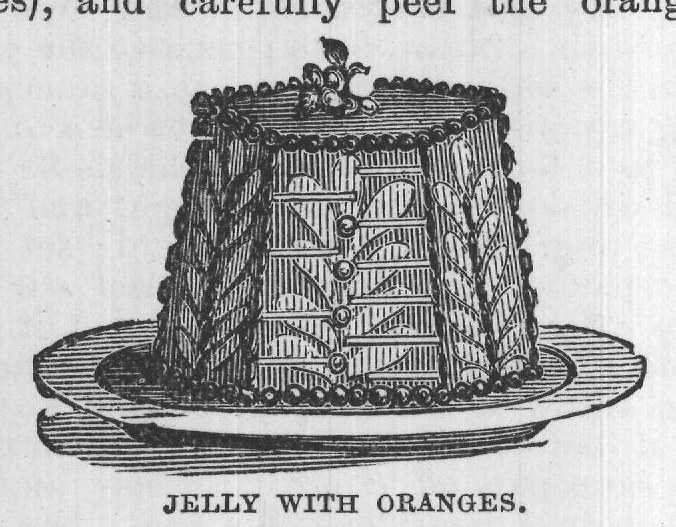
INGREDIENTS for 1½ pint mould.-1½ pint of calf's feet or gelatine jelly, a few drops of prepared cochineal. AVERAGE COST, 1s. 3d.
Make 1 pint of calf's-feet jelly, or, if wished more economical, of clarified syrup JELLY OF TWO COLOURS. and gelatine, flavouring it in any way that may be preferred. Colour one-half of the jelly with a few drops of prepared cochineal, and the other half leave as pale as possible.
Have ready a mould well wetted in every part; pour in a small quantity of the red jelly, and let this set; when quite firm, pour on it the same quantity of the pale jelly, and let this set; then proceed in this JELLY OF TWO COLOURS. manner until the mould is full, always taking care to let one jelly set before the other is poured in, or the colours would run one into the other. When turned out, the jelly should have a striped appearance.
For variety, ha half the mould may be filled at once with one of the jellies, and, when firm, filled up with the other this also has a very pretty effect, and is more expeditiously prepared than when the jelly is poured in small quantities into the mould. Blancmange and red jelly, or blancmange and raspberry cream, moulded in the above manner, look very well. The layers of blancmange and jelly should be about an inch in depth, and each layer should be perfectly hardened before another is added.
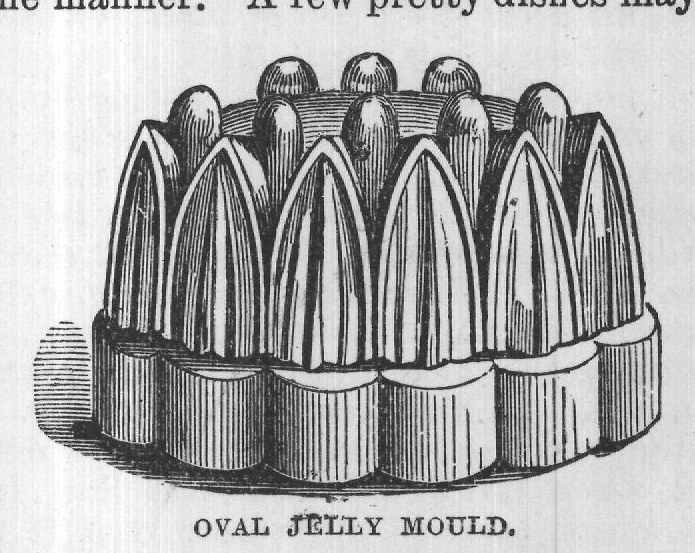
Half a mould of blancmange and half a mould of jelly are frequently served in the same manner. A few pretty dishes may be OVAL JELLY MOULD. made in this way, of jellies or blancmanges left from the preceding day, by melting them separately in a jug placed in a saucepan of boiling water, and then moulding them by the foregoing directions.
TIME. hour to make the jelly.
Note. In making the jelly, ase for flavouring a very pale sherry, or the colour will be too dark to contrast nicely with the reà ješñy.
JELLY, OPEN.
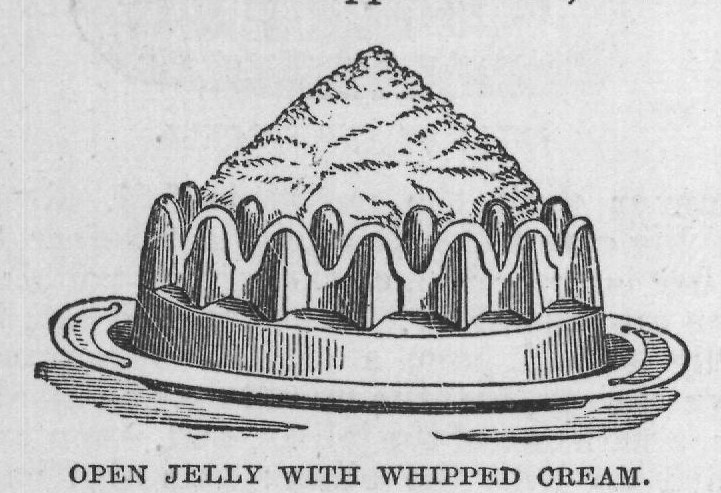
Jelly, Open, with Whipped Cream. (A very pretty dish.)-INGREDIENTS for 1½ pint mould.-1½ pint of jelly, pint of cream, 1 glass of sherry, sugar to taste. AVERAGE COST, 2s. 6d.
Make the above proportion of calf's-feet or isinglass jelly, colouring it and flavouring it in any way that may be preferred; soak a mould, open in the centre, for about 1/24 hour in cold water; fill it with the jelly, and let it remain in a cool place until perfectly set; then turn it out on a dish; fill the centre with whipped cream, flavoured OPEN JELLY WITH WHIPPED CREAM. with sherry and sweetened with pounded sugar; pile this cream high in the centre, and serve. The jelly should be made of rather a dark colour, to contrast nicely with the cream, or the cream may be made pink with colouring and the jelly left pale.
TIME.- hour.
SEASONABLE at any time.
A Victorian display jelly built up in alternating coloured layers. Everything hinges on temperature: each layer must be fully set, and the jelly poured onto it must be cool, or the colours bleed and the stripes are lost.
- Quantities as givenThe ingredient list calls for 1½ pints of jelly for a 1½-pint mould, while the method says to make 1 pint. Make at least the full mould capacity — 1½ imperial pints is 30 fl oz (850 ml) — and a little over, since some is always lost in the pan.
- Calf's feet, isinglass, gelatineCalf's-foot jelly means feet simmered for hours and the stock clarified with egg white. Powdered gelatine gives the same result: for a jelly firm enough to turn out and hold stripes, use roughly 1 oz (about 4 sachets, 28 g) per quart of liquid, which is firmer than a spoonable dessert jelly.
- Prepared cochinealA liquid carmine colouring, still sold as cochineal or carmine. A few drops is literal — the red half should read as a clear ruby, not opaque pink. Any red food colouring works.
- Pouring temperatureLet each poured layer set in the refrigerator until firm but still slightly tacky, then pour the next at barely lukewarm — around body temperature. Warm jelly will melt a channel into the layer beneath and the boundary will go cloudy.
- Wetting the mouldRinsing the mould in cold water and leaving it wet, rather than oiling it, is correct for jelly and helps it release cleanly. To turn out, dip the mould in hot water for a few seconds only.
- Blancmange variationBlancmange in this period may be a milk pudding thickened with cornflour or arrowroot, or one set with isinglass or gelatine. If it is the thickened kind, it sets by cooling rather than gelling and needs to be quite cold and firm before jelly goes on top of it.
- Reusing yesterday's jellyRemelting in a jug standing in hot water is the right method — direct heat scorches and weakens the set. Gelatine loses strength each time it is melted, so a second-day jelly may need a little extra.
- Pale sherryThe note is worth following: use a fino or other very pale sherry for flavouring, as a dark oloroso tints the whole batch and kills the contrast.
- Time and yieldThe stated time has dropped its number; allow about an hour of active work for the jelly itself, then several hours of chilling — a layered 1½-pint mould realistically wants overnight.
Moulded jelly was Victorian showpiece food, and the point of it was as much visual as gustatory: an oval or turreted mould, turned out whole onto a glass dish, announced that a household had moulds and a cook with time. Calf's-foot jelly was the older and more laborious base, made by long simmering of feet and clarifying the stock with egg white and shell; isinglass (from sturgeon swim bladders) and then commercial sheet and powdered gelatine progressively removed the work through the nineteenth century, which is why Mrs Beeton's text offers clarified syrup and gelatine as the "more economical" route. The colouring is cochineal, the red extracted from dried scale insects, long the standard kitchen red before coal-tar dyes. Recipes like this one, with their striped layers and their suggestion for using up yesterday's jelly and blancmange, sit exactly where Victorian display cookery met Victorian thrift.