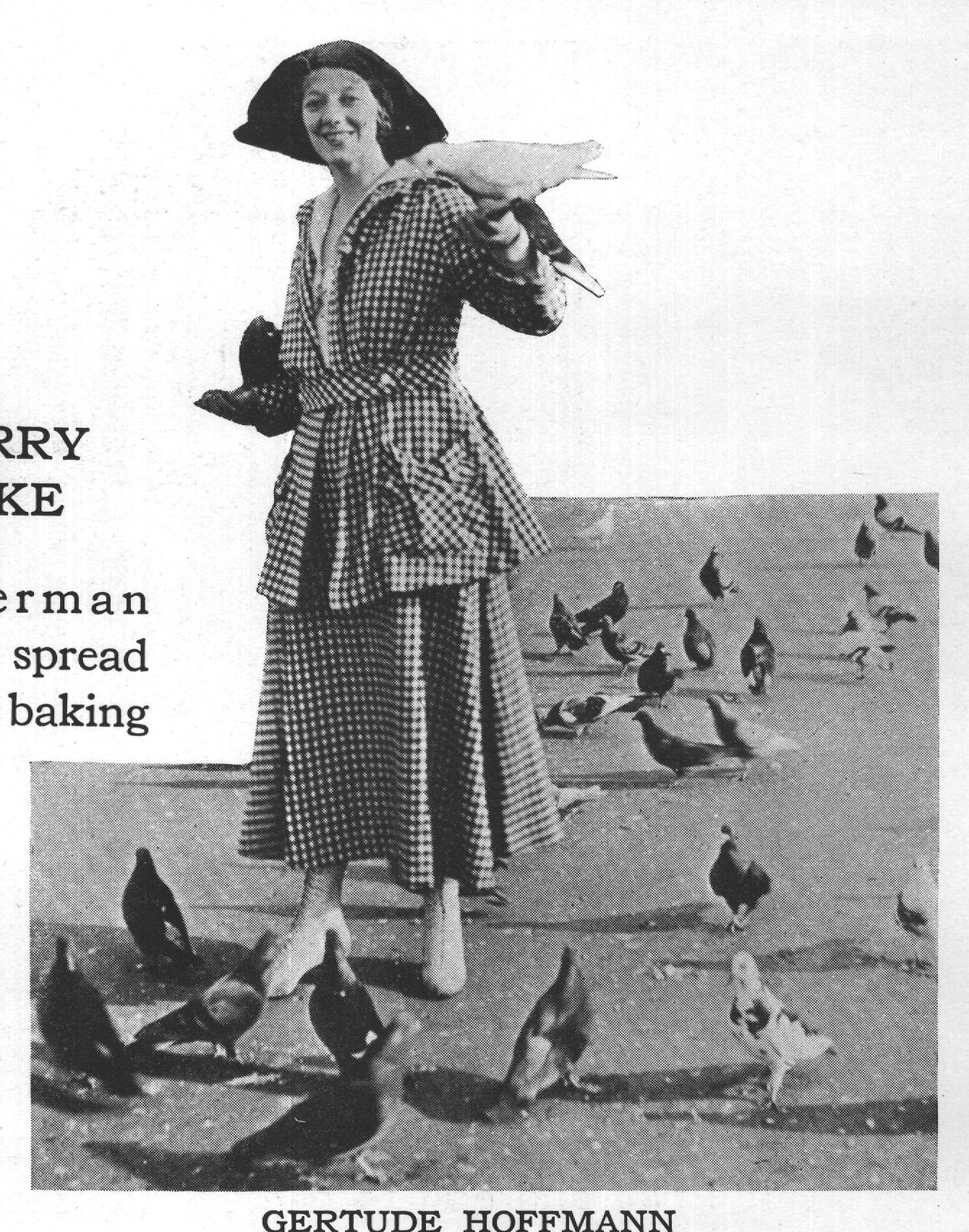
Gertrude Hoffman

SHORTCAKE
Make a German "Blatterteig"; spread thinly over a baking pan about one foot square.
Insert the strawberries about one inch apart and cover lightly with sugar.
Bake slowly. 1½ cups flour 3/4 teaspoon salt 1/4 cup lard Ice water Mix with the ice water and roll out.
This constitutes the "Blatterteig."
Mix salt with flour and cut in shortening with knife. These pigeons in the picture are in no danger from me of being "baked in a pie," as I prefer vegetarian diet.
Din cerly Bestandestoffmann.
SAUTÉD FILLETS OF BEEF Cut beef tenderloin in slices one-inch thick and trim into circular shapes. Season with salt and pepper, and broil six minutes in hot buttered frying pan. Remove marrow from a marrow bone, cut in one-third-inch slices, poach in boiling water, and drain. Put a slice of marrow on each fillet. To liquor in pan add one tablespoon butter, two tablespoons flour, and one cup brown stock. Season with salt, pepper and madeira wine. Pour sauce around meat.
Sincerest regards,
Two unrelated dishes sit under one name here: a flat strawberry tart built on a lard pastry, and a classic sauté of beef fillet with marrow. Both are workable, but the pastry instructions are compressed to the point of shorthand.
- "Blätterteig" is a loose claimThe German word means "leaf dough", i.e. puff pastry, but the recipe given — flour, salt, lard, ice water, cut in with a knife — is a plain short crust with no butter block and no folding. Treat it as a rich pie dough and do not expect it to rise in layers.
- Rest the doughThe original skips this. After mixing to a shaggy mass with ice water, chill the dough 30 minutes before rolling, or it will shrink and tighten in the pan.
- Quantity versus pan sizeOne and a half cups of flour is a tight amount for a full 12-inch square with any edge to speak of. Either roll it out to about a 10-inch square on a lined sheet, or increase the pastry if you want the whole pan covered.
- "Bake slowly"This points to what period cookbooks called a slow oven, put variously at somewhere around 250-325F. For a thin fruit tart that is low; 350-375F for 25-35 minutes gives you a crisp base before the strawberries collapse entirely.
- Strawberries and sugarHull and halve the berries and press them cut side down into the dough; whole berries an inch apart will steam and roll off. The original does not quantify the "light" covering of sugar; 2-3 tablespoons is enough, and more will flood the pastry with juice.
- LardModern supermarket lard is often hydrogenated and blander than the leaf lard the original would have meant. Butter or a butter-lard mix works, though butter dough needs to stay colder while you roll.
- "Broil six minutes in hot buttered frying pan"Broil here means pan-sauté in the older American sense. Six minutes total for a 1-inch fillet is about right for rare to medium-rare, roughly three minutes a side; go by an internal 125–130F rather than the clock.
- MarrowAsk a butcher for split marrow bones. Soak the bones in cold salted water for a few hours to draw out blood, push the marrow out in one piece, slice, then poach a minute or two in barely simmering water until just set — hard boiling turns it to liquid fat.
- The sauceButter and flour into the pan drippings makes a small blond roux; cook it a moment before the stock goes in, add the madeira off the heat, and expect a thin pan sauce rather than a glaze.
Gertrude Hoffmann was one of the best-known vaudeville performers of the early twentieth century, famous as a mimic and as a dancer whose "Vision of Salome" caused a considerable stir around 1908; cookbooks of celebrity contributions like this one traded on exactly that kind of name recognition, and the contributors' handwritten notes and photographs were as much the point as the cooking. Her joke about the pigeons in the accompanying picture being in no danger of ending up "baked in a pie" nods to Sing a Song of Sixpence and to her professed vegetarianism. The garbled signature ("Din cerly Bestandestoffmann") is an artifact of scanning her handwriting, not her spelling. The fillet of beef that follows reads as standard cookery of the day, and it carries its own separate closing ("Sincerest regards"), so it need not be hers at all. Beef marrow on a sautéed tournedos, with a madeira pan sauce, was ordinary restaurant French cooking as filtered through American schools such as Fannie Farmer's; marrow was then cheap and widely eaten, and its near-disappearance from home kitchens is a twentieth-century development rather than any change in the meat itself.